
Unlock seamless Swiss shoots with local production expertise

TL;DR:
Switzerland’s cantonal permit system requires multiple approvals, causing delays and logistical complexity.
Local fixers and crews are essential for navigating permits, languages, and regional regulations efficiently.
Planning for costs, permit timelines, and local partnerships ensures smoother, cost-effective Swiss productions.
Underestimating Switzerland’s regulatory landscape is one of the fastest ways to watch a well-funded production unravel. International crews often arrive assuming that a technically advanced, well-organized country means straightforward filming conditions. The reality? Switzerland’s 26 cantons each require separate permits, processing timelines can stretch from one to three weeks, and four national languages create communication gaps that no amount of pre-trip planning can fully anticipate. This guide walks you through the practical steps to engage local expertise, manage permits, control costs, and keep your shoot on track from pre-production to wrap.
Table of Contents
Key Takeaways
Point | Details |
Local fixers are essential | Navigating permits, location scouting, and negotiations in Switzerland requires experienced local professionals. |
Budget for Swiss realities | Swiss crew rates and logistics are expensive, so always add a 20 percent contingency. |
Early engagement is crucial | Secure local support at least 6 weeks in advance for smooth permit and resource management. |
Multilingual teams unlock efficiency | Language barriers slow paperwork; multilingual experts save time and avoid misunderstandings. |
Why local knowledge is critical for Swiss video productions
Switzerland looks deceptively simple on paper. Efficient infrastructure, stunning locations, world-class facilities. But the moment you apply for a filming permit, the complexity becomes very real very fast.
The country operates under a canton-based regulatory structure where each of the 26 regions sets its own rules for public filming. There is no single national permit you can secure and move on. Costs range from CHF 176 to CHF 880, and processing times run 1 to 3 weeks, with Zurich being the fastest at approximately 10 business days. Rural cantons can take significantly longer and have far less documentation available in English.
Consider what this means in practice:
Multi-location shoots require multiple permit applications filed simultaneously, with different authorities, in different languages.
Rejection or delays in one canton can cascade and push back your entire schedule.
Rural shoots often require direct negotiation with local municipalities, which expect communication in German, French, or Italian.
Private property adds another layer of agreements, liability insurance, and owner negotiations that locals navigate far more efficiently.
“Switzerland’s four national languages, German, French, Italian, and Romansh, mean that English is limited in rural areas, making multilingual crews and fixers essential for paperwork and on-ground negotiations.”
This isn’t just about translation. It’s about cultural fluency, knowing which authority to approach first, understanding unwritten norms around noise levels and public space use, and having the relationships that accelerate bureaucratic processes. International crews who rely solely on email correspondence with Swiss authorities often wait far longer than those represented by a local professional who can follow up in person or by phone in the correct language.
The Swiss production experts who operate in this environment daily understand that local knowledge isn’t a nice-to-have. It’s what separates a smooth shoot from a costly, stressful one.
The essential roles of local fixers and crew
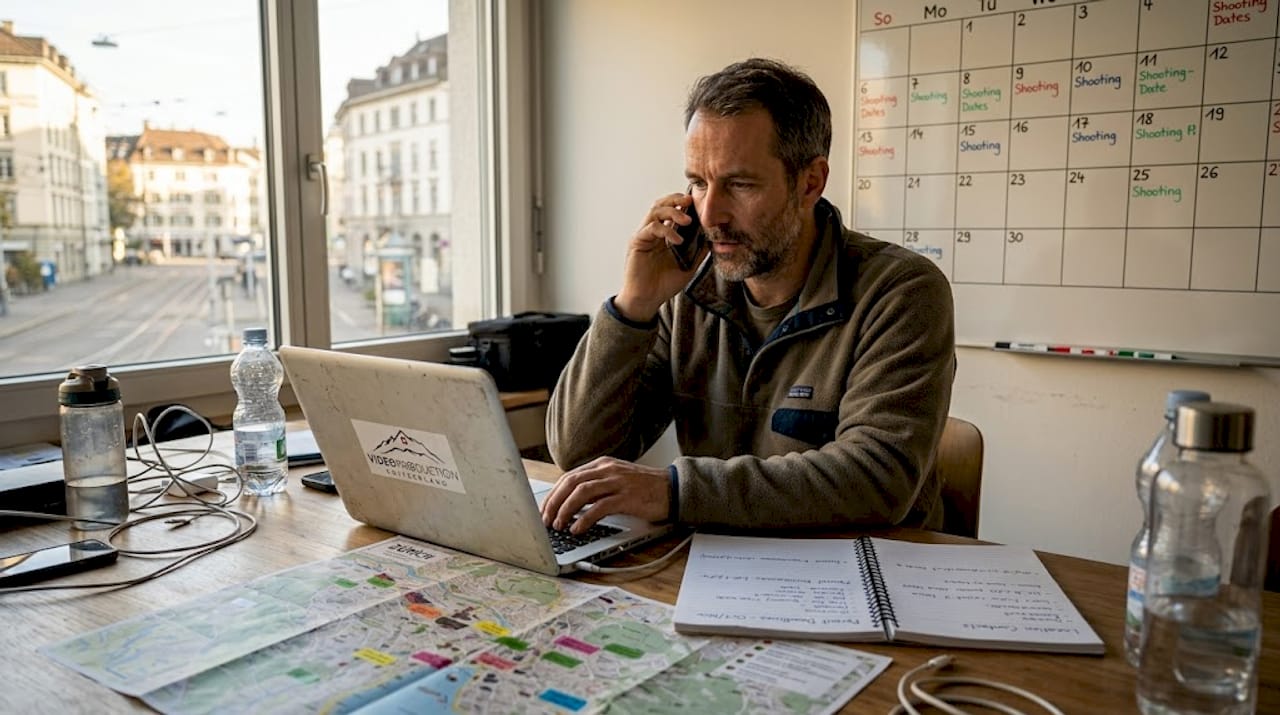
A fixer is your ground-level problem solver. They are not simply a production assistant or a location manager. In Switzerland, a skilled fixer combines the functions of permit coordinator, translator, logistics planner, and relationship manager into one role.
Here is what a well-connected Swiss fixer actually handles for your production:
Permit acquisition across multiple cantons, including follow-up with municipal offices
Visa and entry coordination, particularly for crew entering under Schengen rules for up to 90 days
Location scouting with realistic assessments of access, noise restrictions, and seasonal conditions
Local crew recruitment through established networks with vetted professionals
Logistics management, including transportation routes, equipment loading zones, and parking clearances
Multilingual negotiation with property owners, authorities, and vendors
For crew recruitment, working through local crew agencies that specialize in Swiss productions gives you access to professionals who already understand Swiss labor laws, union agreements, and on-set protocols. This prevents mismatched expectations and day-of complications.
Role | Key Responsibility | Why Local Experience Matters |
Fixer | Permits, visas, logistics | Knows canton-specific processes |
Location Scout | Site research, access checks | Understands local restrictions |
Multilingual Coordinator | Translations, negotiations | Avoids costly miscommunications |
Local Crew | On-set execution | Familiar with Swiss labor norms |
Pro Tip: Engage your fixer at least 6 weeks before your shoot date. Permit windows, crew availability, and location access all require lead time that cannot be compressed without increasing risk and cost.
The bottom line is simple. Multilingual fixers and Swiss fixer services are not a budget line you trim. They are the mechanism by which your production stays legal, on schedule, and on budget.
Navigating costs, incentives, and typical pitfalls
Switzerland is one of the most expensive production environments in the world. Knowing the numbers before you finalize your budget is not optional. It’s the difference between a profitable project and an overrun that damages client relationships.
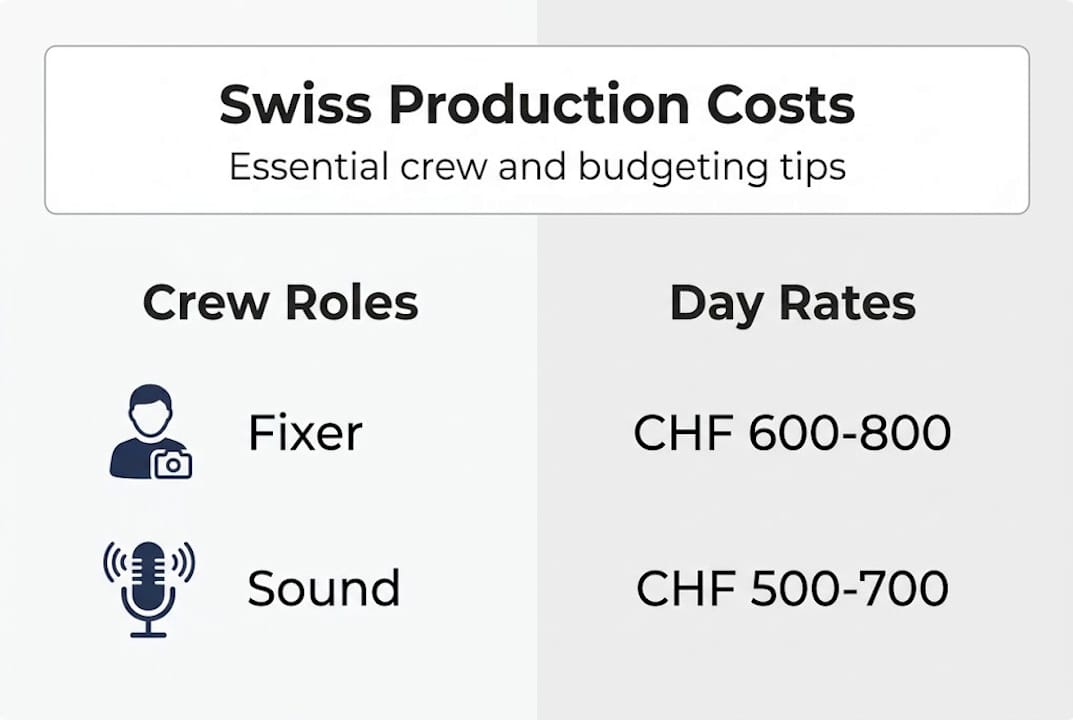
Here is what you should plan for in terms of crew day rates:
Role | Day Rate (CHF) |
Camera Operator | 600 to 800 |
Gaffer | 600 to 800 |
Sound Recordist | 500 to 700 |
Production Assistant | 400 to 500 |
These rates reflect Swiss labor standards and are non-negotiable in most contexts. Attempting to source cheaper alternatives outside established networks tends to create reliability problems that cost more in delays than you save upfront.
On the incentive side, the Geneva Film Commission launched in 2025 a film office support program that includes cash rebates on office costs for qualifying productions. These kinds of incentives are only accessible if you have a local partner who knows the eligibility criteria and can submit the paperwork correctly.
Here are the four most common cost pitfalls international crews encounter:
Underestimating permit costs across multiple cantons for a multi-location shoot
Ignoring weather contingency, especially for Alpine or outdoor shoots where a full day can be lost to conditions that were unpredictable even 48 hours out
Misreading urban versus rural logistics, where what looks like a short drive on a map becomes a two-hour equipment transfer on narrow mountain roads
Missing incentive deadlines, because rebate programs have application windows that close before your shoot date
Pro Tip: Always build at least 20% contingency into your Swiss production budget. Budgeting Swiss productions without this buffer is the single most common financial mistake international teams make here.
Understanding Swiss video production costs in full, before your shoot is confirmed, puts you in a far stronger position to negotiate client contracts and manage expectations on both sides.
Step-by-step: Leveraging local expertise for a flawless shoot
Knowing what local expertise covers is useful. Knowing exactly when and how to deploy it is what makes the difference on shoot day.
Here is a practical sequence that experienced production teams use when planning a Swiss shoot:
Engage your local fixer first, before locations are confirmed or crew is booked. Availability, experience with your specific region, and language coverage should all be verified at this stage.
Audit permit requirements for every location on your shot list. Your fixer should identify which cantons are involved, estimate costs and processing times, and flag any locations that require additional municipal approvals.
Scout with local eyes. Remote scouting via Google Maps and stock photos misses critical operational details: parking restrictions, restricted public zones, seasonal lighting conditions, and access road limitations.
Recruit crew through local agencies that carry existing relationships with Swiss industry professionals. This ensures labor law compliance and realistic day rate agreements from the start.
Build in buffer days, particularly for rural or Alpine locations. A Swiss production planning guide approach accounts for weather, permit delays, and equipment logistics that simply move slower outside urban centers.
Invest in local relationships. Fixers who feel like genuine partners, not just vendors, are more likely to go the extra mile when problems arise on shoot day.
Pro Tip: Pre-production absorbs roughly 70% of your total production investment. Front-loading fixer engagement and permit work is not just best practice; it’s the most efficient use of your budget. And following budget tips for shoots from experienced Swiss-based professionals ensures you’re protecting margin at every stage.
The goal is not just to get through the shoot. It’s to finish with footage you’re proud of, a client who’s impressed, and a production account that reflects the professionalism your team brought to the project.
Rethinking production: What international teams often overlook in Switzerland
Here is a perspective that might push back on your assumptions. Many experienced international filmmakers arrive in Switzerland believing that the country’s reputation for efficiency and organization means production will be straightforward. It’s an understandable assumption. And it’s consistently wrong.
Switzerland’s infrastructure is excellent. But that excellence exists within a regulatory culture that prizes process, precision, and regional autonomy in ways that catch out even veteran crews. The canton system is not a bureaucratic inconvenience. It is a deeply embedded governance model that local authorities take seriously. Showing up without the right permits, or with paperwork filed in the wrong language, doesn’t just create delays. It can shut down your shoot entirely.
What we have observed working with international productions over more than 20 years is this: the teams that integrate local expertise early, treating Swiss-based experts as creative collaborators rather than logistical contractors, consistently produce better work with fewer overruns. Swiss complexity, when you have the right partner, becomes a creative advantage. You get access to locations, permissions, and operational flexibility that no amount of remote planning can replicate. True local knowledge is real-time problem solving, not just permit filing.
How we can help you navigate Swiss production challenges
Every point in this article, from permit timelines to crew day rates to incentive programs, reflects the kind of ground-level complexity that can quietly derail an international production if you’re not prepared for it.
[
At Video Production Switzerland, we provide full-service Swiss production support that covers every stage of your shoot. We handle permits across all 26 cantons, manage multilingual negotiations, scout locations with operational precision, and connect you with vetted local crew who know exactly how Swiss sets run. We also help you understand production costs in Switzerland before you commit, so there are no surprises mid-shoot. Our team has over 20 years of experience working with international filmmakers and production companies, and we’re built around one goal: your shoot runs smooth, on time, and stress-free.
Frequently asked questions
How long does it take to get a filming permit in Switzerland?
Permit approval takes 1 to 3 weeks, depending on the canton, with Zurich often processing applications in approximately 10 business days. Rural cantons typically take longer and involve more direct municipal engagement.
Is English sufficient for managing a Swiss film shoot?
English is often limited outside major urban centers, so hiring multilingual local crews is essential for permit paperwork, authority negotiations, and smooth on-ground operations.
What day rates are typical for crew in Switzerland?
Camera operators and gaffers command CHF 600 to 800 per day, sound recordists CHF 500 to 700, and production assistants CHF 400 to 500, reflecting Switzerland’s premium labor market.
What cash rebates or incentives can foreign productions access in Switzerland?
The Geneva Film Commission launched a 2025 program offering film office support and cash rebates on qualifying office costs for eligible productions shooting in the Geneva region.
Recommended
