
Reliability in Video Production: What Every Filmmaker Needs

TL;DR:
Reliability in video production depends on systems, workflows, and partner consistency rather than just equipment quality.
Adhering to practices like hardware redundancy, clear pre-shoot protocols, and designing for failure enhances dependability across all project sizes.
Reliability in video production is not a gear problem. It is a systems problem. Most production failures do not come from bad cameras or broken lenses. They come from mismatched hardware tolerances, undefined workflows, and production partners who look solid on paper but buckle under real-world pressure. Research reinforces this clearly: only 8.6% of analyzed videos achieved high reliability scores despite 37.3% having high visual quality. Looking polished and being trustworthy are two very different things. Whether you are managing a multi-location corporate shoot or coordinating a complex outdoor campaign, understanding what actually drives dependability will save your budget, your timeline, and your client relationships.
Table of Contents
Key takeaways
Point | Details |
Reliability goes beyond gear | Most production failures stem from workflow gaps and partner inconsistency, not equipment quality alone. |
Hardware redundancy is non-negotiable | The N+1 rule for spare interfaces and components significantly reduces downtime during high-velocity shoots. |
Encoding choices affect delivery | H.265 saves file size but slows encoding. Picking the right format upfront protects your delivery schedule. |
Consistent partners outperform capable ones | A partner who replicates crew quality and methodology across locations is worth more than one with impressive gear lists. |
Design your systems to fail safely | Redundant power sources, signal paths, and timing references protect live productions far better than hoping nothing goes wrong. |
Core factors driving reliability in video production
Most conversations about reliability in video production start and end with gear. That framing misses the majority of real failure points. The hardware matters, but what matters more is how your hardware is organized, redundantly covered, and configured for delivery.
Hardware interfaces and the N+1 rule
The most overlooked failure points on any set are not cameras. They are mounting systems, power connectors, and signal interfaces. These are the components under constant physical stress throughout a shoot day. Interfaces and mounting points are primary failure locations in high-velocity teams, and the fix is straightforward: follow the N+1 rule. For every N operators running the same equipment, carry at least one fully tested spare of every critical interface. This one discipline cuts unplanned downtime sharply on multi-camera setups.
Here is what to audit before every major production:
Power connectors: Check for bent pins, intermittent contact, and compatibility across your specific equipment chain.
Mounting systems: Verify that your quick-release plates are all from the same manufacturer. Mixing “Arca-Swiss compatible” plates from different vendors can increase failure risk by 30 to 40% due to tolerance stack-up under load.
Signal cables and adapters: Every adapter in your chain is a potential point of failure. Reduce them where possible and carry duplicates for each remaining one.
Storage media: Rotate cards and drives on a defined schedule rather than waiting for errors to appear.
Video encoding and delivery reliability
Encoding decisions made in pre-production affect whether your deliverables actually arrive on time and in a format the client can use. The choice between H.264 and H.265 is a real trade-off that production teams frequently underestimate.
Codec | File Size Reduction | Encoding Speed | Best Use Case |
H.264 (CRF 18) | Baseline | Fast | Legacy compatibility, rapid turnaround |
H.265 (CRF 28) | 2 to 5x slower | Archival, bandwidth-limited delivery |
H.265 is excellent for storage efficiency, but its encoding penalty means a two-hour shoot can take significantly longer to process before handoff. If your delivery window is tight, defaulting to H.264 protects your timeline. Choose H.265 when you have buffer time or when file transfer bandwidth is the actual constraint.
Pro Tip: Set your encoding standards at the project kick-off meeting, not the night before delivery. Locking in codec, resolution, and frame rate specifications early prevents last-minute re-encodes that derail handoffs.
Workflow practices that protect consistent video quality
Technical standards only matter if your team actually follows them, every time, on every shoot. Consistent video quality across a production is ultimately a workflow discipline question.
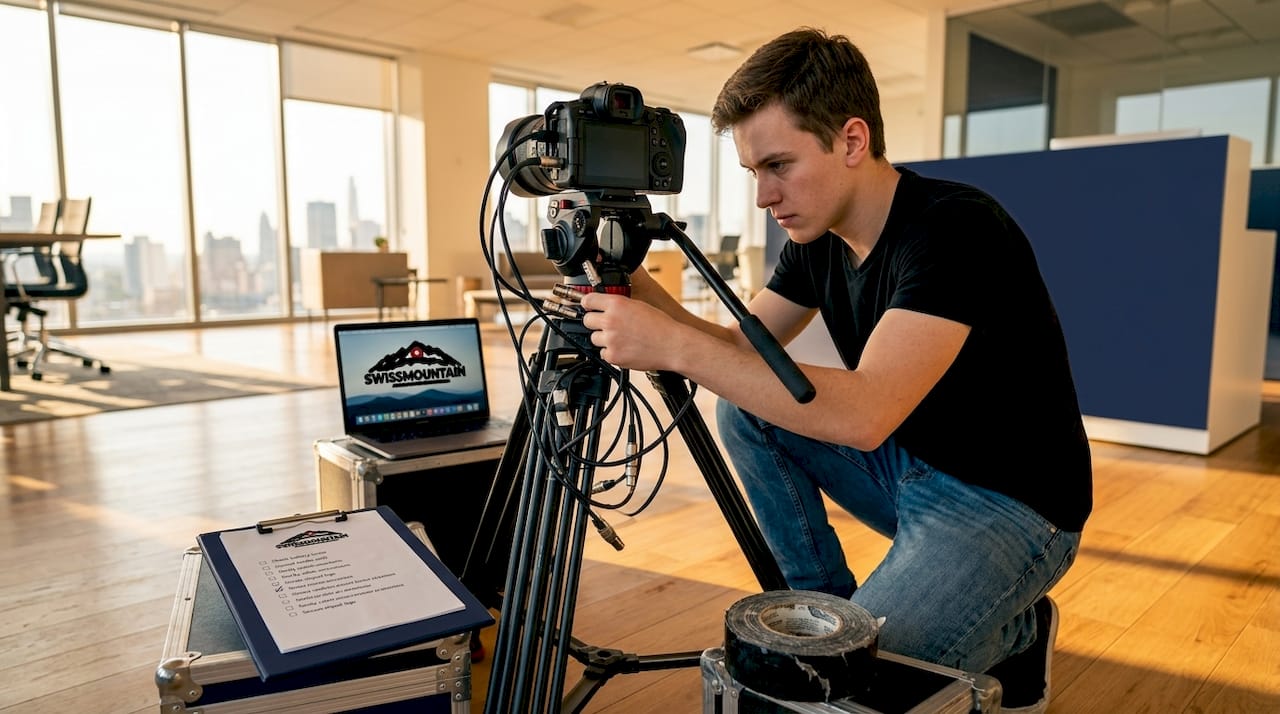
Standardize your equipment configurations. Every operator should build their rig identically, with the same cable routing and the same mount positioning. This matters especially when you are pulling crew from different locations or working with local hires.
Run a formal pre-shoot safety check. Before each shoot day begins, verify that every piece of critical gear has been powered on, tested, and confirmed functional. This is not just battery checks. It includes testing signal paths, confirming storage is formatted and reading correctly, and verifying that all mounts are torqued to spec.
Build time buffers into your schedule by design. Production teams that treat the schedule as aspirational rather than structural are the ones calling for extension days. Time management in production for global media teams shows that planned buffer time costs less than reactive problem-solving almost every time.
Define clear handoff protocols between departments. Camera to DIT. DIT to post. Each handoff should have a checklist and a confirmation step. Undocumented assumptions are where deliverable problems originate.
Conduct a short debrief after each shoot day. What slowed you down? What nearly failed? What worked better than expected? Capturing this while it is fresh costs fifteen minutes and builds a living reliability improvement record for your team.
Pro Tip: The best reliability indicator for an unfamiliar crew is not their reel. It is whether they show up with pre-labeled, organized gear cases. That one detail tells you everything about their process discipline.
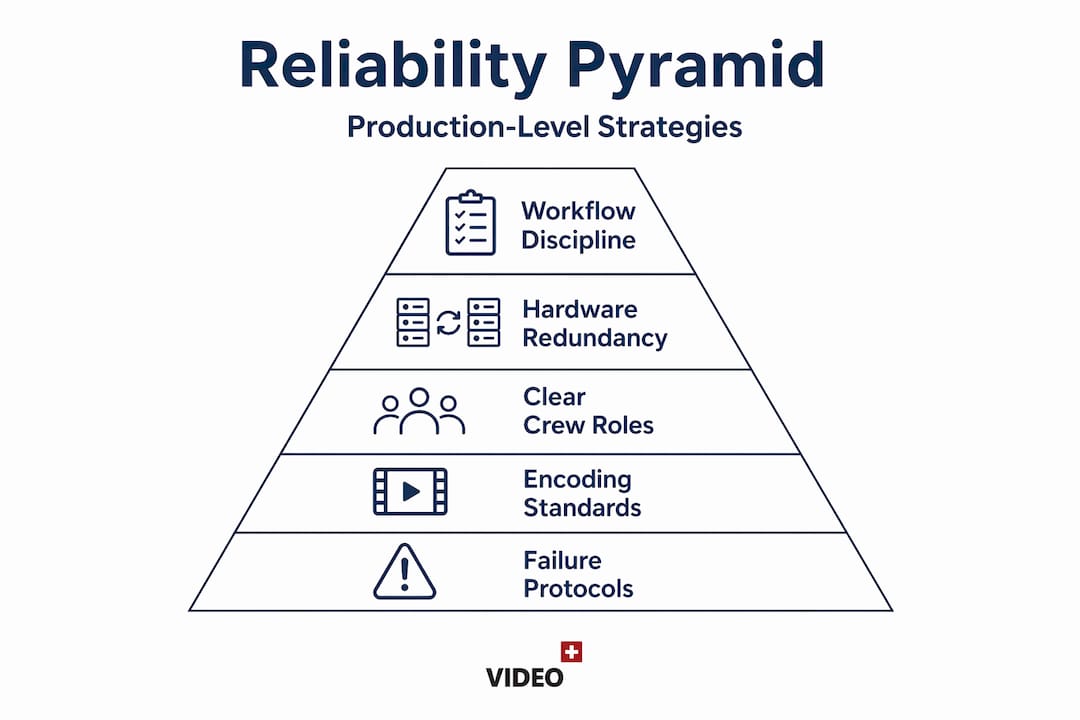
Clear crew role definition also feeds directly into workflow reliability. When everyone knows exactly who owns each responsibility, there are no gaps where things fall through.
Evaluating trusted video production partners
Dependability in filming is not just about what happens on your own team. When you bring in a production partner, a local fixer, or a service company for a shoot in a new location, you are extending your reliability chain to include their processes, their crew, and their relationships.
Reliable production partners maintain consistent crews and methodologies across diverse locations, giving clients predictable quality and genuine trust. That is the benchmark worth applying when you are evaluating any partner for an international or multi-location production.
Here is what separates a trustworthy production partner from one who simply presents well:
They can describe their failure protocols. Ask directly: what happens if a key crew member falls ill the morning of shoot? A reliable partner has an answer ready. An unreliable one improvises.
Their pricing is clear before the contract is signed. Vague estimates that expand later are a warning sign about how they manage everything else.
They hold detailed pre-production calls with structured agendas. This one habit is a reliable predictor of how organized the shoot itself will be.
Their crew stays consistent across projects. Rotating in unknown operators for each shoot breaks the institutional knowledge that makes productions go smoothly.
“A hallmark of reliable production partners is replicating crew consistency and workflow quality across diverse geographical locations, building client trust through predictability.” Elite Video, AP News
Importantly, engagement metrics do not correlate with trustworthiness in video production evaluations. A partner with a flashy portfolio and high view counts on their sample work may still lack the operational discipline that produces consistent deliverables at scale.
Technology’s role in production-level reliability
Modern production setups have introduced powerful tools for managing reliability. They have also introduced new ways to fail.
The most forward-thinking approach in live and broadcast production is designing for failure rather than designing for uptime. Professional broadcast teams assume failure will occur and build mitigation into the architecture from the start. That means separate power sources, independent timing references, and distinct signal routing paths, all running simultaneously so that losing one branch does not take down the production.
Software-defined production systems take this further by decoupling signal management from specific hardware. When a physical device fails, the logical signal path can be rerouted without interrupting output. This architecture is now accessible at mid-range budget levels, not just in high-end broadcast facilities.
For teams using AI-assisted workflows, the right reliability metric is cost per usable clip. This accounts for the overhead of failed generations, review cycles, and compliance rejections, not just successful outputs. It shifts the conversation from “can the AI produce good content?” to “can the AI produce good content repeatably and within budget?” That distinction is the difference between a novelty and a production tool.
Reliability Strategy | Best Application | Key Benefit |
N+1 hardware redundancy | Field and studio shoots | Eliminates single points of hardware failure |
Diverse signal routing | Live broadcast | Maintains output when one path fails |
Software-defined signal management | Broadcast and events | Fast rerouting without physical intervention |
Cost per usable clip tracking | AI-assisted workflows | Measures repeatable delivery, not just peak output |
Pro Tip: When mixing hardware from multiple vendors, test your full assembled rig under load before the shoot. Mechanical tolerances that look compatible on spec sheets often behave differently under the physical stress of a full production day, particularly with mounting systems.
For teams shooting in challenging outdoor environments, maintaining this level of technical discipline requires additional planning. Resources covering outdoor production execution offer practical guidance on keeping quality standards high when conditions are unpredictable.
My take: reliability is a culture, not a checklist
I have been on productions where the gear list was exceptional. Every camera was top-spec, every lens was sharp, the crew had impressive credits. And things still went sideways in ways nobody anticipated. What I have learned, production after production, is that reliability is built long before the shoot day begins.
The real failures I have seen almost never come from hardware outright breaking. They come from the quiet, accumulated friction of unclear roles, underdocumented workflows, and last-minute decisions about encoding or signal routing that should have been locked in during pre-production. A slipping quick-release plate that nobody noticed in the equipment check. A power adapter that “usually works fine” with one specific cable combination that nobody thought to verify.
Here is what I now believe firmly: teams that invest in process documentation and pre-shoot protocol reviews consistently outperform teams with bigger budgets but looser operations. The gear is the minimum viable foundation. The culture of preparation is what actually protects your production.
Redundancy is not pessimism. It is professionalism. The production teams I trust most are the ones who walk into a shoot day having already planned what they will do if something fails. Not because they expect disaster, but because they respect their clients enough to be ready for it.
— Pieter
How Videoproductionswitzerland supports your reliability goals
If you are planning a shoot in Switzerland and the stakes are high, reliability cannot be an afterthought. Videoproductionswitzerland provides full-service production support built around exactly the disciplines this article covers: consistent local crews, structured pre-production planning, permit management, and logistical coordination that takes the guesswork out of international shoots.
[

With over 20 years of experience in the Swiss market, Videoproductionswitzerland handles the variables that typically derail international productions before they become problems on set. Whether you need trusted crew sourcing, location scouting, or end-to-end production management in Switzerland, the team brings the same methodology and quality standards to every project. For transparent budget planning, the production costs overview gives you clear numbers before any commitment is made. Reach out for a free consultation and bring the same level of preparation to your next Swiss shoot that this article outlines.
FAQ
What does reliability in video production actually mean?
Reliability in video production means consistently delivering on-spec, on-time footage regardless of location, crew, or conditions. It covers hardware redundancy, workflow standardization, partner consistency, and delivery processes, not just equipment quality.
Why doesn’t great visual quality guarantee reliable video production?
Research shows that only 8.6% of videos with high visual quality also meet reliability benchmarks. Visual polish reflects production skill in ideal conditions. Reliability reflects whether those standards hold under pressure, across multiple shoots and delivery cycles.
What is the N+1 rule in video production?
The N+1 rule means carrying at least one fully tested spare of every critical hardware interface for every N operators on set. It directly reduces downtime caused by interface and connector failures, which are among the most common failure points in high-velocity productions.
How do I evaluate whether a production partner is truly dependable?
Look for partners who can describe their failure protocols clearly, maintain consistent crews across projects, provide transparent pricing upfront, and run structured pre-production planning calls. These operational behaviors predict on-set reliability more accurately than a strong portfolio alone.
What encoding format best supports reliable video delivery?
H.264 at CRF 18 remains the most reliable choice for tight delivery windows because of its legacy compatibility and fast encoding. H.265 at CRF 28 offers 30 to 50% smaller files but encodes 2 to 5x slower, making it better suited for archival or when transfer bandwidth is the primary constraint.
Recommended
