
Swiss Filming Regulations: What International Crews Must Know
- Pieter Nijssen

- May 25
- 8 min read
TL;DR:
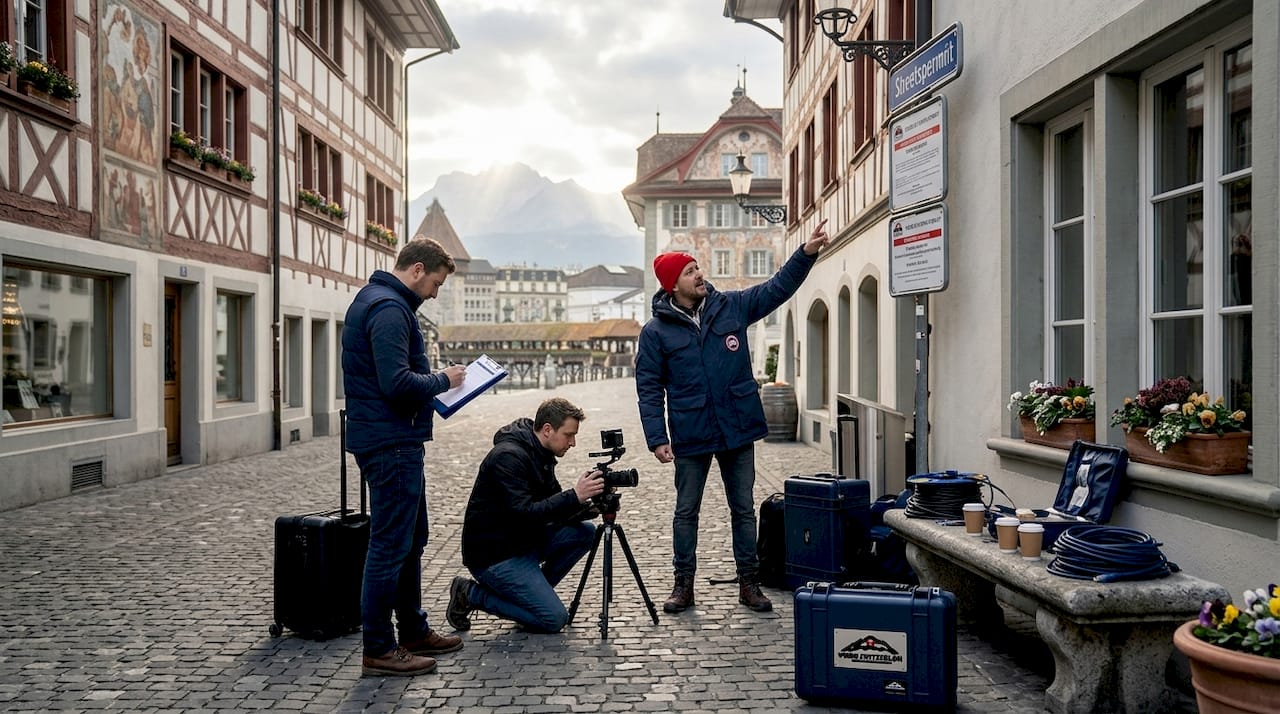
Swiss filming regulations are complex, with permit thresholds varying by location and activity, requiring extensive planning.
Drone operators must register, complete training, and carry liability insurance, with strict restrictions on flying zones and altitude.
Switzerland looks deceptively simple from the outside. Beautiful locations, efficient infrastructure, cooperative locals. Many international productions arrive expecting to set up a camera and start rolling. Then reality hits. Swiss filming regulations are layered, cantonal rules vary by city, drone requirements are strict, and missing a single permit threshold can shut down your shoot day. This guide cuts through the confusion and gives you precise, practical answers on what you actually need to know before your crew lands in Switzerland.
Table of Contents
Key takeaways
Point | Details |
Permit thresholds are specific | Filming over 1 hour, using infrastructure, or bringing more than 5 people requires a formal permit in Zurich. |
Cantons set their own rules | Swiss cantonal filming rules differ by region, so you must research permits city by city. |
Drone compliance is non-negotiable | Operators must register, complete training, and carry CHF 1 million insurance before any aerial filming. |
Holidays restrict productions | Advertising shoots and noisy filming are prohibited on major Swiss public holidays. |
Early planning pays off | Apply for permits at least 4 weeks in advance for sensitive or specialized locations. |
Swiss filming regulations: when you need a permit
The most expensive mistake international crews make in Switzerland is assuming that a small, fast shoot does not require paperwork. The reality is more precise than that.
In Zurich, one of the country’s primary production hubs, the Film Commission has defined clear thresholds. According to permit trigger conditions, a permit is required when any of the following apply:
Your shoot in a public space lasts longer than 1 hour, including setup and preparation time
You use public infrastructure such as roads, barriers, parking areas, or public seating
Your crew on location exceeds 5 people
Your shoot causes any obstruction to pedestrian or vehicle traffic
That last point matters more than most filmmakers realize. Even a small crew of three people can trigger a permit requirement if their equipment or positioning blocks a sidewalk. The no-obstruction rule is the standard for qualifying as a no-permit shoot.
Shoot Type | Permit Required? | Notes |
2-person crew, 30 minutes, no obstruction | No | Must remain fully clear of all foot and vehicle traffic |
6-person crew, outdoor interview | Yes | Crew size alone exceeds the 5-person threshold |
1-hour setup + 2-hour shoot | Yes | Total duration including prep exceeds the 1-hour trigger |
Drone operation over public space | Yes | Always requires registration and may need additional approval |
One area that catches crews off guard is the definition of “preparations.” Clock time starts from when your team arrives and begins placing gear, not when the camera rolls. A 45-minute shoot with 30 minutes of rig setup crosses the 1-hour threshold immediately.
Public holidays add another layer of complexity. On days like Good Friday and Easter Sunday, only quiet filming is permitted, and advertising films or photos are explicitly prohibited. This matters if you are scheduling a commercial shoot and did not check the Swiss holiday calendar in advance. A detailed holiday filming guide for Switzerland can save you from a costly rescheduling scenario.
Pro Tip: Apply for your permit at least 3 weeks before your shoot date. Some locations in Zurich and other major cities require additional safety reviews that extend processing time, especially if your production involves vehicles, crowds, or water.
For urban shooting logistics across Swiss cities, the permit process and requirements are largely similar but not identical. Always verify directly with the local film commission for the specific canton you are shooting in.
Filming at pools, lakes, and protected sites
Switzerland’s most visually striking locations often come with the strictest rules. Swimming pools, public lakes, and culturally significant sites all fall under specialized oversight, and the lead times are longer than for standard public space permits.
For indoor and outdoor swimming pool locations, the recommended lead time is ideally 4 weeks. If you plan to shoot during regular opening hours, additional restrictions apply. Filming must begin before 11 a.m. and is capped at a maximum of 3 hours to minimize disruption to public visitors. Off-season shooting is strongly preferred by facility operators, and reducing crew and equipment size to the minimum improves your approval chances significantly.
For lake and outdoor water locations, the production team carries full responsibility for safety. Swiss safety responsibility rests with production, not the authorities. Emergency services will respond to genuine crises, but they do not supervise your crew. That means you need detailed safety plans, qualified on-set supervisors, and risk assessments in writing before you arrive.
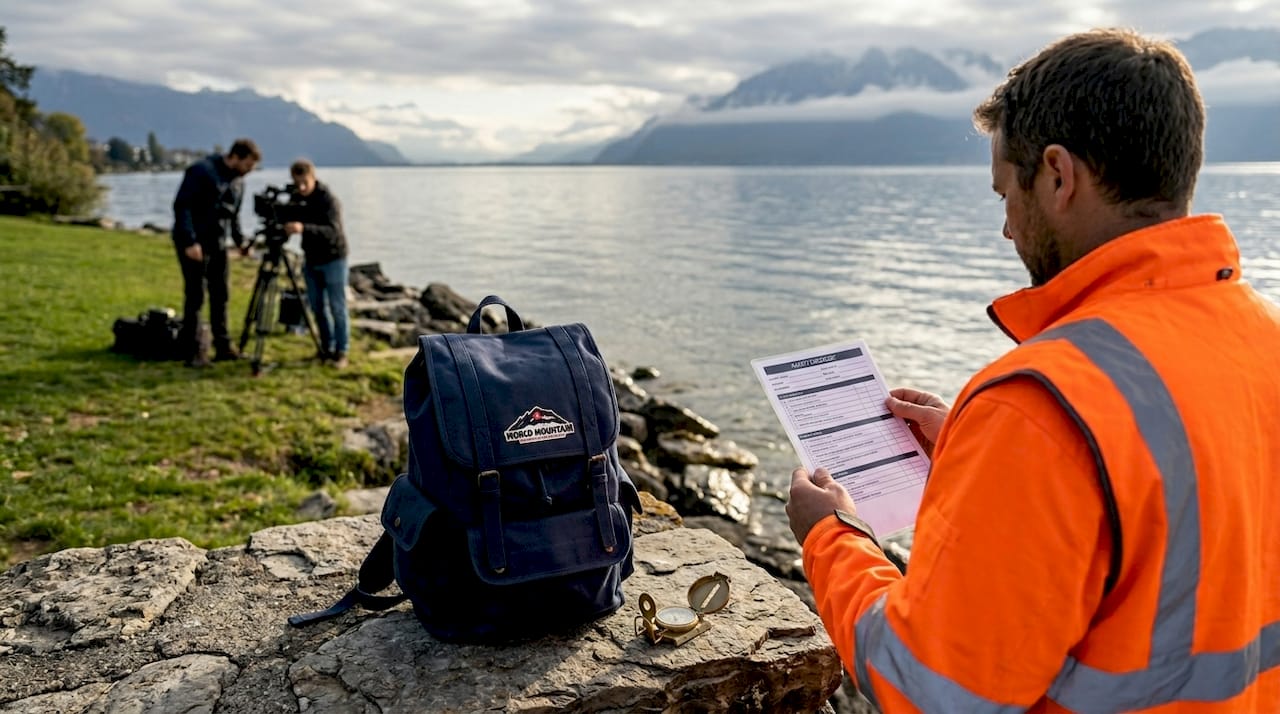
Culturally protected areas follow their own approval chain entirely. The Chinese Garden in Zurich is a clear example: special approvals are required, and filming cannot interfere with the site’s regular operation or public experience. Many heritage sites across Switzerland fall under similar protections.
Here is a practical process to follow for any specialized location:
Identify the managing authority for the location. This may be a municipal department, a private operator, or a heritage body, depending on the site.
Submit a written request describing your production scope, dates, crew size, and equipment list. Vague requests get delayed.
Obtain written confirmation before booking travel or equipment rentals. Verbal approvals do not protect you.
Prepare a safety plan for any water, elevated, or high-traffic environments. Submit it with your permit application.
Keep your crew and gear minimal. Smaller footprint equals faster approval and fewer conditions.
Pro Tip: For lake or pool shoots, hire a local safety coordinator who knows Swiss emergency protocols. This is not a box-checking exercise. Authorities expect professional-grade safety documentation, and it protects your entire production.
Drone filming regulations in Switzerland
Aerial footage of the Swiss Alps or Zurich’s skyline is compelling. Getting it legally requires you to clear several requirements before your drone leaves the ground.
Swiss drone laws were harmonized with EU regulations in 2023, which means operators face a structured classification and registration system. The core requirements are:
Registration on UAS.gate is mandatory for any drone weighing more than 250 grams or equipped with a camera, regardless of weight
Online training and testing must be completed through the official BAZL/FOCA platform before flying
Liability insurance of at least CHF 1 million coverage is required for all commercial operations
Drone classification into categories A1, A2, or A3 determines how close you can fly to people and populated areas
Visual line of sight must be maintained at all times during flight
Maximum altitude is capped at 120 meters above ground
No transport or dropping of objects from drones is permitted under any circumstances
Geographic restrictions are extensive. No-fly zones cover areas around airports, military installations, nature reserves, large public events, and certain urban centers. The Swiss FOCA publishes official restriction maps through the UAS.gate platform. Check them before every shoot because restricted zones are updated regularly.
For a thorough breakdown of these rules organized specifically for film productions, the Swiss drone filming rules resource covers operator responsibilities and location-specific restrictions in detail.
Legal framework for production companies
Beyond location permits, production companies and broadcasters operating in Switzerland face a set of legal obligations that shape how shoots are structured and financed.
The revised Swiss Film Act, updated with provisions effective from 2024, introduced two major requirements for audiovisual services. Streaming platforms and broadcasters providing film content in Switzerland must now allocate 4% of annual gross income to Swiss film production or pay a subsidiary levy after a 4-year grace period. They must also maintain a minimum 30% quota of European films in their catalogs. These rules directly affect co-productions and distribution deals involving Swiss partners.
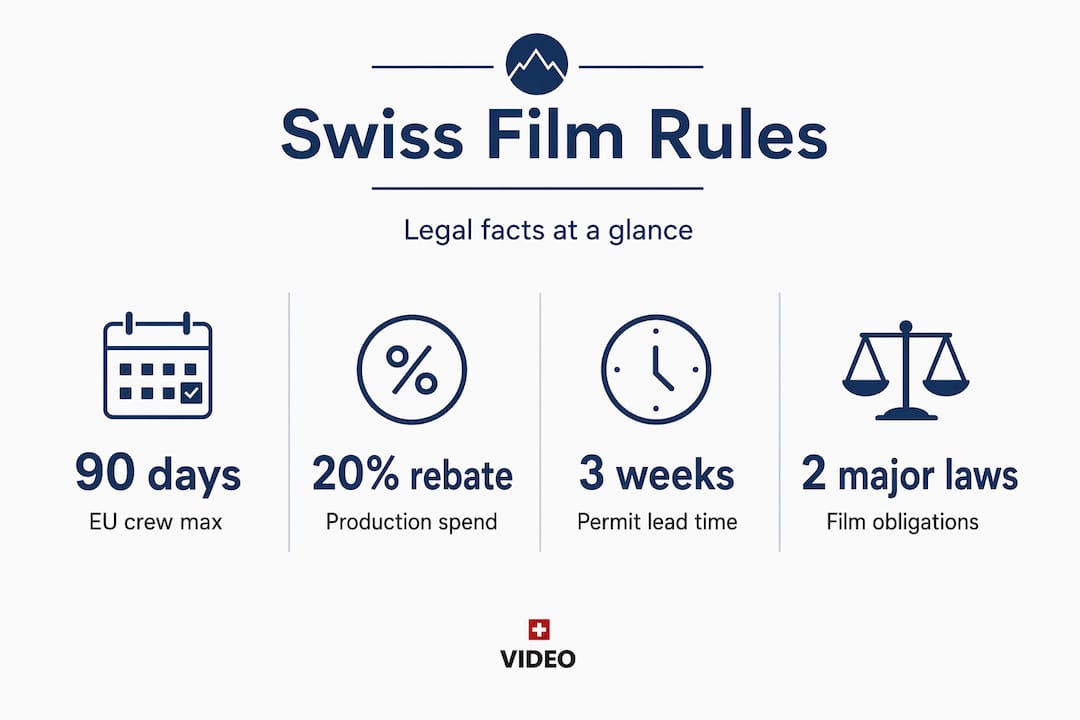
Obligation | Applies To | Threshold or Rate |
Investment in Swiss film | Audiovisual service providers | 4% of annual gross income |
European film quota | Streaming platforms operating in Switzerland | 30% of catalog |
Swiss Production Rebate | Qualifying local productions | 20% of eligible local spend |
Working permit (EU crew) | EU citizens working in Switzerland | Up to 90 days per year |
On the crew side, EU citizens can work up to 90 days per year in Switzerland without formal work permits, subject to employer notification. Non-EU crew members require permits, and processing times vary. Night shoots trigger additional compensation requirements, and public holiday work carries mandatory pay premiums.
The Swiss Production Rebate offers 20% back on eligible local spend, but conditions apply. You need a minimum of 5 shoot days, a majority share held by a Swiss production company, and you cannot include overhead costs or producer fees in the rebate calculation.
If you want to understand what these costs look like in real numbers before committing, reviewing production costs in Switzerland early in pre-production prevents budget surprises down the line.
My take on navigating Swiss regulations
Working with international crews in Switzerland for years has taught me one consistent truth: most compliance problems are not caused by ignorance of the rules. They are caused by underestimating how quickly you can cross a threshold.
A production that planned a “quick 45-minute street interview” arrives with 6 crew members, takes 25 minutes to set up, and suddenly has a permit violation on its hands before a single frame is captured. I have seen this happen more than once, and the stress it creates on a shoot day is completely avoidable.
My strongest recommendation is to conduct a pre-shoot compliance audit. Walk through every location, estimate real setup times honestly, count your crew including fixers and assistants, and check the holiday calendar. That process alone eliminates most of the risk.
The second thing I tell every international team: do not try to minimize crew size on paper while bringing full-scale equipment. Authorities are not fooled, and the goodwill you need for future permits disappears fast. Lean productions that genuinely respect the rules build a track record that opens doors on future shoots.
Finally, the Swiss authorities I have worked with respond well to production companies that communicate clearly and early. A well-written permit application submitted 4 weeks in advance with a proper safety plan gets approved. A rushed request submitted the week before the shoot creates anxiety for everyone.
— Pieter
Plan your Swiss shoot without the guesswork
[
Switzerland is one of the most rewarding places in the world to film. It is also one of the places where poor pre-production planning costs the most. Videoproductionswitzerland handles the full weight of permit applications, cantonal compliance, crew sourcing, and on-ground logistics so your team can stay focused on the creative work. With over 20 years of experience managing international productions across Swiss cities, alpine regions, and specialized locations, we take the complexity off your plate. Get a clear picture of what your production will cost and what support looks like by visiting our full production services page. No guesswork. No last-minute scrambles. Just a shoot that runs the way it should.
FAQ
When does filming in Switzerland require a permit?
A permit is required in Zurich when your shoot in a public space lasts over 1 hour including preparations, involves more than 5 people, uses public infrastructure, or causes any obstruction to foot or vehicle traffic.
What are the drone registration requirements for filming in Switzerland?
Drone operators must register on UAS.gate if the drone weighs more than 250 grams or has a camera, complete mandatory online training, and carry a minimum of CHF 1 million in liability insurance before any commercial flight.
Can EU crew members work in Switzerland without a work permit?
EU citizens can work in Switzerland for up to 90 days per year without a formal work permit, provided the employer files the required notification. Non-EU crew members must obtain work permits through the relevant Swiss authority.
Are there filming restrictions on Swiss public holidays?
Yes. On major holidays like Good Friday and Easter Sunday, only quiet filming without noise is permitted. Advertising films and photos are explicitly prohibited on those days.
What is the Swiss Production Rebate?
The Swiss Production Rebate offers a 20% return on eligible local spend for qualifying productions that complete a minimum of 5 shoot days in Switzerland and hold a majority share through a Swiss production company.
Recommended
