
Why film in Switzerland? Unlock exceptional locations & support

TL;DR:
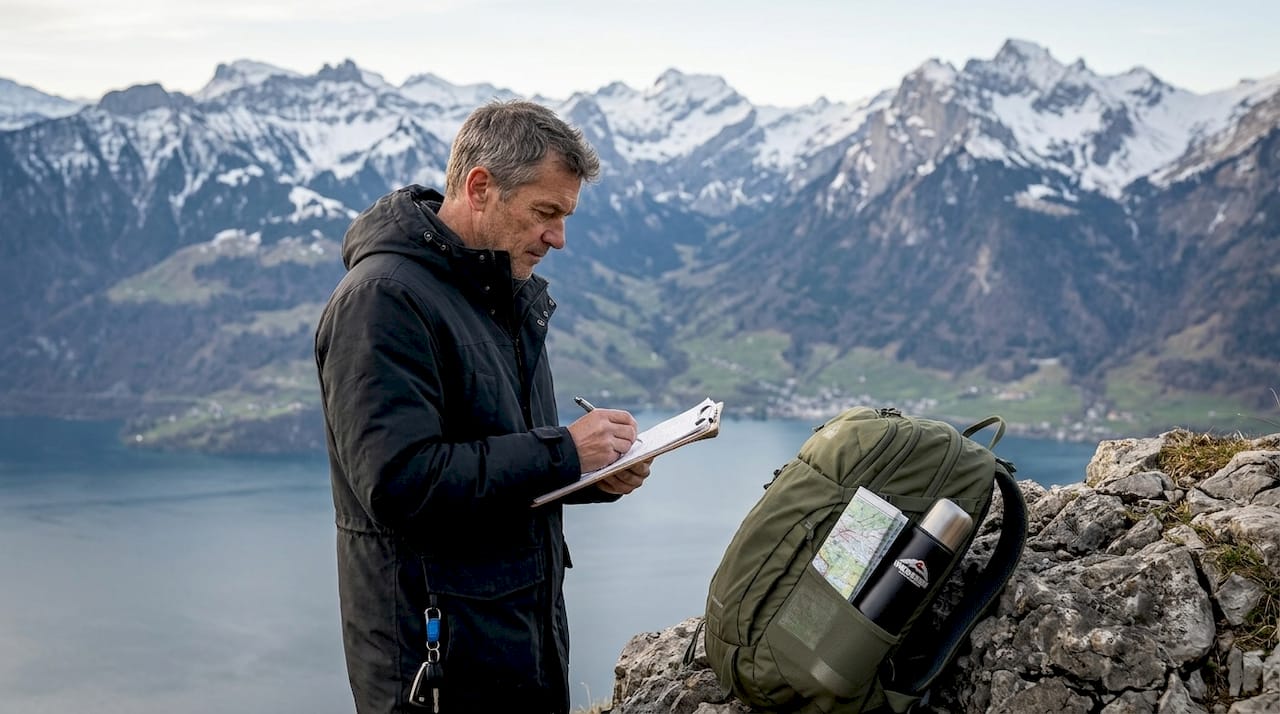
Switzerland offers unmatched location diversity and reliable infrastructure for film productions.
Permitting involves canton-based processes requiring proactive planning and local support.
High crew rates are offset by Swiss efficiency, multilingual crews, and attractive financial incentives.
Switzerland is a small country that punches far above its weight in global film production. Despite its compact geography and reputation for regulatory precision, blockbuster productions keep choosing it for one simple reason: nowhere else in Europe combines such radical visual diversity with the kind of logistical reliability that keeps shoots on schedule and on budget. If you’ve been hesitant about filming here because of perceived complexity or cost, this guide will change your thinking. We’ll walk through the real advantages, from iconic locations and permit mechanics to crew rates and financial incentives, so you can plan your next production with confidence.
Table of Contents
Key Takeaways
Point | Details |
Location variety | Switzerland offers unmatched visual diversity, from alpine peaks to historic cities, all within short travel distances. |
Local support | Proactive film commissions and expert fixers streamline permits, logistics, and language barriers for international crews. |
Financial incentives | Robust rebates and strategic budgeting options significantly offset higher crew and logistical costs. |
Production quality | Highly skilled, multilingual crews ensure productions run efficiently and at a world-class standard. |
Stunning locations and cinematic potential
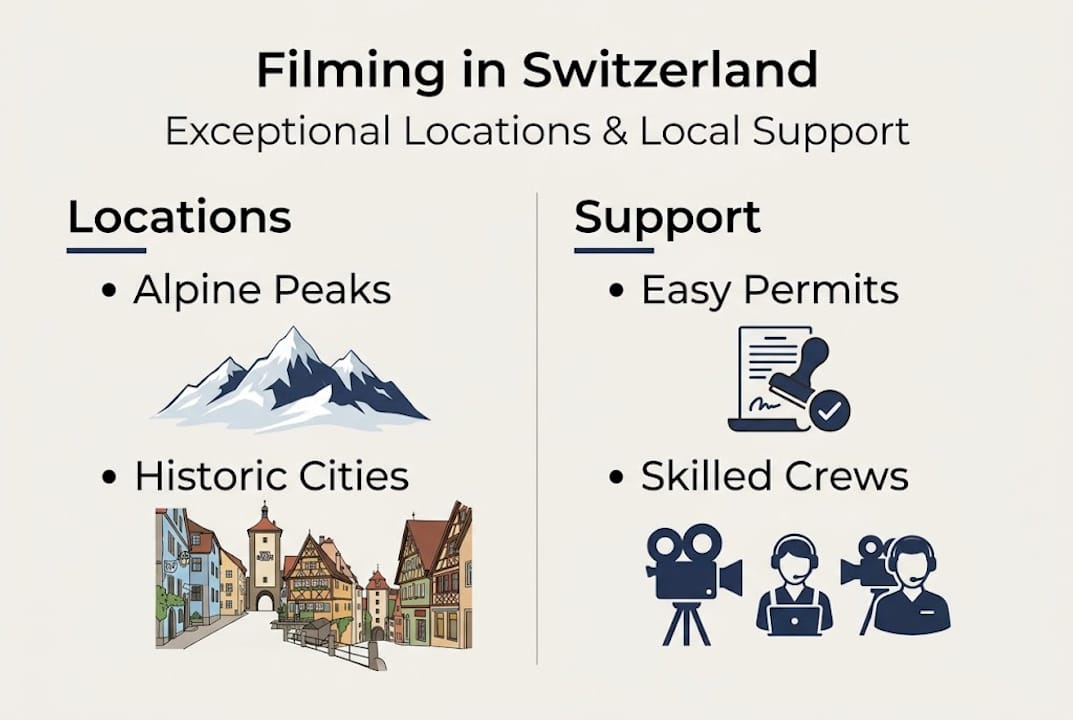
Switzerland’s visual range is genuinely hard to match. Within a two-hour drive, you can move from snow-capped Alpine peaks to sun-drenched Mediterranean lakeshores, from medieval old towns to sleek modern financial districts. That kind of variety, compressed into such a small area, is a production designer’s dream and a logistical advantage that few countries offer.
As Switzerland’s diverse locations including the Alps, lakes, historic cities, and rural villages have proven in productions like James Bond films and Netflix series, the country consistently delivers cinematic looks that would otherwise require shooting across three or four different countries. That’s a real cost and time saving that smart productions are already exploiting.
Compared to other popular European filming destinations, Switzerland holds its own in a specific way. France offers variety but requires navigating dense bureaucracy in major cities. Italy delivers stunning visuals but can be unpredictable on logistics. Switzerland’s edge is the combination: exceptional visuals and reliable infrastructure. Roads are excellent, crew are punctual, and gear rental houses maintain high-quality, well-maintained equipment.
Here’s a quick look at how Switzerland compares for international productions:
Factor | Switzerland | France | Italy |
Location variety | Very high | High | High |
Infrastructure reliability | Excellent | Good | Moderate |
Permit processing speed | 10 days to 3 weeks | 2 to 6 weeks | 3 to 8 weeks |
Crew multilingual capability | Very high | Moderate | Low |
Financial incentives | National + cantonal | National only | National only |
The types of looks you can achieve within a two-hour radius of Zurich or Geneva include:
Alpine drama: Snow, glaciers, dramatic mountain passes
Lakeside elegance: Calm blue waters with luxury architecture
Urban sophistication: Zurich’s financial district, Geneva’s international quarter
Rural authenticity: Timber farmhouses, rolling green hills, fog-filled valleys
Historical depth: Bern’s UNESCO-listed arcades, Lucerne’s medieval bridges
Switzerland attracts hundreds of international productions annually, with the Zurich Film Commission alone supporting 600+ annual productions through free permit, location, and crew coordination services.
For a broader overview of what’s available across the country, the Switzerland production services guide is a strong starting point. And if you want to understand the specific hurdles before you arrive, reviewing the common filming challenges in Switzerland will save you real time in pre-production.
Efficient permitting and strong local support
Once you understand the range of locations, the next step is understanding the access mechanics. Switzerland’s permit system is canton-based, meaning each of the country’s 26 cantons manages its own rules, fees, and timelines. This sounds complicated, and it can be if you go in unprepared. But with the right local support, it becomes very manageable.
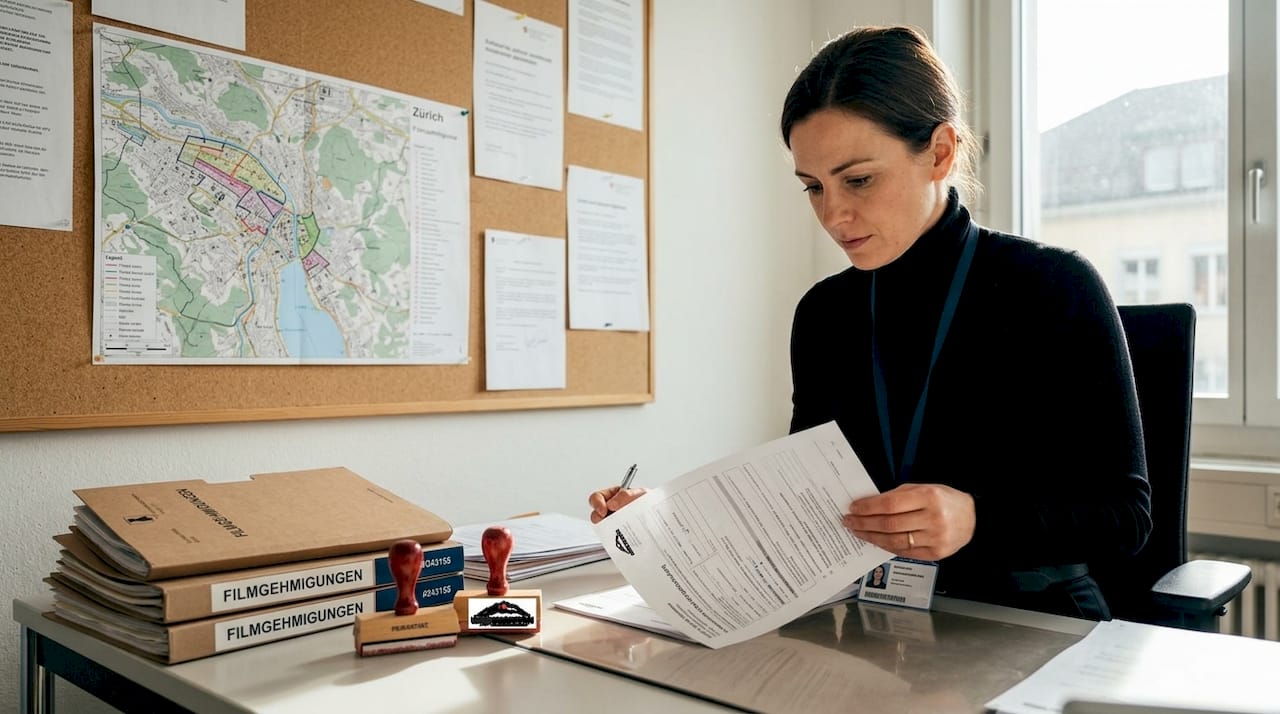
Permit fees range CHF 176 to 880 depending on the canton, with processing times typically running one to three weeks. Zurich is the fastest at around 10 days. Geneva runs two to three weeks. The key rule: contact the relevant film commission at least six weeks before your shoot date. That buffer gives you room to handle revisions without stress.
Here’s how the major cities compare on permit logistics:
City | Processing time | Typical fee range | Film commission support |
Zurich | ~10 days | CHF 176 to 500 | Zurich Film Commission |
Geneva | 2 to 3 weeks | CHF 300 to 880 | Geneva Film Commission |
Bern | 2 to 3 weeks | CHF 200 to 600 | Bern city authority |
Basel | 1 to 2 weeks | CHF 150 to 500 | |
Ticino | 2 to 3 weeks | CHF 200 to 700 | Ticino Film Commission |
For aerial work, drone permits require a separate application through FOCA (the Federal Office of Civil Aviation). This is a national-level requirement on top of any cantonal permit, so build that into your timeline. Detailed rules are covered in the guide to Swiss drone rules.
Here’s a step-by-step process for securing permits efficiently:
Identify all locations and the cantons they fall within
Contact each film commission at least six weeks before the shoot
Submit location and crew details as requested by each canton
Apply for FOCA drone permit if aerial footage is needed (allow extra time)
Confirm all approvals in writing at least one week before shoot day
For full details on the licensing process, the guide to film licensing in Switzerland covers every step clearly.
Pro Tip: If your production spans multiple cantons or languages, a local fixer who knows each commission personally will cut your permit timeline significantly. They handle the language nuances and know which contacts to call directly, which means fewer delays and fewer surprises.
Skilled crews and efficient production logistics
With permissions in hand, focus shifts to assembling and managing your production team. Swiss crew rates are higher than in most European countries, and that’s worth addressing directly. Crew day rates run CHF 500 to 1,000 per person, with DOPs (directors of photography) at CHF 800 to 1,000 and fixers between CHF 600 and 900 per day. These numbers reflect a market where people show up on time, work efficiently, and don’t need hand-holding.
Here’s a breakdown of typical crew categories and rates:
Director of Photography (DOP): CHF 800 to 1,000 per day
Camera operator: CHF 600 to 800 per day
Sound recordist: CHF 500 to 700 per day
Gaffer (lighting chief): CHF 550 to 750 per day
Production fixer/coordinator: CHF 600 to 900 per day
Production assistant: CHF 300 to 500 per day
What you’re buying at these rates is more than just skill. Swiss crews are genuinely multilingual. Switzerland has four official languages (German, French, Italian, and Romansh), and most experienced crew members operate confidently in at least two of them, plus English. That matters enormously on international sets where communication breakdowns cost real money.
Efficiency is the other major factor. A Swiss crew that completes a complex location setup in four hours versus six hours isn’t just faster. That difference compounds across a multi-day shoot and can offset a significant portion of the higher day rates. The film production tips for Switzerland section covers how to structure your days to maximize this efficiency advantage.
Pro Tip: When recruiting crew, match your genre to your team. A commercial production in Zurich needs different specialists than a documentary in the Valais Alps. Use a local crew recruitment specialist in Switzerland who understands both the technical requirements and the regional terrain.
Financial incentives and strategic budgeting
Once you know who and what you’ll need, the last crucial element is making the numbers work. Switzerland’s incentive landscape is more generous than most international filmmakers realize, and the structure rewards those who plan ahead.
At the national level, the PICS (Promotion of International Co-Productions with Switzerland) program offers a 20 to 40% rebate on Swiss spend for qualifying international co-productions, with a cap of CHF 600,000. This is real money, and it’s available to productions that meet the co-production criteria. At the cantonal level, Zurich offers up to CHF 30,000 in production support plus CHF 6,000 for scouting. Geneva and Neuchatel are launching regional rebates in the 15 to 30% range, which can be combined with national incentives.
Here’s a summary of the major incentives available:
PICS (national): 20 to 40% rebate on qualifying Swiss spend, up to CHF 600,000, for international co-productions
Zurich cantonal: Up to CHF 30,000 production grant plus CHF 6,000 scouting support
Geneva cantonal: 15 to 30% rebate (launching 2026)
Neuchatel cantonal: Regional rebate scheme launching alongside Geneva
Combination rule: National and cantonal incentives can be stacked for maximum return
For detailed guidance on structuring your budget to capture these incentives, the budgeting for Swiss film projects resource walks through the key decisions. And for practical strategies on staying within your approved budget during production, the guide on Swiss filming budgets is essential reading.
Pro Tip: Build a 15 to 20% weather contingency into your Alpine or outdoor shoot budget. Swiss mountain weather shifts fast, and a single lost shoot day in a remote location can cost more than the contingency itself. Plan for it upfront rather than scrambling for budget mid-production.
What most filmmakers miss about Switzerland
Having navigated the technical details, let’s cut through the noise and share an insider perspective. The most common mistake we see from international productions is treating Switzerland like a more expensive version of another European destination. It isn’t. The cost structure reflects a fundamentally different operating model, one built around reliability, not just execution.
The sticker shock on crew rates and permit fees is real. But productions that factor in Swiss efficiency consistently report that fewer days are lost to logistics failures, miscommunication, or equipment issues. That reliability has a dollar value that rarely appears in the initial budget comparison.
The other critical mistake is underestimating canton complexity. Productions that contact commissions late, skip the local fixer, or assume one permit covers multiple regions end up paying for it in delays. Switzerland rewards preparation. The filmmakers who thrive here are the ones who engage local expertise early and treat the video production services available as a strategic asset rather than an optional add-on. The support infrastructure exists precisely to turn these challenges into advantages. Use it.
Plan your Swiss production with expert support
If the Swiss advantage sounds compelling, here’s how to get your next production started. Managing locations, permits, crew, and budget across multiple cantons is genuinely complex work. The good news is you don’t have to figure it out alone.
[
We specialize in taking the guesswork out of Swiss productions for international filmmakers and brands. From permit applications and crew sourcing to location scouting and on-set logistics, we handle the moving parts so you stay focused on your creative vision. Start by reviewing the full breakdown of Swiss production costs to build a realistic budget, then connect with our team through full-service production support for a free initial consultation. Reliable execution, seamless logistics, and total peace of mind. That’s what we deliver.
Frequently asked questions
How long does it take to get a film permit in Switzerland?
Processing times vary by canton, ranging from 10 days in Zurich to two to three weeks in Geneva. Applying at least six weeks before your shoot date is strongly recommended to allow time for any revisions.
Are there financial incentives for filming in Switzerland?
Yes. The national PICS program offers 20 to 40% back on qualifying Swiss spend, and Zurich, Geneva, and Neuchatel all offer regional support that can be combined with national incentives.
Can I use drones for filming in Switzerland?
Yes, but aerial work requires a separate FOCA drone permit in addition to any cantonal location permit. Build extra lead time into your pre-production schedule for this application.
What are typical crew rates in Switzerland?
Crew day rates run CHF 500 to 1,000, with DOPs at CHF 800 to 1,000 and fixers between CHF 600 and 900 per day, reflecting the high skill level and multilingual capability of Swiss crews.
Why choose Switzerland over other countries for filming?
Switzerland’s unique location diversity combined with efficient logistics, multilingual crews, and stackable financial incentives gives it a genuine edge over other European destinations, especially for productions that value reliability as much as visual impact.
Recommended
