
Achieve Swiss-level quality standards in video production
- Pieter Nijssen

- 5 hours ago
- 9 min read

TL;DR:
Swiss video production emphasizes rigorous planning, technical standards, and logistical reliability.
Quality metrics like VMAF, PSNR, and SSIM guide Swiss footage encoding strategies.
Budgeting includes high crew rates, equipment costs, permits, and a 20% contingency for unforeseen delays.
High budgets do not guarantee high-quality video. That misconception costs international filmmakers and brand managers real money every year. Swiss video production stands apart because it treats workflow precision, technical benchmarks, and logistical reliability as equal partners to creative vision. This guide walks you through exactly how Swiss productions are structured, what technical standards they meet, how to budget realistically, and how to navigate permits and compliance without losing your mind. Whether you are shooting a 60-second brand film in Zurich or a multi-day documentary in the Alps, these standards apply and they are achievable.
Table of Contents
Key Takeaways
Point | Details |
Workflow rigor | Swiss-quality productions depend on detailed planning and professional execution in every phase. |
Technical standards | Precise codec and bitrate choices ensure visually lossless results, especially for international delivery. |
Realistic budgeting | Budgeting for Swiss rates and equipment means allowing room for contingencies and optimizing for authentic formats. |
Logistical precision | Smooth production requires multilingual crews, timely permits, and knowledge of incentive programs. |
Innovation and adaptation | Hybrid workflows and AI can lower costs in some cases, but Swiss producers prioritize creative control for narrative projects. |
Understanding Swiss production workflows
The standard production workflow in Switzerland follows three clearly defined phases: pre-production, production, and post-production. Swiss companies treat end-to-end service as the baseline, not a premium add-on. That means you get a single point of accountability from concept to final delivery, which removes the coordination chaos that plagues productions juggling multiple vendors.
Pre-production is where Swiss quality is actually built. Scripting, storyboarding, location scouting, permit applications, and crew scheduling all happen here. Rushing this phase is the single biggest mistake international teams make. Pre-production accounts for roughly 70% of the budget in well-run Swiss productions, reflecting how seriously local firms weight planning over improvisation.
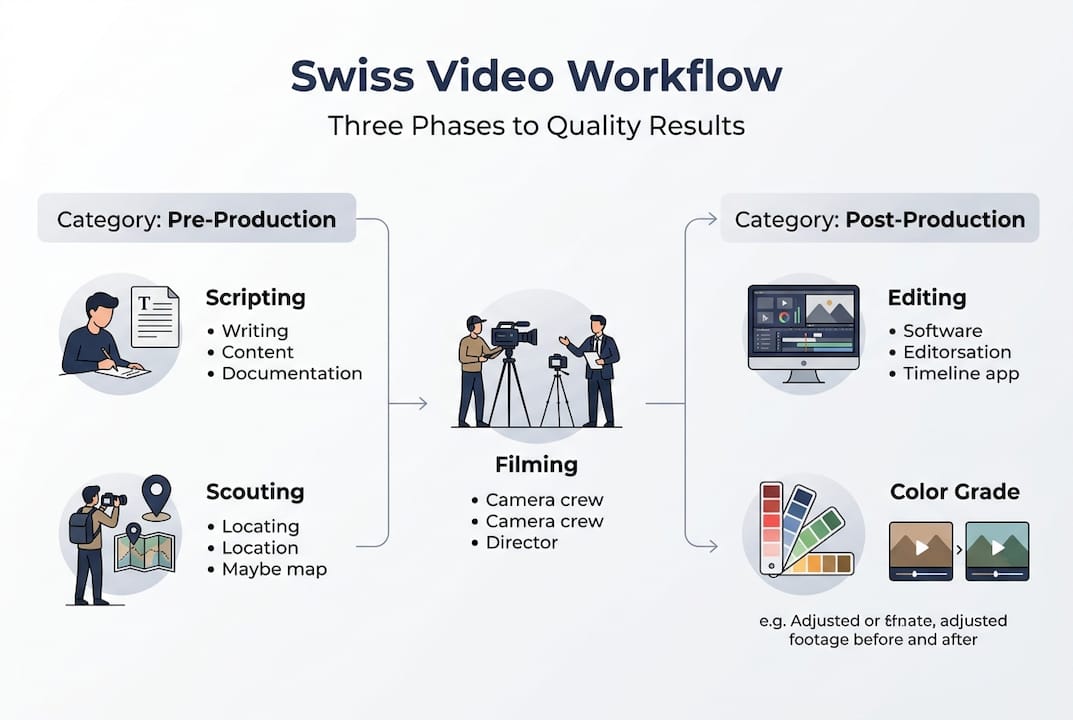
Production covers the actual shoot days. Swiss crews use high-end cinema cameras, professional lighting rigs, and sound equipment that meets broadcast standards. Crew members are vetted, punctual, and experienced with international clients.
Post-production includes editing, color grading, audio mixing, and motion design. Swiss post houses maintain strict quality control at each stage, often running multiple review rounds before final export.
Here is how the three phases compare in focus and resource allocation:
Phase | Primary focus | Typical resource share |
Pre-production | Planning, scripting, permits | High |
Production | Filming, directing, sound | Medium |
Post-production | Editing, grading, delivery | Medium |
The Swiss video production services guide outlines how full-service providers like Noxediem and Prodswiss structure these phases for international clients. Exploring the Switzerland video production guide also gives you a strong overview of what to expect from local partners.
Confirm all locations and permits before shoot week
Lock the script before storyboarding begins
Schedule buffer days for weather-dependent outdoor shoots
Align post-production timelines with your delivery deadline from day one
Pro Tip: Spend more time in pre-production than feels necessary. Every hour of planning saves three hours of expensive on-set problem-solving.
Technical benchmarks: Codecs, bitrates, and quality metrics
With workflow context established, let’s unpack the technical benchmarks that underlie Swiss video quality. These are not abstract specifications. They directly affect how your footage holds up through editing, color grading, and multi-generation encoding.
Two codecs dominate professional Swiss production. JPEG XS is the preferred choice for live and low-latency workflows, offering 6:1 to 8:1 compression while remaining visually lossless at 200-400 Mbps for 1080p/50. HEVC handles storage-focused workflows, with first-generation files running at 40-60 Mbps and higher bitrates required for multi-generation encoding to prevent quality breakdown.
Swiss precision emphasizes reliability. Prefer JPEG XS for live production and HEVC for storage, and always plan your bitrate strategy around how many generations of encoding your footage will go through.
Quality measurement in Swiss productions relies on three primary metrics:
PSNR (Peak Signal-to-Noise Ratio): Measures mathematical difference between original and compressed frames. Higher is better, though it does not always reflect perceived quality.
VMAF (Video Multi-Method Assessment Fusion): Netflix-developed metric that correlates closely with human perception. Swiss broadcasters increasingly use this as their primary benchmark.
SSIM (Structural Similarity Index): Evaluates luminance, contrast, and structure to gauge visual fidelity.
Why does this matter for your production? If your footage will go through multiple rounds of editing, color grading, and re-encoding before final delivery, low bitrates at the capture stage create visible artifacts in the final output. Swiss producers account for this from day one.
The video production cost breakdown explains how codec choices affect both quality and budget, which is useful when you are comparing bids from different vendors.
Codec | Best use | Bitrate range | Compression ratio |
JPEG XS | Live, low-latency | 200-400 Mbps | 6:1 to 8:1 |
HEVC | Storage, archival | 40-60 Mbps (1st gen) | Variable |
Budgeting for Swiss-level quality: Costs, crew rates, and equipment
Understanding benchmarks is only half the battle. Strategic budgeting is equally crucial for achieving Swiss-quality production without financial surprises mid-shoot.
Swiss crew rates reflect the country’s high cost of living and professional standards. Daily rates run CHF 500-1000 per crew member, with short brand videos starting around CHF 5,000 and documentary budgets ranging from CHF 250,000 to CHF 500,000. The Prodswiss estimator starts at CHF 2,460 for entry-level packages. Cinema camera rentals typically run CHF 800-1,500 per day depending on the system.
Here is a realistic budget comparison across project types:
Project type | Estimated budget | Crew size | Duration |
Short brand video (<90s) | CHF 5,000-15,000 | 3-5 | 1 shoot day |
Mid-length commercial | CHF 30,000-80,000 | 6-10 | 2-4 shoot days |
Documentary | CHF 250,000-500,000 | 10-20 | Multi-week |
For brands, authentic short videos under 90 seconds optimized for specific channels often deliver the best return on investment. They are fast to produce, easy to repurpose, and perform well across social and digital platforms.
Allocate CHF 800-1,500/day for cinema camera packages
Factor in travel and accommodation for crew if shooting in remote Alpine locations
Include post-production costs upfront, not as an afterthought
Use staying within budget in Switzerland as a planning reference
Pro Tip: Build a 20% contingency into every Swiss production budget. Weather changes fast in the Alps, and permit delays can push shoot days. That buffer is not waste; it is insurance.
For a full breakdown of what drives costs up or down, the Swiss video production costs page gives you transparent pricing across service tiers.
Logistics and compliance: Permits, multilingual crews, and incentives
With finances mapped out, successful Swiss-level productions must next address logistics and compliance in detail. This is where many international teams underestimate the complexity and pay for it in delays.
Film permits typically require 1-3 weeks, with Zurich processing applications in about 10 days. Drone permits take longer, averaging 2-4 weeks through FOCA (Federal Office of Civil Aviation). Each canton has its own rules, so a permit valid in Geneva may not cover a shoot in Lucerne.
Drone compliance deserves special attention. Drones under 250g face minimal restrictions, but urban areas and national parks require specific approvals regardless of weight. Cantonal variation means you need to check rules location by location, not just nationally.
Here are the key steps for a smooth permit application:
Identify all filming locations and their respective cantons at least four weeks before the shoot
Submit permit applications simultaneously across all cantons to avoid sequential delays
Confirm drone category and register with FOCA if required
Secure written approval before booking crew and equipment for those locations
Keep digital copies of all permits accessible on set
Swiss crews are a logistical asset in themselves. Most speak German, French, Italian, and English, which removes communication friction on international shoots. The PICS (Promotion of International Co-Productions in Switzerland) program offers 20-40% cash refunds on qualifying Swiss spend, up to CHF 600,000. That is a meaningful offset for larger productions.
Tips for maximizing PICS incentives:
Confirm eligibility before budgeting, as spend thresholds apply
Document all Swiss-based expenditure meticulously from day one
Work with a local production partner familiar with the application process
The Swiss production checklist essentials is a practical reference for keeping all logistics on track.
Innovation, edge cases, and hybrid workflows
To truly master quality standards, international producers must know how Swiss teams adapt and innovate for special scenarios. The Swiss market has embraced hybrid AI-traditional workflows faster than most European markets.
Hybrid AI-traditional workflows reduce costs by 40-60% compared to fully traditional approaches, but they come with a trade-off: reduced creative control for narrative-driven projects. AI-generated B-roll can cut costs by 80-95% for certain content types, making it ideal for commercials and product showcases.
When traditional approaches remain essential:
Emotional storytelling and character-driven narratives
Projects where authenticity of environment is a core message
High-profile brand films where visual originality is non-negotiable
Common pitfalls and how to avoid them:
Multi-generation encoding artifacts: Capture at the highest bitrate your workflow supports and avoid re-encoding until final export
Drone no-fly surprises: Confirm airspace restrictions at every location, not just the primary shoot site
Weather contingency gaps: Build buffer days into Alpine or outdoor shoots, especially in spring and autumn
Crew language mismatches: Confirm language proficiency during the booking process, not on shoot day
For a deeper look at how Swiss crews compare across specializations, the Swiss film crew comparison breaks down roles and capabilities clearly. If you are working on music-driven content, creating professional music videos on a budget offers useful context for hybrid production approaches.
Pro Tip: Use AI and hybrid workflows for B-roll, product shots, and commercial content. Reserve traditional crews for any project where emotional authenticity and narrative depth are the primary deliverables.
What most guides miss about Swiss quality standards
Having explored every aspect of Swiss quality standards, here is a perspective that rarely gets discussed openly. Most articles focus on gear lists and location beauty. The real driver of Swiss quality is something less glamorous: rigorous planning and logistical precision.
The Swiss production approach emphasizes reliability, multilingual support, and incentive structures that make premium costs viable. But what that really means in practice is that Swiss producers treat pre-production as a creative act, not an administrative one. Rushed pre-production causes more creative failures than any equipment limitation ever will.
Authentic, story-driven work consistently outperforms technically polished but emotionally hollow content. The productions that win awards and drive real brand results are the ones where the story was locked before the camera ever rolled.
Swiss quality is not just a matter of equipment. It is end-to-end reliability, authentic storytelling, and logistical precision working together.
Partnering with a local fixer or full-service production company removes the permit and logistics burden entirely, so your team stays focused on the creative work that only you can do.
Get Swiss-level quality for your next video project
If you are ready to put these standards into practice, expert support is available for every stage of your production in Switzerland.
[
At videoproductionswitzerland.com, we handle permits, crew sourcing, equipment, locations, and logistics so you can focus entirely on your creative vision. Our packages cover everything from short brand videos to full-scale documentary productions, with transparent pricing and no hidden costs. Multilingual crews, reliable problem-solving, and over 20 years of Swiss market experience mean your shoot runs on time and on budget. Reach out for a free consultation and get a custom plan built around your project.
Frequently asked questions
What are the main phases of video production in Switzerland?
Swiss production follows three defined phases: pre-production, production, and post-production, with pre-production receiving the most budget and planning focus to protect final quality.
How long does it take to get film or drone permits in Switzerland?
Film permits take 1-3 weeks depending on the canton, while drone permits through FOCA typically require 2-4 weeks based on location and project complexity.
What technical standards are used for video quality in Switzerland?
JPEG XS is preferred for live production at 6:1 to 8:1 compression, while HEVC handles storage at 40 Mbps and above. Quality is measured using PSNR, VMAF, and SSIM metrics.
How do Swiss companies balance quality and budget?
They invest heavily in pre-production planning and use hybrid AI-traditional workflows for B-roll and commercial content, reserving full traditional crews for narrative projects where creative depth matters most.
Are there financial incentives for international productions in Switzerland?
Yes. The PICS program offers 20-40% refunds on qualifying Swiss spend, up to CHF 600,000, making Switzerland a financially competitive choice for international productions.
Recommended
