
Production Coordinator in Manufacturing: Why It Matters

Juggling multiple permits, schedules, and team communications during a film shoot in Switzerland can quickly become overwhelming without the right support. For international filmmakers and production managers, understanding the role of a Production Coordinator is crucial to keep projects running smoothly. This guide highlights how a dedicated coordinator acts as the vital link between departments, managing logistics, resources, and workflow to help you achieve hassle-free filming from Zürich to Geneva.
Table of Contents
Key Takeaways
Point | Details |
Role of a Production Coordinator | A Production Coordinator is vital for ensuring efficient workflows and communication across manufacturing departments. |
Core Responsibilities | Key duties include managing schedules, tracking inventory, and facilitating communication to prevent workflow bottlenecks. |
Essential Skills | Strong organizational, analytical, and communication skills are crucial for effective production management. |
Compliance and Risk Management | Production Coordinators should maintain thorough documentation and implement safety protocols to mitigate legal risks. |
Defining the Production Coordinator Role
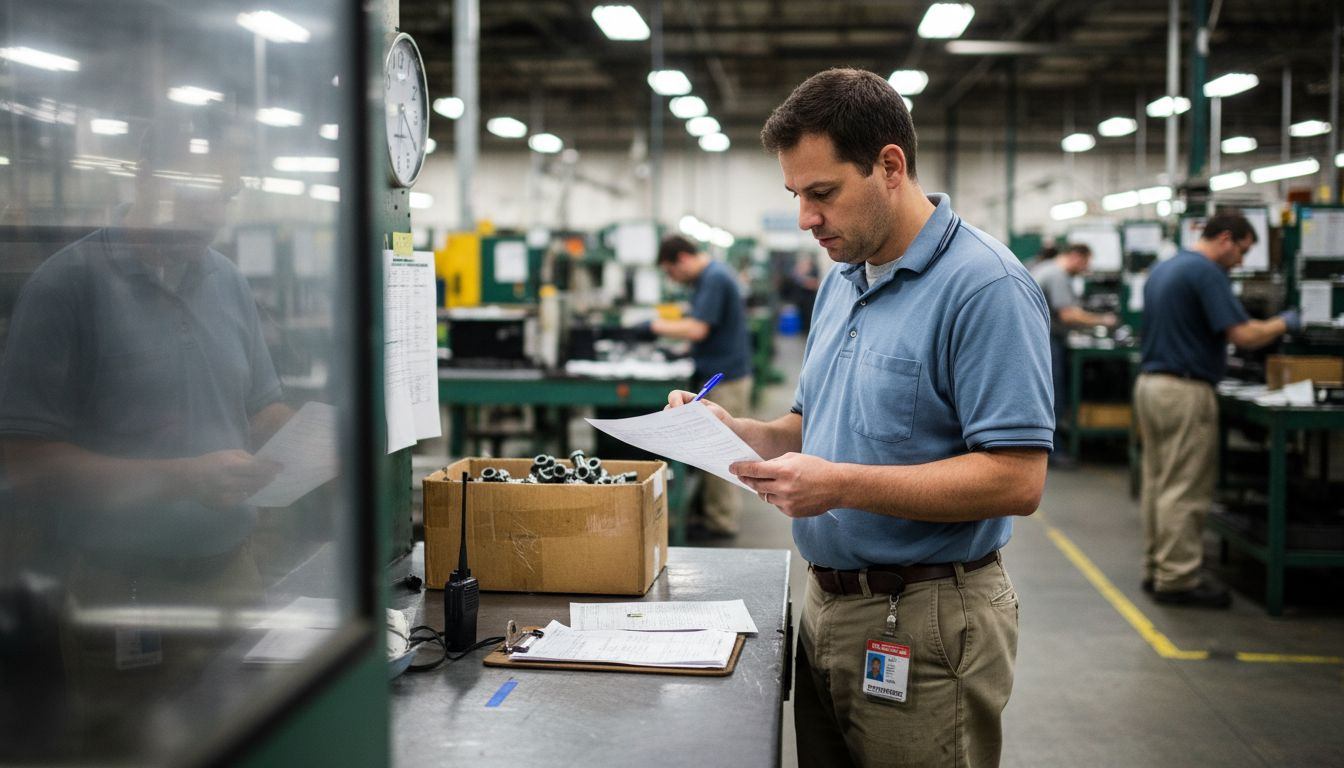
A Manufacturing Production Coordinator plays a critical role in streamlining complex operational workflows within manufacturing environments. These professionals serve as essential connectors between multiple departments, ensuring that production processes flow smoothly and efficiently. Their responsibilities extend far beyond simple scheduling, encompassing strategic resource management and cross-functional communication.
The core responsibilities of a Production Coordinator involve several key areas:
Managing production schedules and timelines
Coordinating resources across different departments
Tracking inventory levels and material requirements
Facilitating communication between production teams and management
Monitoring equipment and resource allocation
Identifying potential workflow bottlenecks
Production Coordinators are uniquely positioned to optimize manufacturing processes by acting as strategic intermediaries. They leverage their comprehensive understanding of production systems to minimize downtime, maximize productivity, and ensure that organizational targets are consistently met. Their role requires exceptional organizational skills, strong communication capabilities, and a nuanced understanding of manufacturing workflows.
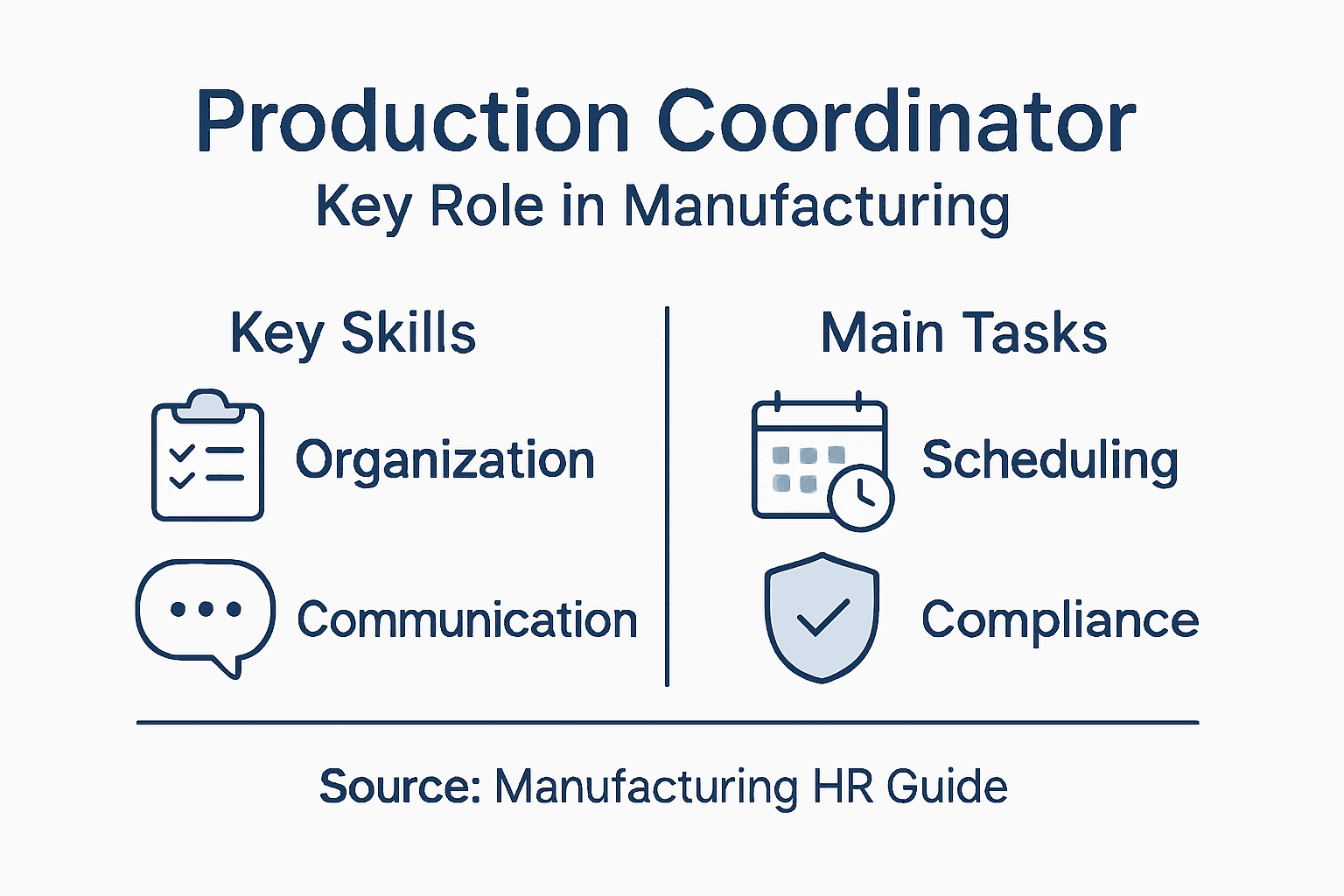
These professionals typically interact with multiple stakeholders, including production teams, supply chain managers, quality assurance personnel, and senior leadership. By maintaining clear communication channels and implementing strategic coordination techniques, Production Coordinators help transform complex manufacturing operations into streamlined, efficient systems.
The following table provides a quick reference of stakeholder interactions and their impact on production coordination:
Stakeholder Group | Typical Interaction | Impact on Production |
Production Teams | Daily workflow coordination | Ensures smooth operations |
Supply Chain Managers | Resource allocation | Minimizes delays |
Quality Assurance | Compliance checks | Maintains standards |
Senior Leadership | Strategic updates | Aligns objectives |
Pro tip: Develop strong cross-departmental communication skills and maintain detailed documentation to excel as a Production Coordinator.
This blog article is written by Pieter Nijssen, founder of Video Production Switzerland and an experienced video producer working across Switzerland. He delivers professional corporate and commercial video production for both international and local clients. Pieter is known for a reliable, stress-free production process and high production standards.
Key Responsibilities and Core Skills
A Production Coordinator must possess a comprehensive skill set to effectively manage complex manufacturing environments. Manufacturing production management requires a strategic blend of technical knowledge, interpersonal skills, and operational expertise.
Core responsibilities of a Production Coordinator typically include:
Developing and maintaining production schedules
Coordinating materials and resource procurement
Implementing quality control protocols
Managing inventory and supply chain logistics
Tracking production metrics and performance indicators
Facilitating interdepartmental communication
Ensuring compliance with safety and operational standards
The role demands a unique combination of analytical and interpersonal skills. Production Coordinators must effectively analyze complex production data, identify potential inefficiencies, and develop strategic improvement plans. Their ability to communicate effectively across multiple departments enables them to align production activities with broader organizational objectives.
Successful Production Coordinators are masters of coordination, transforming operational challenges into streamlined manufacturing processes.
Key skills required for this role include:
Advanced organizational capabilities
Strong analytical thinking
Excellent communication skills
Proficiency in data management software
Problem-solving expertise
Leadership and team coordination abilities
Pro tip: Develop comprehensive technical skills while maintaining strong interpersonal communication abilities to excel in production coordination.
This blog article is written by Pieter Nijssen, founder of Video Production Switzerland and an experienced video producer working across Switzerland. He delivers professional corporate and commercial video production for both international and local clients. Pieter is known for a reliable, stress-free production process and high production standards.
Essential Qualifications and Certifications
Production Coordinators require a strategic combination of educational credentials and professional certifications to succeed in complex manufacturing environments. Manufacturing job requirements typically encompass both academic preparation and specialized training.
Educational pathways for aspiring Production Coordinators include:
Bachelor’s degree in Business Administration
Supply Chain Management degree
Engineering degree
Manufacturing Management certificate
Associate’s degree in Industrial Technologies
Bachelor’s degree in Operations Management
While educational backgrounds vary, most employers seek candidates with specialized knowledge and demonstrated competencies. Professional certifications can significantly enhance a Production Coordinator’s marketability and career advancement potential. These credentials validate expertise and demonstrate commitment to continuous professional development.

Key professional certifications that can distinguish a Production Coordinator include:
Here is a summary table outlining how key professional certifications benefit a Production Coordinator’s career:
Certification | Skill Area Enhanced | Career Advantage |
CPIM | Inventory management | Higher efficiency, expertise |
PMP | Project leadership | Broader role opportunities |
Six Sigma (Green/Black Belt) | Process improvement | Streamlined operations |
Lean Manufacturing Certificate | Waste reduction | Increased productivity |
Quality Management Systems | Compliance and auditing | Regulatory readiness |
Certified in Production and Inventory Management (CPIM)
Project Management Professional (PMP)
Six Sigma Green/Black Belt
Supply Chain Professional Certification
Lean Manufacturing Certification
Quality Management Systems Certification
Professional certifications transform theoretical knowledge into verified, industry-recognized expertise.
Pro tip: Continuously update your certifications and pursue specialized training to remain competitive in the evolving manufacturing landscape.
This blog article is written by Pieter Nijssen, founder of Video Production Switzerland and an experienced video producer working across Switzerland. He delivers professional corporate and commercial video production for both international and local clients. Pieter is known for a reliable, stress-free production process and high production standards.
Workflow Management and Process Optimization
Workflow management represents a critical strategic function for Production Coordinators seeking to maximize manufacturing efficiency. Efficient factory management requires a systematic approach to understanding, analyzing, and continuously improving production processes.
Key strategies for effective workflow optimization include:
Mapping current production workflows
Identifying bottleneck points and inefficiencies
Implementing standardized work procedures
Utilizing data-driven performance metrics
Establishing clear communication protocols
Developing continuous improvement mechanisms
Integrating technology-enabled tracking systems
Successful workflow management demands a holistic perspective that balances human performance with technological capabilities. Production Coordinators must develop comprehensive strategies that integrate people, processes, and systems into a seamless operational framework. This approach requires constant monitoring, analysis, and adaptive problem-solving to maintain optimal manufacturing performance.
Effective workflow optimization transforms operational challenges into strategic opportunities for organizational growth.
Critical components of process optimization involve:
Detailed process documentation
Regular performance benchmarking
Cross-functional team collaboration
Technology integration
Lean manufacturing principles
Continuous skill development
Pro tip: Develop a systematic approach to workflow analysis, focusing on data-driven insights and incremental improvements.
This blog article is written by Pieter Nijssen, founder of Video Production Switzerland and an experienced video producer working across Switzerland. He delivers professional corporate and commercial video production for both international and local clients. Pieter is known for a reliable, stress-free production process and high production standards.
Risks, Compliance, and Legal Considerations
Production Coordinators carry significant responsibilities for managing legal and regulatory risks within manufacturing environments. Workplace safety compliance requires comprehensive understanding of complex legal frameworks and proactive risk management strategies.
Critical areas of legal and compliance focus include:
Workplace safety regulations
Environmental protection standards
Quality control requirements
Labor law compliance
Occupational health protocols
Equipment operation standards
Hazardous material handling guidelines
Documentation and reporting procedures
Effective risk management involves developing robust systems that anticipate potential legal challenges before they emerge. Production Coordinators must maintain meticulous documentation, implement comprehensive training programs, and establish clear communication channels with regulatory agencies. This proactive approach helps organizations mitigate potential legal vulnerabilities and maintain operational integrity.
Compliance is not a destination, but a continuous journey of vigilance and adaptation.
Key legal risk mitigation strategies involve:
Regular compliance audits
Staff training and certification programs
Comprehensive documentation systems
Proactive safety monitoring
Regular policy and procedure updates
Transparent reporting mechanisms
Pro tip: Develop a systematic approach to legal compliance by creating comprehensive checklists and maintaining rigorous documentation practices.
This blog article is written by Pieter Nijssen, founder of Video Production Switzerland and an experienced video producer working across Switzerland. He delivers professional corporate and commercial video production for both international and local clients. Pieter is known for a reliable, stress-free production process and high production standards.
Common Mistakes and How to Avoid Them
Production Coordinators face numerous potential pitfalls that can significantly disrupt manufacturing operations. Production management challenges require strategic awareness and proactive problem-solving skills to mitigate risks effectively.
Common mistakes that Production Coordinators must vigilantly avoid include:
Poor interdepartmental communication
Inadequate production scheduling
Insufficient inventory tracking
Neglecting equipment maintenance
Overlooking safety protocol compliance
Failing to implement continuous improvement strategies
Reactive instead of proactive problem management
Inconsistent performance documentation
Effective mistake prevention requires developing robust systems that anticipate potential operational disruptions. Production Coordinators must cultivate exceptional communication skills, maintain meticulous documentation, and consistently analyze performance metrics to identify and address potential issues before they escalate into significant problems.
Preventing mistakes is not about perfection, but about creating systematic approaches that minimize operational risks.
Key strategies for avoiding common production coordination errors include:
Implementing comprehensive communication protocols
Developing detailed contingency planning
Utilizing advanced tracking technologies
Conducting regular performance reviews
Investing in continuous staff training
Creating standardized operational procedures
Pro tip: Develop a culture of transparent communication and continuous learning to proactively identify and address potential operational challenges.
This blog article is written by Pieter Nijssen, founder of Video Production Switzerland and an experienced video producer working across Switzerland. He delivers professional corporate and commercial video production for both international and local clients. Pieter is known for a reliable, stress-free production process and high production standards.
Streamline Your Manufacturing Coordination with Expert Video Production Support
Managing complex workflows and coordinating multiple stakeholders is essential for any Production Coordinator striving to optimize manufacturing processes. Just like the detailed planning and seamless communication required in manufacturing, producing high-quality video content in Switzerland demands precise coordination of permits, trusted crews, equipment, and logistics. At Video Production Switzerland, we understand the critical nature of flawless execution to prevent delays and inefficiencies, much like a Manufacturing Production Coordinator ensures smooth operational flow.

Discover how partnering with a reliable local expert can remove stress from your production schedules, guarantee on-time delivery, and ensure every detail from scouting locations to transportation is managed professionally. Whether you are an international filmmaker or a brand aiming for a streamlined shoot, take the next step by exploring our full service offerings at Video Production Switzerland and see firsthand how strategic coordination and expert logistical management transform your project outcomes. Act now to secure your free consultation and start experiencing the seamless support crucial to your project’s success.
Frequently Asked Questions
What is the primary role of a Production Coordinator in manufacturing?
A Production Coordinator is responsible for streamlining manufacturing workflows, managing production schedules, coordinating resources, and facilitating communication between departments to ensure efficient operations.
What skills are essential for a successful Production Coordinator?
Key skills include advanced organizational capabilities, strong analytical thinking, excellent communication skills, problem-solving expertise, and leadership abilities. Proficiency in data management software is also important.
How does a Production Coordinator optimize manufacturing processes?
They optimize manufacturing processes by identifying bottlenecks, implementing standard procedures, utilizing data-driven metrics, and ensuring clear communication protocols across departments to streamline operations.
What educational qualifications are typically required for a Production Coordinator?
A bachelor’s degree in fields such as Business Administration, Supply Chain Management, or Operations Management is often required, along with specific certifications like CPIM, PMP, or Six Sigma to enhance career prospects.
Recommended
