
On-Location Support Switzerland for International Film Crews

TL;DR:
Effective Swiss on-location support relies on specialized local partners, early permit preparation, and flexible service contracts. Rapid response times in urban areas ensure minimal delays, but Alpine locations require pre-planned redundancies for continuity. Building strong, early relationships with vetted support teams enhances production success across Switzerland’s diverse linguistic and geographic regions.
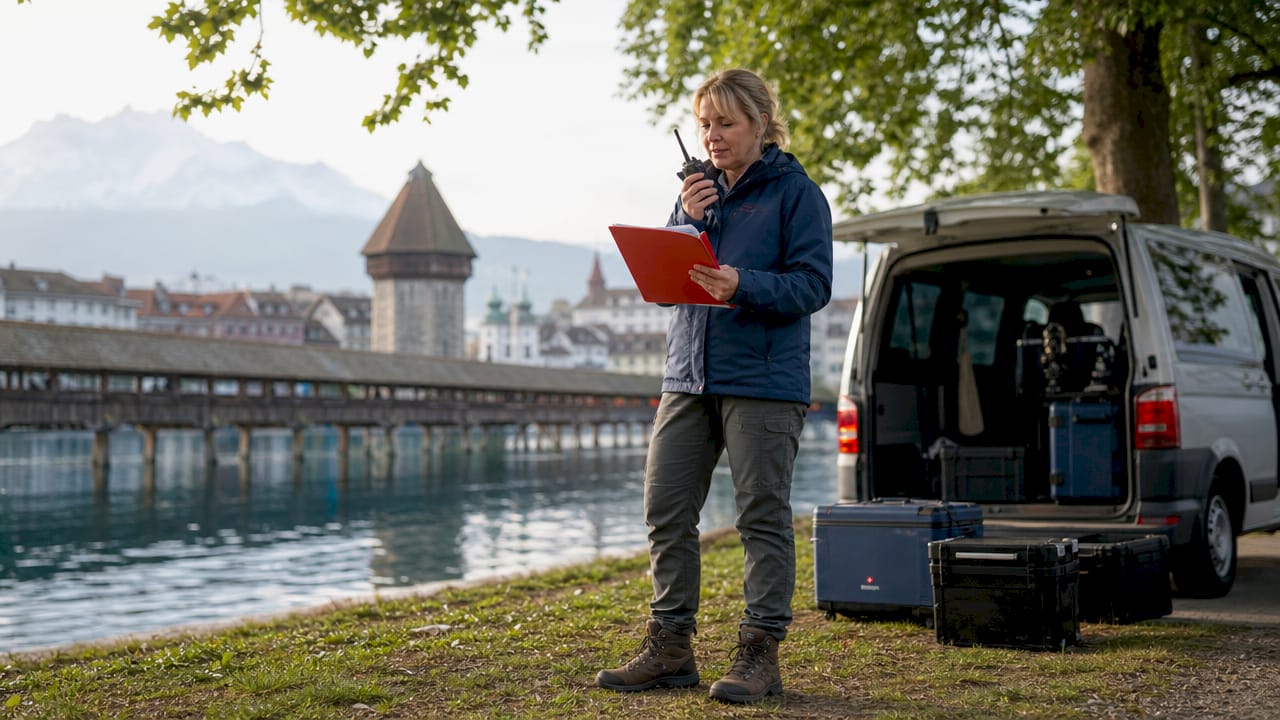
On-location support Switzerland is the expert, on-site logistical and technical assistance that international film crews depend on to keep shoots running without costly interruptions. The industry term for this discipline is “field support services,” covering everything from equipment maintenance and permit coordination to multilingual crew management and emergency response. Switzerland’s four linguistic regions, strict labor regulations, and precision-driven work culture make this support category far more specialized than what general logistics firms provide. Getting it right separates a smooth, on-schedule shoot from an expensive, stressful ordeal.
What types of on-location support services are essential for film productions in Switzerland?
Field support services in Switzerland fall into four core categories, each addressing a distinct production risk. Understanding what each covers helps you plan your budget, your timeline, and your vendor relationships before you land at Zurich Airport.
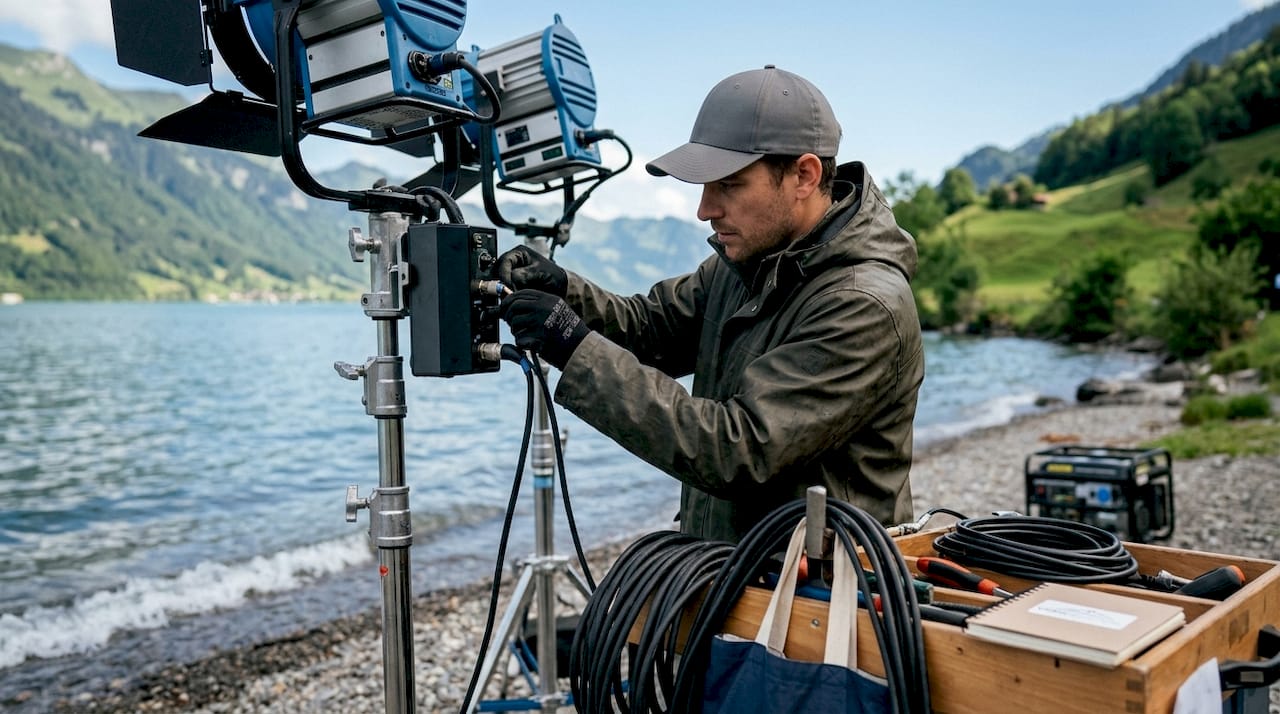
Technical field support covers camera systems, lighting rigs, sound equipment, and IT infrastructure on set. Providers like AWSMTECH offer SmartHand IT services that deploy certified technicians to your location, handling hardware troubleshooting and network issues without requiring you to ship specialists from abroad. Booking standard technical maintenance typically requires a lead time of 2 to 3 months, though emergency repairs can often be arranged on shorter notice. That gap matters enormously for productions that finalize Swiss shoot dates late in the pre-production cycle.
Logistical coordination support handles permits, transportation routing, and vendor sourcing across Swiss cantons. Each canton operates its own filming permit process, and what works in Geneva does not automatically apply in Bern or St. Gallen. Local partners with established relationships inside cantonal administrations cut approval times significantly.
Emergency and rapid-response support is the safety net every production needs but hopes never to use. Swiss urban IT and technical support providers typically guarantee response times of 1 to 4 hours for urgent issues in cities like Zurich and Winterthur. That window is tight enough to resolve most equipment failures before they consume a full shoot day.
Flexible infrastructure support covers location-independent data and connectivity solutions. Providers using data centers in Aarau can deliver long-term logistical support without requiring you to maintain local physical servers, which is a practical advantage for productions running multi-week shoots across different Swiss regions.
Technical field support: equipment, IT, and hardware maintenance
Logistical coordination: permits, transport, and vendor management
Emergency response: rapid technician deployment within 1 to 4 hours
Flexible infrastructure: location-independent data and connectivity
Pro Tip: Book your technical support vendor at least 10 weeks before your first shoot day in Switzerland. Emergency slots exist, but they cost significantly more and are not guaranteed during peak production seasons in summer and early autumn.
How does Swiss local expertise elevate production support compared to general logistics providers?
Swiss local expertise is not a marketing phrase. It is a measurable operational advantage rooted in regulatory knowledge, multilingual communication, and a precision standard that general logistics firms simply do not replicate.
Switzerland has four official languages: German, French, Italian, and Romansh. Effective team leaders for Swiss site support must identify location-specific risks and coordinate across these linguistic regions to keep operations smooth. A logistics firm based in London or Los Angeles that has never managed a shoot in Ticino will not know that Italian-speaking canton officials expect a different communication register than their German-speaking counterparts in Zurich. That cultural gap creates delays, misunderstandings, and occasionally permit rejections.
Swiss technical support providers like GF Service Maschinen GmbH demonstrate how Swiss precision and technology combine to define support quality in high-stakes environments. Their approach merges traditional Swiss engineering standards with technology-driven solutions, producing a reliability benchmark that general logistics providers cannot match without years of local investment.
The table below compares specialized Swiss field support partners against general logistics firms on the dimensions that matter most to production teams:
Dimension | Specialized Swiss partner | General logistics firm |
Permit knowledge | Canton-specific, current | Generic or outdated |
Language capability | German, French, Italian on demand | English only or limited |
Technical response time | 1 to 4 hours in urban hubs | 24 to 48 hours typical |
Regulatory compliance | Swiss labor law expertise | Unfamiliar with local rules |
Equipment sourcing | Local vendor network | International shipping required |
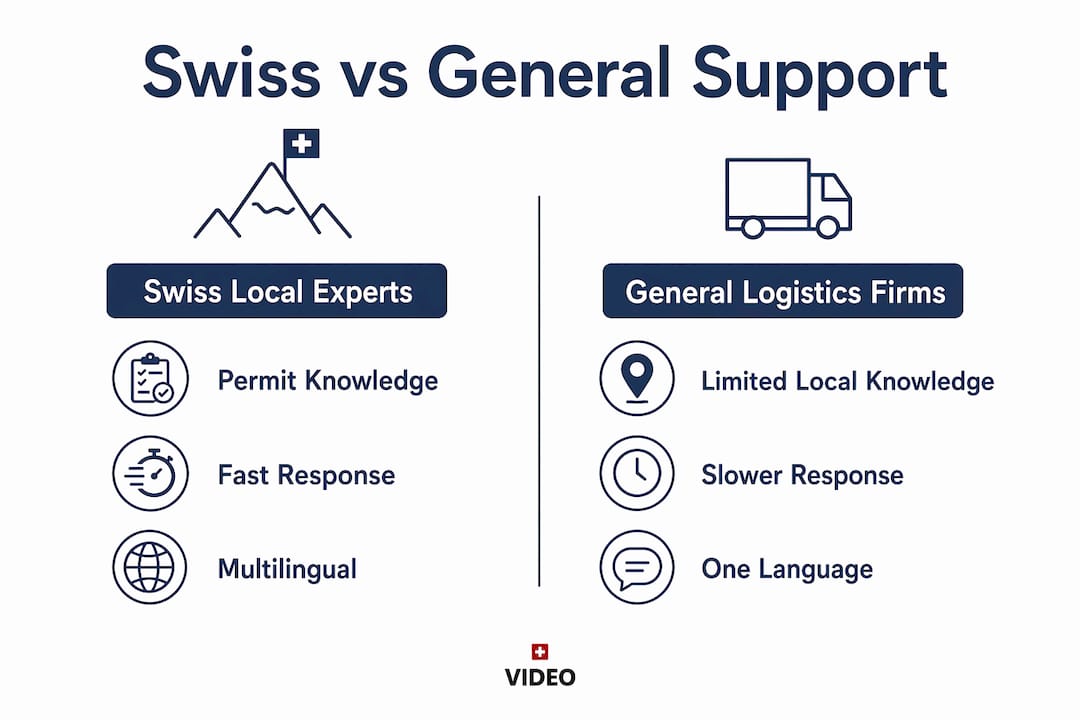
The response time gap alone justifies choosing a specialized partner. A 24-hour delay waiting for an overseas technician costs far more than the premium a local Swiss provider charges.
Pro Tip: When vetting a Swiss support partner, ask specifically which cantons they have active permit relationships in. A provider with documented experience in Zurich, Vaud, and Ticino covers the three most common international shoot locations and signals genuine local depth.
What are the best practices for securing reliable onsite assistance in Switzerland?
Preparation is the single biggest factor separating productions that run smoothly in Switzerland from those that spend their first week firefighting administrative problems. The following steps reflect what experienced international crews have learned through trial and expensive error.
Confirm work permits and driving licenses before departure. Swiss work permits and local driving licenses are mandatory for on-site teams, and most Swiss providers do not sponsor permits. Your crew members and contracted technicians must hold valid documentation before they arrive. Processing times vary by nationality and canton, so start this process at least three months ahead.
Book technical and maintenance support with adequate lead time. Standard specialized field support requires booking 2 to 3 months in advance. If your production schedule is confirmed, lock in your technical support vendor immediately. Waiting until six weeks out risks losing your preferred provider to another production.
Use time credit or hour bundle contracts for scalable coverage. Flexible hour bundle contracts allow productions to scale support services up or down without lengthy renegotiation. If your shoot extends by three days or you need an extra technician for a complex sequence, you draw from your existing credit rather than drafting a new agreement under time pressure.
Clarify bring-in versus onsite service modes upfront. Bring-in repair services where equipment is dropped at a local hub can resolve issues faster than waiting for a technician to travel to your set. Confirm which mode your provider defaults to and whether onsite dispatch is available at your specific locations.
Consider an IT team as a service model for multi-week productions. The IT team as a service model reduces administrative overhead and delivers on-demand multilingual expert support without the complexity of hiring local staff directly. For productions running four weeks or longer, this model eliminates the HR burden while keeping technical coverage consistent.
Map your shoot locations against support hub proximity. Zurich, Winterthur, Basel, and Geneva all have established local support infrastructure. Remote Alpine locations require advance planning for extended response windows. Build that buffer into your production schedule rather than discovering it on shoot day.
How do response times and support infrastructure affect production continuity?
Production continuity in Switzerland depends directly on how fast your support team can reach you and resolve a problem. A broken camera rig or a failed network connection does not pause the Swiss weather or your location permit window.
Swiss urban IT and technical support providers in cities like Zurich and Winterthur guarantee response times within 1 to 4 hours for urgent issues. That speed is achievable because these providers maintain local technician hubs rather than dispatching from regional centers. The practical implication for your production is that a critical equipment failure at 7 a.m. can be resolved before your first scheduled shot at 10 a.m.
Combining remote monitoring with fast on-site interventions via local technician hubs optimizes uptime and minimizes costly shoot delays. Remote diagnostics can identify the nature of a problem before a technician departs, meaning they arrive with the right parts and the right expertise rather than making a preliminary assessment visit first.
The table below shows typical support response windows across Swiss production hubs:
Location | Typical response window | Support hub proximity |
Zurich | 1 to 2 hours | High density of local providers |
Winterthur | 1 to 3 hours | Strong IT and technical coverage |
Geneva | 1 to 3 hours | French-speaking specialist availability |
Basel | 2 to 4 hours | Cross-border logistics advantage |
Alpine regions | 4 to 8 hours | Advance planning required |
Productions shooting in Alpine locations face the widest response windows. The practical solution is to carry redundant equipment for critical systems and pre-position a technician on location for shoot days that cannot tolerate delays. This is a cost that experienced productions build into their Swiss budgets from the start, not a surprise discovered mid-shoot.
Key takeaways
Reliable on-location support in Switzerland requires specialized local partners, advance permit preparation, flexible service contracts, and a clear understanding of response time realities across Swiss urban and Alpine locations.
Point | Details |
Book support early | Standard technical field support requires 2 to 3 months lead time; do not wait until pre-production is complete. |
Verify permits before arrival | Swiss work permits and local driving licenses are mandatory and providers do not sponsor them. |
Use hour bundle contracts | Time credit contracts let you scale support up or down without renegotiating under pressure. |
Choose local over general | Specialized Swiss partners offer 1 to 4 hour response times and canton-specific permit knowledge that general firms cannot match. |
Plan for Alpine delays | Remote locations require redundant equipment and pre-positioned technicians to maintain production continuity. |
What I have learned about Swiss production support after two decades in the field
After more than 20 years working with international productions in Switzerland, the pattern I see most often is this: crews arrive with excellent creative plans and underestimated logistical ones. They assume that Switzerland, being a wealthy, well-organized country, will simply work. It does work, but only if you understand its rules.
The multilingual reality catches more productions off guard than any other factor. A crew that managed a smooth shoot in Zurich will sometimes assume the same contacts and communication style will carry them through a Lugano shoot two weeks later. It will not. Ticino operates on Italian time, Italian professional norms, and Italian-language permit processes. That is not a criticism. It is simply a fact that requires preparation.
What I have found actually works is building your Swiss support team the same way you build your creative team: with specific vetting, clear contracts, and early engagement. The productions I have seen run without major disruption are the ones that treated their local support partner as a co-producer, not a vendor. They shared their shot lists, their location plans, and their contingency scenarios. In return, they got support teams that anticipated problems rather than reacting to them.
You can explore how other international crews have handled common production challenges in Switzerland to see what preparation actually looks like in practice.
— Pieter
Plan your Swiss shoot with a trusted local partner
International productions need more than a contact list. They need a partner who has already solved the problems you have not encountered yet.
[
Videoproductionswitzerland provides full-service on-location support for international crews shooting across Switzerland, covering permits, crew sourcing, equipment logistics, transportation, and on-set coordination. With over 20 years of Swiss production experience, the team handles the details that derail shoots so you can stay focused on your creative work. Whether you are planning a single shoot day in Zurich or a three-week multi-location production across the Alps, the process starts with a free consultation. Explore Swiss video production services or review production costs and packages to understand exactly what your budget covers before you commit.
FAQ
What does on-location support in Switzerland include?
On-location support in Switzerland covers technical field services, permit coordination, equipment logistics, multilingual crew management, and emergency response. Specialized providers handle both onsite and bring-in service modes depending on urgency and location.
How far in advance should I book field support services in Switzerland?
Standard specialized technical support requires booking 2 to 3 months ahead. Emergency support can often be arranged on shorter notice, but availability is not guaranteed and costs are higher during peak production periods.
What response times can I expect from Swiss technical support providers?
Urban support hubs in Zurich, Winterthur, and Geneva typically guarantee response times of 1 to 4 hours for urgent issues. Alpine and remote locations require longer windows, often 4 to 8 hours, making redundant equipment planning necessary.
Do international crew members need Swiss work permits?
Yes. Swiss work permits and local driving licenses are mandatory for on-site crew and technicians. Most Swiss support providers do not sponsor permits, so international productions must secure documentation independently before the shoot begins.
What is a time credit contract and why does it matter for productions?
A time credit or hour bundle contract lets you pre-purchase a block of support hours that you draw from as needed. This model allows you to scale technical and logistical support up or down without renegotiating contracts under time pressure during a live shoot.
Recommended
