
Equipment Rental for Film Crews: A Practical U.S. Guide


The fastest, lowest-risk route to professional gear in the U.S. is to reserve early, confirm your Inland Marine or equivalent insurance certificate before pickup day, and work with a local production partner for logistics coordination. For international productions, that last step is where things most often go sideways.
Lead times by category: specialty cinema cameras and lenses, several weeks to a few months; standard cinema packages, several weeks; lighting and grip trucks, a few weeks; audio and sound gear, about a week or two.
Insurance verification: rental houses require a certificate of insurance before releasing gear. Without an active annual production policy, you will be pushed into per-rental waivers that cost more and slow down pickup.
Local production partner: Videoproductionswitzerland coordinates gear logistics, permits, and vendor communication for international crews, removing the friction of managing U.S. rental houses from abroad.
Pro Tip: Submit your insurance certificate to the rental house at least 48 hours before pickup. It is the single step most likely to delay your shoot if left to the morning of.
Table of Contents
What are your insurance options, and when does an annual policy pay off?
What does equipment rental actually cost beyond the base rate?
What do rental houses provide on set, and what must your crew supply?
Why international producers underestimate U.S. rental logistics
Videoproductionswitzerland handles the logistics so your crew can focus on the shoot
What should you book first, and how far ahead?
Start with your camera and lens package. Specialty glass, anamorphics, and high-end cinema bodies from houses like Panavision or Lensrentals move fast, especially around award-season and summer commercial peaks.
Booking priority order:
Specialty cameras and lenses: several weeks to a few months out
Standard cinema camera packages: several weeks out
Lighting and grip trucks: a few weeks out
Sound and audio packages: about a week or two out
Power distribution and expendables: 1 week out
Pre-booking checklist:
Confirm live stock availability online before calling (many houses now offer real-time inventory tracking)
Verify crew availability for pickup and tech support on the same days
Add a 2-day buffer for international shipments or customs clearance
Cross-check all serial numbers against your gear list before signing the reservation
How does the rental-house workflow actually run?
The standard process follows four steps: Reservation, Insurance verification, Pickup/Delivery with inspection, and Return with final technician inspection. Rental houses follow this cycle consistently, and knowing each stage prevents last-minute surprises.
Reservation: Submit your gear list, confirm availability, and pay a deposit (typically a credit card hold).
Insurance verification: Provide your certificate of insurance. The rental house confirms coverage limits before releasing gear.
Pickup/Delivery and inspection: A technician powers on and checks every item. You sign a condition report. Delivery fees apply if the house ships to your location.
On-set support: Some houses supply on-set technicians by contract. Confirm this at booking, not on shoot day.
Return and final inspection: The technician re-inspects all gear. The deposit hold is released only after inspection clears.
Pro Tip: Photograph every item at pickup with timestamps. A signed condition report plus your own photos is the fastest way to resolve any deposit dispute at return.
What are your insurance options, and when does an annual policy pay off?
For multi-day, high-value shoots, an active annual production policy with Inland Marine coverage is almost always cheaper and less disruptive than buying per-rental waivers. Productions without annual insurance are typically pushed into short-term options that cost more per day and add administrative friction at pickup.
Coverage type | Cost profile | Coverage limits | Admin friction | Best for |
Per-rental waiver | Higher per-day cost | Usually capped, gear-specific | High (new paperwork each rental) | One-off, low-value rentals |
Short-term rental insurance | Moderate, variable | Broader than waivers | Moderate | Short projects, occasional shoots |
Annual production policy (Inland Marine) | Lower per-day over time | High, customizable | Low (one certificate, reused) | Multi-day, high-value, repeat shoots |
Pro Tip: Ask your rental house for their exact insurance verification procedure before your shoot week. Some require the certificate to name the rental house as an additional insured, which takes a day to arrange with your broker.
How do you choose the right rental house for your shoot?
Prioritize support level over rate for any complex or multi-day production. Inventory depth and on-set support are the main reasons productions return to the same vendor, not price alone.
Decision criteria:
Inventory depth and condition of gear
Live stock tracking and online booking availability
On-set technician availability and day rates
Delivery radius, fees, and turnaround windows
Deposit policies and credit card hold amounts
Responsiveness to international logistics and customs questions
Questions to ask any rental house before booking:
What does your insurance verification process require, and how long does it take?
Do you provide condition reports at pickup and return?
What is your policy on last-minute gear swaps or substitutions?
Do you offer on-set technicians, and what are their rates?
What happens if gear is returned late or damaged?
The trade-off between booking channels is real. Peer-to-peer platforms offer flexibility but variable support. National rental houses give you reliable inventory and technicians. Studio and production-facility rental departments offer integrated lot support but often require a production affiliation.
What does equipment rental actually cost beyond the base rate?
Expect to budget a significant amount above base rental fees for logistics and support on multi-day or complex shoots. Hidden logistics and technician fees frequently make the total cost materially higher than the rate card suggests.
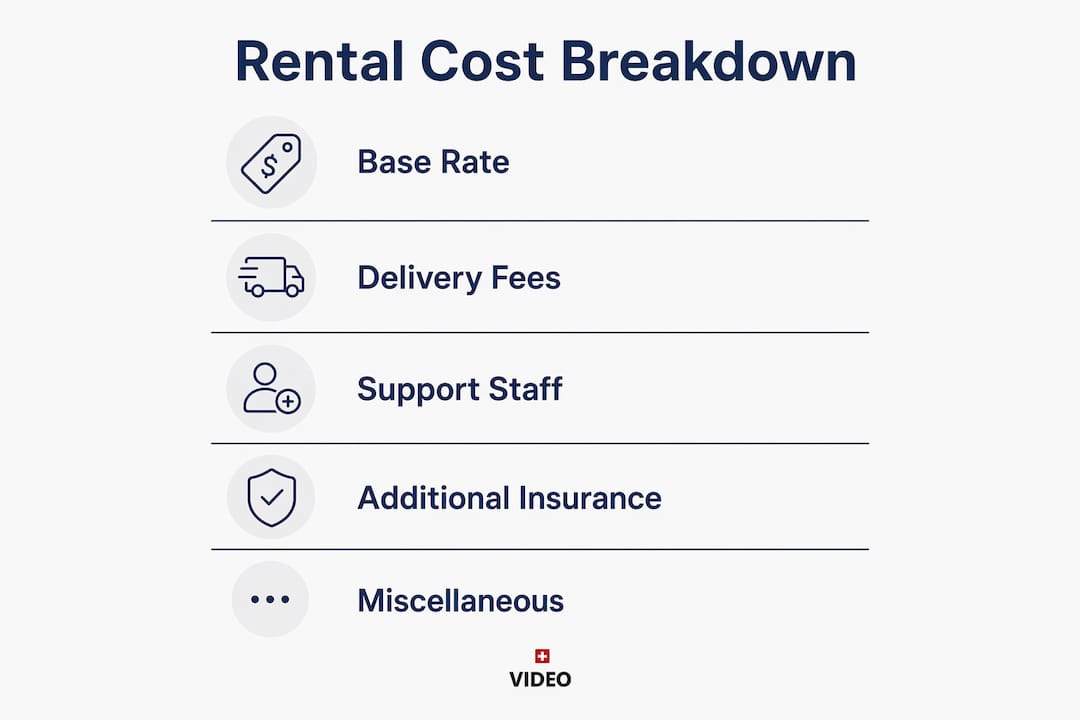
Cost component | Notes |
Daily/weekly rental rate | Base fee per item or package |
Delivery and pickup fees | Varies by distance and truck size |
Technician day rate | Required for some full-service packages |
Insurance waiver or certificate processing | Per-rental or annual policy cost |
Deposit/credit card hold | Released after return inspection |
Cleaning and maintenance fee | Applied if gear is returned dirty or damaged |
Taxes | State-dependent; confirm at booking |
Overnight courier or customs fees | Relevant for shipped or cross-border gear |
For a 3-day commercial shoot, a base camera package can realistically increase substantially once delivery, a technician day, insurance, and taxes are added. Budget for it from day one.
What do rental houses provide on set, and what must your crew supply?
Full-service rental providers can supply pre-loaded grip trucks, power distribution, and on-site rigging expertise. That saves hours of setup time. But not every house will send a dedicated technician unless you contract one explicitly.
Choosing equipment only on specifications rather than compatibility and support is the most common rental mistake. The best rental houses offer creative support, helping test compatibility and preventing on-set failures before they happen.
What rental houses typically provide:
Kit builds and pre-rigged packages
Power distribution and cable setups
Hot-swap replacement gear for critical failures
On-set technicians (contracted separately)
Test kits and pre-shoot gear checks
What your crew must supply:
Department leads (DP, gaffer, sound mixer)
Consumables (batteries, tape, gels, expendables)
Production liability insurance
Crew transport and catering
A local production coordinator bridges the gap between what the rental house delivers and what your crew needs on the ground, especially when you are managing logistics from another country.
Where should you book gear in the U.S.?
Three booking channels cover most productions: peer-to-peer marketplaces, national rental houses with online stock tracking, and studio or production-facility rental departments.
Channel comparison:
P2P platforms (e.g., ShareGrid): flexible pricing, wide geographic reach, but support and condition standards vary by owner.
National rental houses (e.g., Adorama Rentals, Lensrentals, Rentex): reliable inventory, technician support, standardized insurance processes.
Studio/production-facility departments (e.g., Warner Bros. Studios): integrated lot support, but typically require a production affiliation or studio relationship.
Evaluation dimensions for any provider:
Insurance and damage coverage options
Support level and on-set technician services
Delivery and pickup options and fees
Deposit requirements and hold policies
Real-time inventory tracking capability
Rate structure and cleaning/maintenance policy
Pickup, delivery, and return: what to check every time
Always do a joint condition inspection with the rental technician and document everything with timestamped photos and a signed condition report. Large rental houses require technician-led inspections at both pickup and return before releasing deposit holds.
Pickup checklist:
Verify serial numbers against the rental agreement
Power on and function-test every item
Check for cosmetic and functional damage
Confirm all accessories, cables, and spares are present
Get the technician’s direct contact for on-set issues
Confirm the expected return inspection window
Return checklist:
Clean and pack gear to rental house standards
Allow extra time for technician inspection (do not schedule a flight immediately after drop-off)
Get written confirmation of inspection completion and deposit release timeline
Plan buffer time for the day of return. Late returns and multi-source returns cause delays because each rental house performs its own technician inspection before releasing deposits.
Key Takeaways
Securing professional equipment rental for film crews in the U.S. requires early reservations, confirmed Inland Marine insurance, and a clear budget that accounts for logistics, technician fees, and inspection buffers.
Point | Details |
Book specialty gear early | Reserve specialty cameras and lenses several weeks to a few months out; standard packages several weeks out. |
Confirm insurance first | An annual production policy with Inland Marine coverage costs less per day than per-rental waivers on multi-day shoots. |
Budget 20% above base rates | Delivery, technician fees, taxes, and deposits routinely push total costs well above the rate card. |
Inspect at pickup and return | Timestamped photos and a signed condition report protect your deposit and prevent disputes. |
Use a local production partner | Videoproductionswitzerland coordinates gear logistics, permits, and vendor communication for international crews shooting in the U.S. |
Why international producers underestimate U.S. rental logistics
The conventional wisdom says: find the best gear at the best rate and book it. That works fine for a local crew that already has vendor relationships, an insurance broker on speed dial, and a line producer who knows which rental house answers the phone at 6 AM. For international productions, especially those coordinating from Switzerland or elsewhere in Europe, the gap between “gear is booked” and “gear is on set and working” is where productions get hurt.
The insurance step alone can stall a pickup by a full day if your certificate does not name the rental house correctly as an additional insured. Deposit holds can tie up a substantial deposit hold on a credit card that may not have the headroom if you are working in a foreign currency. And return-day logistics, where every house runs its own inspection before releasing funds, can cascade into missed flights and extended hold charges.
The producers who handle U.S. rentals smoothly are not necessarily the ones with the biggest budgets. They are the ones who treat the rental workflow as a production department in its own right, with its own lead times, its own paperwork, and its own day-of-return buffer built into the schedule. Check the video production costs page for a realistic budget framework before you finalize any gear list.
Videoproductionswitzerland handles the logistics so your crew can focus on the shoot
International productions coordinating U.S. equipment rentals from Switzerland face a specific problem: the time zone gap, the vendor relationships, and the insurance paperwork all need someone on the ground who knows how U.S. rental houses actually operate. Videoproductionswitzerland fills that role directly, managing gear coordination, permit handling, vendor communication, and logistics so your production arrives on set ready to work, not still sorting out paperwork.
[
With over 20 years of experience supporting international shoots, Videoproductionswitzerland takes the coordination burden off your plate: sourcing trusted rental vendors, confirming insurance compliance, managing delivery schedules, and handling last-minute swaps when something goes wrong on set. You get reliable execution without juggling vendors across multiple time zones. Contact the team at videoproductionswitzerland.com to start planning your next U.S. production.
Useful sources and next steps
Recommended resources:
Videoproductionswitzerland: full-service production coordination for international crews
Video production costs and budget guidance: sample cost frameworks for international shoots
Panavision: cinema camera and lens rental with global facilities
Lensrentals: national rental house with online stock tracking and condition reports
Adorama Rentals: step-by-step rental process guide including insurance verification
Sunbelt Rentals Film & TV: full-service grip, power, and rigging for large productions
What to ask before you reach out to any rental house:
Is your insurance verification process documented, and how long does it take?
Do you offer live stock availability online?
What is your policy on technician support and last-minute substitutions?
What deposit hold amount should I plan for?
Do you handle delivery to remote or non-studio locations?
Pro Tip: Use the rental house’s online booking system to confirm live availability before calling. It saves time and gives you a paper trail for the reservation.
Recommended
