
Find reliable local job recruitment agencies for film crews in Switzerland 2026


Many international filmmakers arrive in Switzerland assuming any recruitment agency can supply qualified film crews. This misconception often leads to mismatched hires, production delays, and budget overruns. Switzerland’s film industry ecosystem relies on specialized local recruitment agencies, film commissions, and fixers who understand the unique demands of video production. Unlike standard staffing firms focused on permanent corporate roles, these specialized partners connect you with verified local crews experienced in short-term creative projects. This guide clarifies how to identify and engage the right local recruitment resources to ensure your Swiss shoot runs smoothly from pre-production through wrap.
Table of Contents
Understanding The Unique Role Of Local Recruitment Agencies For Film Production In Switzerland
Effective Methodologies For Sourcing Local Film Production Crews In Switzerland
Selecting The Right Local Recruitment Partners: Film Commissions, Fixers, Or General Recruiters?
Practical Tips For International Filmmakers When Engaging Swiss Local Job Recruitment Agencies
Streamline Your Swiss Film Production With Expert Local Support
Key takeaways
Point | Details |
Film commissions offer free crew connections | They facilitate over 600 annual productions with tailored local crew access and logistical support. |
General recruiters lack film expertise | Standard agencies focus on permanent finance and IT roles, risking crew skill mismatches for productions. |
Specialized fixers excel in complex shoots | They provide essential on-the-ground expertise for challenging alpine locations and weather-sensitive projects. |
Database sourcing improves efficiency | Centralized verified crew databases and vendor management systems boost hiring speed and reduce administrative burden. |
Local Swiss resources ensure success | Leveraging film-specific partners optimizes crew quality, reliability, and cultural fit for international shoots. |
Understanding the unique role of local recruitment agencies for film production in Switzerland
Standard recruitment agencies in Switzerland primarily serve corporate clients seeking permanent employees in finance, IT, and administrative sectors. Their databases contain accountants, software developers, and office managers, not camera operators, gaffers, or production assistants. When international filmmakers contact these general recruiters for crew needs, they encounter fundamental mismatches in expertise and service models.
Film crew hiring demands differ dramatically from corporate recruitment. Productions require short-term contracts spanning days or weeks, not permanent placements. Creative roles need specialized technical skills that general recruiters cannot assess accurately. A Switzerland video production guide emphasizes the importance of understanding these distinctions before engaging local partners.
The Zurich Film Commission connects producers with local crews free of charge for over 600 annual productions. These film commissions maintain relationships with verified local professionals across all production departments. They understand union rules, typical day rates, and crew availability patterns specific to the Swiss film industry. Their services include location scouting support, permit assistance, and connections to equipment rental houses.
Specialized fixers fill another critical niche in Switzerland’s recruitment ecosystem. These professionals offer on-the-ground expertise for challenging shoots in alpine regions, navigating weather unpredictability and remote location logistics. A fixer experienced with mountain filming knows which local crews handle altitude work comfortably and which equipment suppliers stock gear suitable for extreme conditions.
Pro Tip: Always verify a recruitment partner’s film-specific experience by requesting references from recent video productions they supported, not just corporate staffing success stories.
Key differences between recruitment partner types include:
Film commissions provide free services funded by regional tourism and economic development budgets
Fixers charge fees but deliver hands-on logistical management and problem-solving during shoots
General recruiters focus on permanent placements with different fee structures unsuitable for temporary crew hires
Specialist film recruiters exist but remain rare in Switzerland compared to commission and fixer options
Effective methodologies for sourcing local film production crews in Switzerland
Database sourcing forms the foundation of efficient crew recruitment in Switzerland. Film commissions and specialist agencies maintain centralized databases containing verified information about local crew members, their skills, availability, and past project experience. This approach eliminates the time-consuming process of cold-calling individual freelancers or posting generic job ads that attract unqualified applicants.

Headhunting targets highly specialized or critical roles where the talent pool remains small. For example, finding a Swiss-based underwater cinematographer or a drone pilot certified for alpine flying requires direct outreach to known specialists. Recruiters leverage industry networks and personal relationships to identify and approach these niche professionals who may not actively monitor job boards.
Pre-shoot calls dramatically reduce mis-hires and last-minute surprises. Before finalizing crew contracts, experienced recruiters conduct phone or video interviews to confirm availability, clarify project expectations, and assess communication skills. These conversations reveal potential red flags like scheduling conflicts or mismatched experience levels that written resumes might obscure. A detailed budgeting Swiss video productions resource highlights how proper crew vetting prevents costly on-set replacements.
Vendor management systems (VMS) streamline temporary hiring administration. Swiss staffing using VMS systems achieve 66% admin efficiency gains, adaptable to temp crew hires for film shoots. These platforms automate contract generation, timesheet tracking, and payment processing, reducing the administrative burden on production managers who would otherwise handle paperwork manually.
Combining these methodologies creates a robust recruitment process:
Search centralized databases for qualified candidates matching specific role requirements
Conduct headhunting outreach for specialized positions not filled through database searches
Schedule pre-shoot calls with top candidates to verify fit and availability
Use VMS platforms to manage contracts and payments efficiently once crew is confirmed
Maintain backup candidate lists in case of last-minute cancellations or emergencies
Pro Tip: Request that your recruitment partner provide at least two qualified candidates per critical role, giving you options if your first choice becomes unavailable.
Methodology | Best Use Case | Efficiency Gain |
Database sourcing | Standard crew roles with large talent pools | High speed, broad reach |
Headhunting | Specialized skills, small talent pools | Targeted quality, slower |
Pre-shoot calls | All hires to verify fit and availability | Reduces mis-hires significantly |
VMS platforms | Administrative efficiency for temp contracts | 66% admin time reduction |
The video production Switzerland guide provides additional context on how these methodologies integrate with broader production planning processes.
Selecting the right local recruitment partners: Film commissions, fixers, or general recruiters?
Film commissions represent the ideal first contact point for most international productions shooting in Switzerland. These government-supported organizations offer free services including crew connections, location scouting assistance, and permit guidance. They maintain relationships with verified local professionals across all production departments and understand regional filming regulations. Their funding model means no fees burden your production budget.
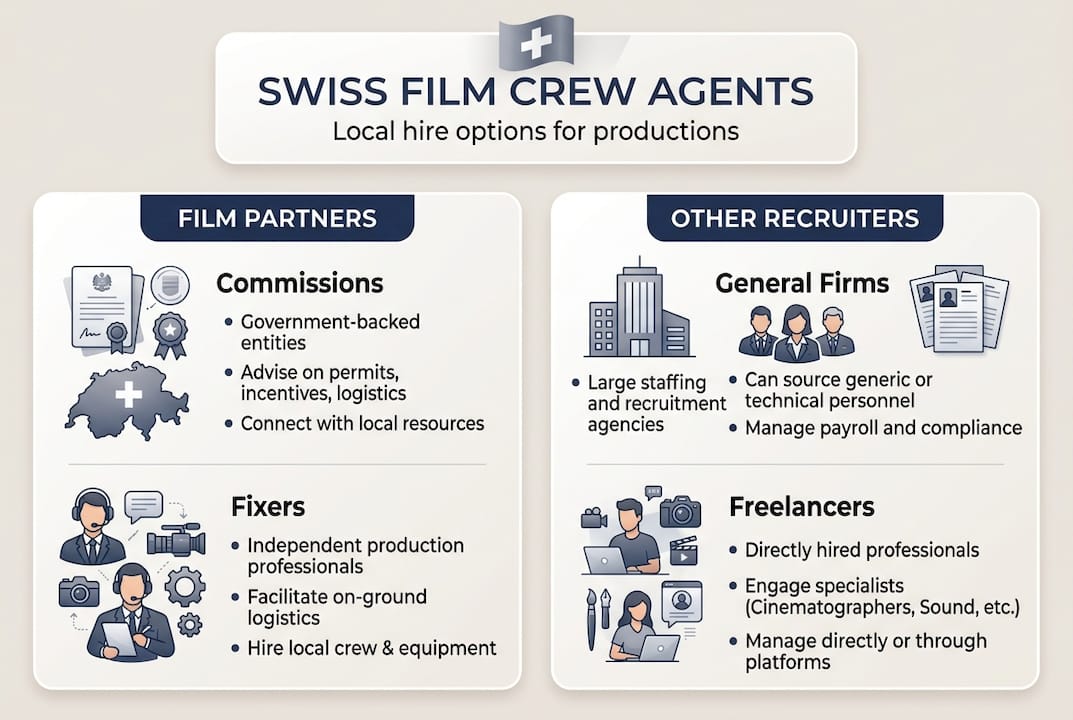
Fixers provide hands-on expertise for challenging shoots requiring on-the-ground problem-solving. If your production involves alpine locations, unpredictable weather, or complex logistics, a fixer’s local knowledge becomes invaluable. They navigate relationships with local authorities, secure last-minute equipment replacements, and adjust schedules when conditions change. Fixers charge fees reflecting their active involvement throughout your shoot.
General recruiters focus on permanent corporate placements and lack film industry insight. General recruiters excel in permanent finance and IT roles but lack film-specific crew expertise, risking mismatches. Their databases contain office professionals, not camera operators or sound mixers. Their fee structures assume long-term placements, making them economically unsuitable for temporary crew hires spanning days or weeks.
Choosing incorrectly between these partner types creates predictable problems. Hiring through a general recruiter might deliver a candidate with an impressive resume who lacks practical set experience. The person knows photography theory but cannot troubleshoot a camera malfunction under time pressure. Such mismatches cause production delays, crew tension, and budget overruns as you scramble for replacements.
Local film-specific partners optimize crew quality, reliability, and cultural fit. They understand Swiss work culture, typical communication styles, and professional expectations within the local film industry. This knowledge helps them match international productions with crews who adapt smoothly to your working methods while bringing valuable local perspective.
Partner Type | Strengths | Limitations | Best For |
Film commissions | Free services, broad crew networks, permit help | Limited hands-on involvement during shoots | Most productions needing crew connections |
Fixers | On-ground expertise, active problem-solving, local relationships | Charge fees, focus on logistics over pure recruitment | Complex shoots, alpine locations, weather challenges |
General recruiters | Large databases, established processes | No film expertise, unsuitable fee structures | Not recommended for film crew hiring |
The Swiss film crew comparison offers deeper analysis of crew quality variations across different sourcing approaches.
Key selection criteria include:
Project complexity: Simple shoots favor film commissions, complex productions need fixers
Budget constraints: Commissions offer free services, fixers require fee allocation
Location challenges: Alpine or remote shoots demand fixer expertise
Crew size: Large crews benefit from commission networks, small specialized teams suit fixer connections
Timeline: Rushed productions need fixers’ hands-on urgency, planned shoots work with commissions
Practical tips for international filmmakers when engaging Swiss local job recruitment agencies
Engage film commissions early in your pre-production timeline, ideally three to six months before shooting. Early contact gives them time to understand your crew requirements, identify suitable local professionals, and facilitate introductions. Waiting until weeks before your shoot limits available crew options as experienced locals book months in advance for peak filming seasons.
Vet fixers carefully by requesting references from productions with similar challenges to yours. If you are shooting in alpine environments, ask for contacts from other filmmakers who worked with the fixer in mountain locations. Verify their experience navigating Swiss weather unpredictability, local authority relationships, and equipment sourcing for extreme conditions. For alpine or weather-sensitive shoots, experienced fixers are essential to navigate logistics.
Schedule pre-shoot calls with all key crew members at least two weeks before production begins. These conversations confirm availability, clarify your creative vision and technical requirements, and establish communication protocols. Ask about their recent projects, preferred working methods, and any concerns about your shoot plan. This dialogue surfaces potential issues while you still have time to adjust plans or find alternatives.
Understand local labor laws affecting crew contracts and working conditions. Switzerland has specific regulations around working hours, overtime compensation, and mandatory break periods. Your recruitment partner should explain these requirements, but verify you understand the implications for your shooting schedule and budget. Violating local labor laws creates legal liability and damages your reputation for future Swiss productions.
Maintain flexible communication practices that respect Swiss professional culture. Swiss crews typically value punctuality, clear written agreements, and direct communication. Confirm all arrangements in writing, provide detailed call sheets, and respond promptly to questions. Cultural awareness prevents misunderstandings that could strain crew relationships during high-pressure production days.
Pro Tip: Build contingency time into your shooting schedule to accommodate Switzerland’s unpredictable mountain weather, which can force sudden location or timing changes even with experienced local crews.
Additional best practices include:
Request crew resumes and reels before finalizing hires to verify claimed experience
Clarify payment terms, currency, and timing expectations upfront to avoid confusion
Discuss equipment compatibility if crew members provide their own gear
Establish clear chains of command and decision-making authority before shooting begins
Plan film crew accommodation logistics early to ensure availability near locations
The Switzerland production checklist provides a comprehensive framework for organizing all pre-production elements including crew recruitment.
Streamline your Swiss film production with expert local support
Navigating Switzerland’s specialized recruitment ecosystem takes time and local knowledge that international filmmakers often lack. We offer full-service video production support designed specifically for international crews filming in Switzerland. Our services include direct connections to reliable local recruitment resources, whether you need film commission introductions or experienced fixer partnerships.
[
Our team handles the complexity of crew sourcing, permit coordination, and logistical planning so you focus on creative execution. We maintain relationships with verified local professionals across all production departments and understand which recruitment approaches suit different project types. Benefit from transparent pricing outlined in our video production costs in Switzerland page for accurate budgeting. Partner with us to reduce administrative burdens while ensuring your Swiss shoot delivers the quality and efficiency your project demands.
Frequently asked questions
What are the main differences between film commissions and private recruiters in Switzerland?
Film commissions provide free crew connections funded by regional economic development budgets and specialize in video production needs. They maintain networks of verified local film professionals and offer additional services like location scouting and permit guidance. Private recruiters focus on permanent corporate placements in finance and IT sectors, lacking the film-specific expertise necessary for temporary creative crew hires. Their fee structures assume long-term placements, making them economically unsuitable for short-term production work.
How can international filmmakers find reliable fixers for challenging Swiss locations?
Start by requesting fixer recommendations from Swiss film commissions who maintain relationships with experienced local logistics specialists. Vet candidates by asking for references from productions that faced similar challenges, particularly alpine shoots or weather-sensitive projects. Verify their experience with local authorities, equipment sourcing networks, and problem-solving under pressure. Schedule detailed conversations about your specific location challenges to assess their knowledge and preparedness before committing.
Are general staffing agencies in Switzerland suitable for temporary film crew hires?
General staffing agencies excel at placing permanent employees in corporate finance, IT, and administrative roles but lack understanding of film production dynamics. Their databases contain office professionals rather than camera operators, gaffers, or production assistants with relevant set experience. Film commissions and specialist fixers provide better options for video production staffing because they understand creative industry workflows, typical day rates, and the specialized skills required for various crew positions. Using general agencies risks hiring mismatches that cause production delays.
What timeline should international filmmakers follow when engaging Swiss recruitment partners?
Contact film commissions three to six months before your planned shoot date to allow time for crew identification and introductions. Experienced local professionals book months in advance during peak filming seasons, so early engagement expands your available talent pool. Schedule pre-shoot calls with confirmed crew members at least two weeks before production begins to clarify expectations and surface potential issues. Build additional buffer time into alpine or weather-dependent shoots since Swiss mountain conditions can force sudden schedule adjustments even with thorough planning.
Recommended
