
Filming in urban Switzerland: the complete guide
- Pieter Nijssen

- May 18
- 10 min read
TL;DR:
Filming in Swiss cities involves complex permits, strict drone regulations, and privacy laws unfamiliar to international crews. Knowing local procedures, obtaining detailed permits, and working with Swiss support teams ensures a legal, efficient production. Relying on local expertise and understanding community considerations is essential for successful urban filming in Switzerland.
Filming in urban Switzerland is one of those projects that looks straightforward on paper until you actually try to do it. International crews arrive expecting a visually stunning, relatively easy shoot and quickly discover that Switzerland’s regulatory environment has almost nothing in common with what they’ve managed back home. Drone no-fly zones cover significant swaths of major cities. Permit processes vary by canton and municipality. Privacy laws carry real teeth. This guide covers everything you need to know about Switzerland film permits, certified drone operations, legal compliance, and practical logistics so your shoot stays on schedule and on the right side of Swiss law.
Table of Contents
Understanding drone regulations and legal requirements in Swiss cities
Navigating permits and logistical planning for filming in Swiss urban environments
Drone filming best practices in urban Switzerland: safety, privacy, and creative opportunities
Drone certification categories and permissions: a comparison for filmmakers in urban settings
Benefits of professional video production support for international crews filming in Swiss cities
Streamline your urban Swiss filming with expert full-service video production support
Understanding drone regulations and legal requirements in Swiss cities
Switzerland does not take airspace casually. As an international filmmaker stepping into Zurich, Geneva, Basel, or Bern, assuming your existing drone experience transfers is the fastest way to lose your equipment to authorities and your production to delays.
Here is the regulatory baseline you need to know before your crew touches down:
Drone registration: Drone operators must register all drones weighing 250 grams or more, or any drone equipped with a camera, on the official UAS.gate platform. Your operator number must be visibly displayed on the aircraft.
Pilot certification: Swiss A1/A3 certification requires completing an online training course and passing an exam. This is mandatory for drones over 250 grams. As of 2026, there are no shortcuts for international pilots.
Altitude limits: Maximum flight altitude is 120 meters above ground level. No exceptions for film shoots unless you hold a special authorization from FOCA (Federal Office of Civil Aviation).
Visual line of sight: You must maintain VLOS at all times. Flying a drone through a viewfinder or FPV goggles alone does not satisfy this requirement without a second crew member acting as visual observer.
No-fly zones: Swiss drone regulations prohibit flights near airports, military installations, federal buildings, and densely populated urban zones without explicit authorization. Cities like Zurich and Geneva have tight restricted corridors.
Privacy laws: Switzerland’s data protection framework treats aerial footage of private property, identifiable individuals, and private gatherings as legally sensitive. Filming without consent in these contexts can trigger fines and force you to destroy footage.
“Swiss drone regulations strictly prohibit flying in no-fly zones including airports, military zones, and densely populated urban areas, with steep penalties for violations.” — DroneWaz
Understanding the full picture of drone laws in Switzerland before pre-production begins is not optional. It is the difference between a productive shoot and a legal headache that derails your entire timeline.
Pro Tip: Before your crew arrives, run every planned drone location through FOCA’s interactive map. Many spots that look clear on Google Maps are inside protected or restricted zones. This step alone saves days of rescheduling on location.
With a solid grasp of drone regulations, let’s explore the process for obtaining essential permits and planning logistics for your urban film shoot in Switzerland.
Navigating permits and logistical planning for filming in Swiss urban environments
Permit requirements for filming in urban Switzerland are not centralized. Every city, and in some cases every district within a city, manages its own application process. For international crews accustomed to a single national film commission, this is a real adjustment.
Here is the step-by-step process that actually works:
Start early. Permit timelines in Swiss cities average four to six weeks. During peak filming seasons, particularly spring and autumn when shooting commercials in Switzerland is most common, that window can stretch further.
Identify the right authority. Zurich, Geneva, Bern, and Basel each have dedicated film offices or municipal permit departments. Smaller cities may route you through local police or the city administration directly.
Coordinate with police for operational days. Street closures, crowd management, and safety barriers require separate approvals from cantonal police. Securing film permits is step one; police coordination is step two, and both run in parallel, not in sequence.
Submit your full production brief. Swiss authorities expect detailed documentation, including your script or treatment, equipment list, drone specifications, and crew size. Vague applications get rejected or delayed.
Plan your shoot days around natural light and foot traffic. Golden hour in Zurich’s Altstadt or along Geneva’s lakefront gives you extraordinary material. But those same locations see heavy pedestrian traffic midmorning. Scheduling around public flow reduces disruption and speeds up approvals.
Beyond permits, logistics for international crews require deliberate planning:
Arrange dedicated equipment storage close to each filming location. Swiss cities are compact, but transport timing matters enormously with gear-heavy shoots.
Book accommodation near your primary shooting zones. Distances that look short on maps can add significant time when you factor in gear transport.
Confirm your video shoot planning in Switzerland includes bilingual or multilingual crew contacts. German, French, and Italian are all in play depending on the city, and a miscommunication with a local official on shoot day costs you time you cannot recover.
Pro Tip: Build a single-page permit status tracker shared with your entire production team. Include the authority name, contact, submission date, and expected approval date for every location. When you’re managing multiple Swiss city filming permits across a five-day shoot, this document becomes the spine of your logistics operation.
Having permits and logistics in place, let’s examine practical recommendations for drone filming specifically tailored to urban Swiss settings.

Drone filming best practices in urban Switzerland: safety, privacy, and creative opportunities
Switzerland’s urban environments are genuinely extraordinary for aerial footage. The sight lines across Lake Zurich, the medieval rooflines of Bern’s Zähringer district, and Geneva’s Jet d’Eau from above are the kind of shots that define a production. Getting there legally and safely requires discipline.
Follow these practices on every urban drone operation:
Consult FOCA’s map before every flight, not just once during pre-production. Temporary flight restrictions appear regularly around events, VIP movements, and emergency services operations.
Stay below 120 meters. Even if a creative shot demands altitude, crossing that threshold without authorization is not worth the risk. Swiss enforcement is active, not theoretical.
Never fly over crowds without an operational authorization. The standard Open Category rules do not permit flight over uninvolved people unless you meet specific A1 subcategory criteria with a certified aircraft.
Use low-speed mode near people. Beyond the safety benefit, lower speeds reduce rotor noise considerably, which matters for commercial video shooting in areas where audio recording is happening simultaneously.
Account for urban canyon effects. Streets lined with tall buildings create unpredictable wind shear and GPS interference. Fly manual in tight urban corridors and always bring a second battery set.
“Respecting privacy and legal restrictions is not only a legal requirement but essential for community trust and successful drone filming in urban areas.” — DroneWaz
Filming in winter Switzerland adds another layer of challenge. Cold temperatures reduce battery performance by 20 to 40 percent depending on your equipment. Plan shorter flight sessions, keep spare batteries warm in insulated cases, and build extra battery time into your production schedule. Filming in swiss cities vs. countryside becomes particularly stark in winter: urban heat island effects keep city centers several degrees warmer than surrounding areas, which can extend usable flight time when you plan accordingly.
Pro Tip: Schedule your most complex drone shots for the first two hours after sunrise. Light is soft and directional, wind is typically calmer in Swiss cities at that hour, and foot traffic is minimal. These three factors converging at once is not something you manufacture by luck.
With these drone filming essentials covered, let’s review a comparative overview of drone certification categories and their implications for urban shoots in Switzerland.
Drone certification categories and permissions: a comparison for filmmakers in urban settings
Switzerland uses the European Union Aviation Safety Agency (EASA) framework for its Open Category drone classifications. Understanding the difference between subcategories is not a technicality. It determines what shots you can legally execute and where.
Category | Max drone weight | Distance from people | Certification required | Urban shoot feasibility |
A1 | Under 900g | Can fly over uninvolved people (Class C1) | A1/A3 certificate | High, with restrictions |
A2 | Up to 4kg | 30m standard; 5m in low-speed mode | A2 supplementary certificate | Moderate, proximity use |
A3 | Any (no C class) | 150m from residential, commercial, recreational areas | A1/A3 certificate | Low for dense urban areas |
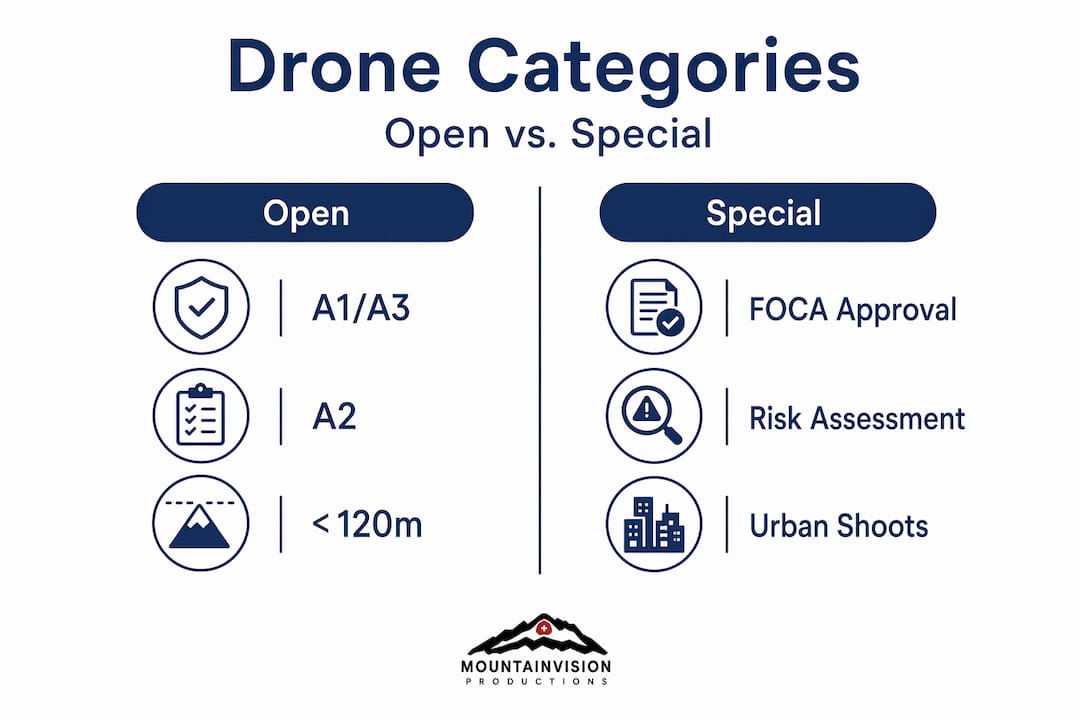
The Open Category subcategories define the operational envelope for your entire drone program. Most urban shoots in Switzerland rely on A1 or A2 certified equipment and operators.
Key points for filmmakers selecting certification levels:
A1 certification is your baseline for urban work. Lightweight drones under 900g with an A1/A3 certificate give you flexibility near pedestrian areas without the additional training burden of A2.
A2 certification opens proximity shots that are simply unavailable otherwise. If your production involves tight tracking shots alongside subjects in public spaces, this is the certification your operator needs. The swiss drone regulations guide details exactly what the A2 exam covers.
A3 category operations are largely incompatible with dense urban filming. The 150-meter clearance from residential and commercial areas eliminates most Swiss city locations entirely.
Verify your operator’s certification documentation before travel. Swiss authorities have requested to see certification papers on location, and an unverified operator means a grounded drone.
The drone law details for filmmakers go deeper on Special Category operations, which require individual FOCA authorization and are relevant for high-altitude work or flights over crowds at scale.
Understanding categories and certifications completes the regulatory picture; next, we explore professional video production support to streamline your urban Swiss shoot.
Benefits of professional video production support for international crews filming in Swiss cities
Budget-friendly filming in Switzerland is not about cutting corners. It is about not wasting budget on avoidable problems: permits rejected due to incomplete applications, drone operations halted by authorities, or a full shoot day lost because nobody confirmed the location was available.
Working with local Swiss production support removes those risks. Here is what that looks like in practice:
Regulatory compliance from day one. Local teams know which municipal office handles which permit type, which police departments require advance notice, and which locations have informal restrictions that never appear in official guides.
Certified drone operators already cleared. You are not waiting on overseas training results. Your operator arrives with Swiss-recognized credentials, registered equipment, and experience navigating the specific no-fly zone borders around your target locations.
Location scouting with legal context built in. A local scout does not just send you beautiful photos. They tell you which location requires a permit, which has restricted drone access, and which blocks have noise ordinances that affect your audio setup.
Multilingual crew coordination. International filming in Switzerland crosses at least two language regions in most productions. A bilingual production manager eliminates the communication friction that slows down approval processes and on-set coordination.
Logistics handled end to end. Transport, equipment storage, accommodation near shoot locations, crew scheduling across time zones: these are full-service production support capabilities that keep your production calendar intact.
Pro Tip: Before your first planning call with any Swiss production partner, prepare a one-page shoot brief covering locations, drone requirements, crew size, and shoot dates. A partner who can give you specific, accurate feedback on that brief within 48 hours is demonstrating the kind of local knowledge that actually protects your schedule. Visit our video production FAQs for answers to the most common questions international crews ask before their first Swiss production.
With these support advantages in mind, let’s provide a fresh perspective on filming in urban Switzerland that can help you rethink your approach.
Rethinking urban filming in Switzerland: why local regulation knowledge beats global drone experience
Here is the uncomfortable truth we have seen play out repeatedly: the production companies that run into the most serious problems in Swiss cities are often the most experienced international crews. Not the first-timers who arrive asking questions, but the veterans who assume that two decades of drone work across 30 countries means they understand the environment they’re walking into.
Switzerland enforces its Swiss drone laws expertise with a consistency and rigor that surprises even crews who have operated across the EU under EASA rules. The local overlay, including cantonal privacy interpretations, municipal no-fly zone extensions, and culturally expected behaviors around public filming, is invisible to anyone who hasn’t worked here directly.
Swiss cities have some of the highest population densities of any filming environment in Europe, combined with some of the strongest privacy expectations. Residents here regard unwanted aerial filming above their neighborhood as a genuine intrusion, and they know their rights. That community relationship matters beyond legal compliance. A neighborhood that feels respected by a film crew is a neighborhood that lets you work efficiently. One that doesn’t can generate complaints that pull permits mid-shoot.
The deeper insight is this: the film permit process in Switzerland is not an obstacle designed to block your production. It is a framework built around genuine community and safety concerns. When you approach it with that understanding, equipped with local knowledge and local partners, Switzerland’s regulatory environment stops being a burden and becomes a competitive filter. You execute the shoot. Other productions don’t.
Streamline your urban Swiss filming with expert full-service video production support
Planning a shoot in Zurich, Geneva, Basel, or anywhere across Switzerland’s urban landscape? Getting the creative work right is hard enough without juggling permit applications, drone certification checks, and multilingual logistics at the same time.
[
Our team handles all of it. We navigate Switzerland film permits, certified drone operations, location scouting, crew coordination, and on-the-ground logistics so you stay focused on your production. With over 20 years of full-service video production support in Switzerland, we know exactly what Swiss authorities require and how to get it approved without delays. Transparent video production pricing means you plan your budget with confidence, not guesswork. Have specific questions before you commit? Browse our common video production questions or contact us directly to discuss your project. Your next Swiss shoot should run on time, on budget, and without surprises.
Frequently asked questions
Do I need to register my drone before filming in Swiss cities?
Yes, all drones weighing 250 grams or more or equipped with a camera must be registered on UAS.gate before any flight in Switzerland, including commercial productions in urban areas.
What is the maximum allowed altitude for drone flights in urban Switzerland?
Drones must stay at or below 120 meters above ground level in Switzerland; exceeding this limit requires special FOCA authorization, which must be secured well before your shoot date.
How can I find out if my planned filming location is within a no-fly zone?
Use the official FOCA interactive map before every flight day, as temporary restrictions appear regularly around events, public gatherings, and emergency operations that won’t show on static maps.
What certifications do drone pilots need to film commercially in Swiss urban areas?
Pilots must hold at least the A1/A3 certificate for standard drone work; anyone flying in close proximity to people during urban shoots requires the additional A2 supplementary certification.
Can I rely on my international drone experience when filming in urban Switzerland?
No. Swiss cantonal regulations, municipal no-fly overlays, and strict privacy enforcement create a legal environment that operates differently from most other markets, making local expertise non-negotiable for a compliant and efficient shoot.
Recommended
