
Crew Hiring Switzerland: 2026 Guide for Filmmakers


TL;DR:
Hiring Swiss film crew requires careful worker classification, compliant contracts, and early engagement with local agencies. Misclassifying workers as employees or pseudo-self-employed can lead to fines, taxes, and legal liabilities if not properly verified before production. Building relationships with specialized recruiters and confirming contractor status in advance ensures smooth, lawful, and efficient shoots.
Crew hiring Switzerland is the process of sourcing, vetting, and contracting local film and production professionals in compliance with Swiss labor law to support international video shoots. For international filmmakers, getting this right means understanding how Swiss authorities classify workers, knowing which local recruitment channels deliver reliable talent, and structuring contracts that hold up legally. Get it wrong and you face fines, production delays, and liability that no shoot budget can absorb. This guide covers the legal framework, the best local recruitment resources, and the contract practices that keep your production on track.
What are the legal distinctions for crew hiring in switzerland?
Swiss labor law draws a clear line between employees and independent contractors, and that line carries serious legal consequences. The Swiss Federal Supreme Court defines employment by two factors: factual subordination to a client and organizational integration into the client’s operation. If your local camera operator works exclusively for your production, follows your daily schedule, and uses your equipment, Swiss authorities may classify that person as an employee regardless of what your contract says.
Misclassification triggers retroactive social security contributions, tax liabilities, and potential fines. For a foreign production company with no Swiss legal entity, that exposure is real and difficult to resolve remotely. The risk is not theoretical. Swiss cantonal tax offices and the AHV (the national social security system) actively audit contractor arrangements, especially in project-based industries like film.
The concept of pseudo-self-employment is the specific risk to watch. A contractor is considered pseudo-self-employed when they have only one client, bear no business risk, and are integrated into the client’s workflow. Swiss courts look at the full picture, not just the contract label.
To protect your production, look for these contractor characteristics:
Multiple active clients: The crew member works for other productions or companies, not just yours.
Business risk: They invoice for results, not hours, and carry their own professional liability insurance.
Non-integration: They use their own equipment, set their own schedule within agreed deliverables, and are not supervised like staff.
Variable payment structure: Fixed monthly payments over time signal employment to Swiss courts. Project-based or milestone invoicing is safer.
Pro Tip: Request a formal confirmation of self-employed status from the relevant Swiss social security authority (AHV compensation office) before your shoot begins. This formal confirmation reduces your legal exposure significantly and takes the guesswork out of compliance.
Swiss law also regulates temporary staff leasing separately. If you use a crew agency that places workers at your disposal, that agency must hold a cantonal or federal permit for personnel leasing. Informal arrangements without proper authorization expose both the agency and your production to fines and liability.
Which recruitment agencies and platforms find swiss film crew?
The Swiss labor market for film and media professionals is smaller than markets in the UK or Germany, but it is well-organized. Local job portals like jobs.ch and swissjobs.ch list thousands of active postings, including roles for camera operators, gaffers, sound engineers, and production assistants. These platforms are a solid starting point for direct outreach to local freelancers.
For faster results with better candidate quality, specialized film and media recruitment agencies are the more reliable path. These agencies pre-screen candidates for skills, work authorization, and professional references. They also understand the specific demands of international productions, including tight timelines and location-specific requirements.
Here is how to evaluate any crew agency or platform before committing:
Verify industry specialization. A general staffing agency may not understand the difference between a DIT and a colorist. Agencies with dedicated film and media divisions deliver better matches.
Check compliance credentials. Confirm the agency holds the required personnel leasing permits if they are placing workers directly with your production.
Request references from international productions. An agency that has placed crew for foreign shoots understands the logistical and legal nuances you face.
Review candidate vetting practices. Ask specifically whether they confirm work authorization, check social security registration, and verify insurance coverage.
Assess response speed. Swiss productions often move fast. An agency that takes three days to respond to an inquiry will cost you on a tight pre-production schedule.
Pro Tip: Early engagement with film-specialized agencies cuts hiring time by weeks. Contact your preferred agencies at least six to eight weeks before your shoot date, especially for technical roles like DPs, gaffers, and sound mixers, which fill quickly in the Swiss market.
Building a direct relationship with two or three reliable local recruiters pays dividends across multiple projects. Swiss production networks are tight. A recruiter who knows your standards will prioritize your briefs and flag candidates before they are posted publicly.
How should you structure contracts for swiss production crew?
Contract structure is where many international productions make costly mistakes. Clear contract drafting is the single most effective way to protect your production legally and operationally. A well-written agreement defines the relationship, limits liability, and gives both parties a shared reference point when disputes arise.
Every contract with Swiss crew should include these core elements:
Defined scope of work: Specify exact deliverables, shoot dates, locations, and role responsibilities. Vague scopes invite disputes and blur the contractor-employee line.
Project-based payment terms: Structure fees as project or milestone payments, not weekly or monthly salaries. Payment frequency is a factor Swiss courts weigh when assessing employment status.
Non-integration clause: State explicitly that the contractor operates independently, uses their own tools where applicable, and is free to work for other clients during the engagement.
Confidentiality provisions: Swiss productions often involve unreleased content. A clear non-disclosure clause protects your project and is standard practice in the industry.
Termination conditions: Define notice periods, kill fees, and conditions under which either party can exit the agreement without penalty.
Liability and insurance: Require contractors to carry their own professional liability insurance and specify who bears responsibility for equipment damage or third-party claims.
The distinction between a freelance contract and an employment contract in Switzerland is not just semantic. An employment contract triggers mandatory contributions to AHV, accident insurance under SUVA, and potential entitlement to paid leave. A freelance contract avoids these obligations only when the contractor genuinely qualifies as self-employed. Mixing employment-style terms into a freelance contract is the most common pitfall international productions face.
Informal agreements and handshake deals are the leading cause of compliance problems on Swiss shoots. Swiss labor authorities treat undocumented arrangements as employment by default.
What practical steps streamline the hiring process in switzerland?
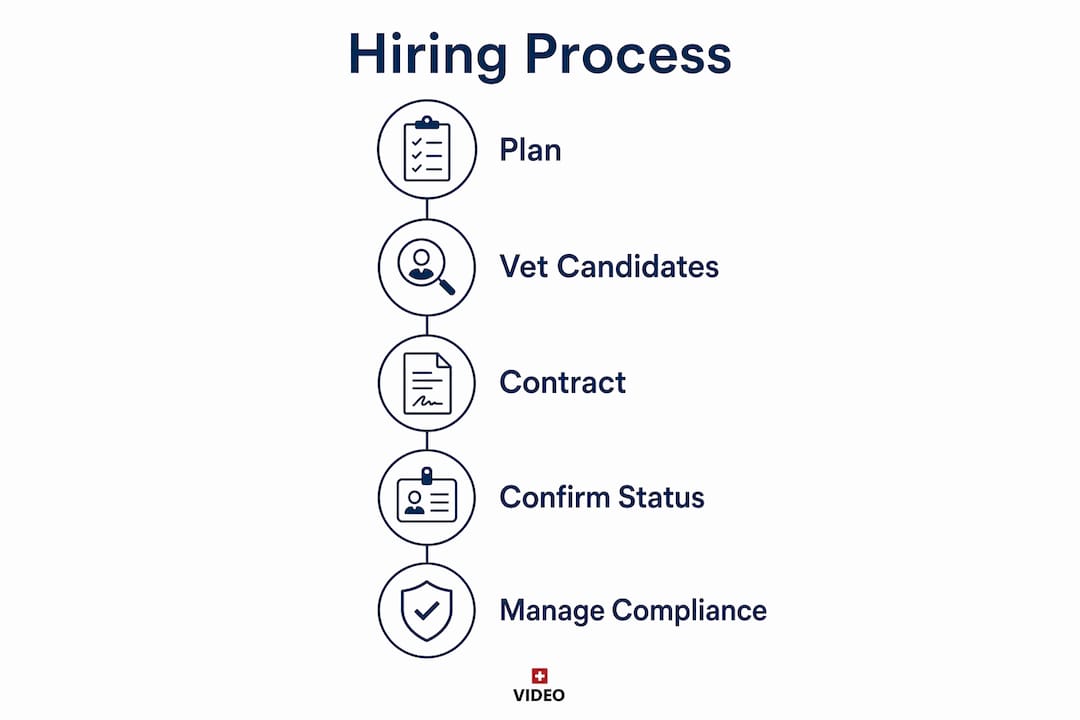
A structured hiring process removes the stress of last-minute scrambling and protects your production from administrative surprises. Follow these steps from role definition to first shoot day:
Define every role before outreach. Write a one-paragraph brief for each position covering required skills, shoot dates, location, and expected deliverables. Vague briefs waste everyone’s time.
Confirm work authorization early. EU and EEA nationals can work in Switzerland under bilateral agreements, but non-EU nationals require work permits. Screening for legal work status before contracting prevents last-minute crew replacements.
Request social security and insurance documentation. Ask each contractor for their AHV number and proof of professional liability insurance before signing any agreement.
Draft and sign contracts before the shoot. Never start a shoot day with unsigned agreements. Swiss labor law defaults to employment for undocumented arrangements.
Brief crew on cultural expectations. Swiss professionals value punctuality, clear communication, and defined responsibilities. Communicating expectations clearly before day one reduces friction on set.
Confirm logistics in writing. Confirm call times, locations, parking, and equipment responsibilities by email. Written confirmation protects both parties and keeps the shoot running on schedule.
The productions that run smoothest in Switzerland are the ones that treat compliance as a pre-production task, not a post-production problem. Every administrative step you complete before the shoot is one fewer crisis to manage on location.
A trusted full-service production partner handles most of these steps on your behalf, including candidate vetting, contract preparation, and compliance confirmations. For international teams without a Swiss legal entity or local contacts, that support removes the biggest operational risks from the equation.
Key takeaways

Successful crew hiring in Switzerland requires correct worker classification, compliant contracts, and early engagement with specialized local recruitment channels.
Point | Details |
Classify workers correctly | Swiss courts assess factual subordination and integration, not just contract labels, to determine employment status. |
Secure self-employment confirmation | Obtain formal AHV confirmation of contractor status before your shoot to reduce pseudo-self-employment liability. |
Use specialized film agencies | Agencies with dedicated media divisions deliver faster, better-matched candidates than general staffing platforms. |
Draft contracts with precision | Include scope, project-based payment, non-integration clauses, and termination terms in every crew agreement. |
Start compliance in pre-production | Work authorization checks, insurance verification, and signed contracts must be complete before shoot day one. |
What i’ve learned after 20 years of swiss production hiring
The biggest mistake I see international productions make is treating Swiss crew hiring like a logistics task rather than a legal one. They focus on finding the right DP or sound mixer, which matters, and then handle the paperwork as an afterthought. That approach works fine until it doesn’t, and in Switzerland, when it doesn’t work, the consequences arrive fast.
The pseudo-self-employment issue catches foreign productions off guard more than any other compliance problem. A production company from Los Angeles or London hires a local camera operator for three weeks, pays them a flat weekly rate, and supervises their daily work. That arrangement looks like employment to Swiss authorities regardless of what the contract says. I have seen productions receive retroactive AHV assessments months after a shoot wrapped, and the amounts are not trivial.
My practical advice is to build your compliance checklist before you build your shot list. Confirm contractor status, get the AHV documentation, and sign contracts before anyone sets foot on location. It takes two extra days in pre-production and saves weeks of legal headaches afterward.
The other thing I would tell any international filmmaker is to invest in local relationships, not just local hires. A recruiter who knows your standards, a fixer who understands Swiss permit requirements, and a production partner with established crew networks will deliver more value than any job portal. Switzerland’s film production community is small and well-connected. The right introduction opens doors that a job posting never will.
— Pieter
How Videoproductionswitzerland handles crew sourcing for you
Planning a shoot in Switzerland and not sure where to start with local crew?
[
Videoproductionswitzerland takes the guesswork out of Swiss crew sourcing for international productions. With over 20 years of experience in the Swiss market, the team handles candidate vetting, compliance confirmations, contract preparation, and on-location crew management so you can focus on your creative vision. From DPs and gaffers to production assistants and fixers, every crew member is screened for skills, work authorization, and professional reliability. If you want to understand what full production support costs before committing, the production cost breakdown gives you a clear picture upfront. No surprises, no stress.
FAQ
What defines an employee versus a contractor under swiss law?
Swiss law defines employment by factual subordination and organizational integration into the client’s operation. A worker who follows your schedule, uses your equipment, and works exclusively for your production is likely classified as an employee regardless of the contract label.
How do i confirm a swiss crew member’s self-employed status?
Request a formal written confirmation from the relevant AHV compensation office before the shoot begins. This confirmation documents the contractor’s status and reduces your production’s liability for retroactive social security contributions.
Which job portals list swiss film and media crew?
Jobs.ch and swissjobs.ch are Switzerland’s leading online job portals and list postings for film and media professionals. Specialized film crew agencies deliver faster results and pre-screened candidates for technical roles.
Do non-eu crew members need a work permit to work in switzerland?
Yes. Non-EU and non-EEA nationals require a Swiss work permit before starting any paid work. EU and EEA nationals can work under bilateral agreements, but you should still confirm authorization before contracting.
What happens if i use an informal agreement with swiss crew?
Swiss labor authorities treat undocumented arrangements as employment by default, which triggers mandatory AHV contributions, accident insurance obligations, and potential fines. Always use a written, signed contract before shoot day one.
Recommended
