
Avoid costly video production mistakes in Switzerland

TL;DR:
Switzerland’s stunning landscapes and cities attract commercial shoots, but permit rules and language barriers often cause costly delays. Proper planning of audio, lighting, and scheduling, combined with local coordination, prevents unfixable mistakes and unforeseen expenses. Engaging experienced Swiss local experts ensures smooth production and mitigates risks in this complex environment.
Switzerland looks flawless on camera. The alpine backdrops, precision-engineered cities, and golden-hour light seem tailor-made for high-end commercial shoots. But canton-specific permitting rules and multilingual paperwork requirements catch international teams off guard more often than you’d expect. A single overlooked permit application can shut down an entire shoot day, costing thousands in crew holding time, equipment rental, and rescheduled talent. The good news? Most of these mistakes are entirely predictable, which means they’re preventable. This guide walks you through the top production errors we see international filmmakers and brand managers make in Switzerland, with expert-backed strategies to stop them before they happen.
Table of Contents
Swiss-specific logistics: Permit, language, and weather pitfalls
Scheduling mistakes: Turnarounds, day/night flips, and cost impacts
Smart investments: Local fixers and multi-lingual coordination
Hard-won lessons: What most guides miss about Swiss video production
Get expert support for your Swiss production, not just advice
Key Takeaways
Point | Details |
Prioritize audio monitoring | Good sound capture and monitoring prevent the most expensive post-production fixes. |
Plan lighting and framing | Mistakes in lighting or camera angles create unrecoverable footage gaps without careful pre-checks. |
Master Swiss logistics | Permit rules, multilingual paperwork, and weather need special handling for international crews. |
Schedule with union rules in mind | Ignoring turnaround and day/night flips dramatically hikes costs and creates legal exposure. |
Content structure beats polish | Well-structured videos engage viewers better than technically perfect but poorly paced productions. |
Audio issues: The most costly mistake
Bad audio destroys otherwise excellent footage. And the painful truth is that audio quality problems are among the most common production mistakes and are nearly impossible to correct in post-production. Once muffled dialogue or background noise is baked into your recording, no amount of software cleanup will fully restore it.
Switzerland presents specific audio challenges. Mountain locations carry wind noise that standard on-camera microphones cannot handle. City environments in Zurich or Geneva introduce tram sounds, construction, and crowd noise at unpredictable intervals. Indoor locations with stone or concrete walls, like historic civic buildings or modern glass offices, create significant echo.
Here are the core audio mistakes to eliminate from your production checklist essentials:
Wrong microphone for the environment: A cardioid condenser works in a quiet studio, not on a mountain ridge. Use a shotgun mic with a proper windscreen outdoors.
No dedicated sound monitor: Relying on the camera operator to “listen back” after a take is too late. A dedicated sound mixer with headphones catches problems in real time.
Failing to scout for audio, not just visuals: A beautiful cobblestone square in Bern might look perfect but ring like a concert hall on recording.
Skipping a backup recording: Running dual-system sound (a separate audio recorder alongside the camera) gives you a safety net when the primary track has an issue.
Not using a room tone reference track: Even 30 seconds of ambient sound at each location makes editing seamless and natural.
“The most recoverable audio problem is one you catch on set. The least recoverable is the one you only notice in the edit suite, 500 miles from your talent.”
Pro Tip: Always conduct a full sound check at each new location before your first scripted take. Walk the space, listen through headphones, and identify interference sources. This takes five minutes and can save an entire shooting day.
With audio covered, let’s zoom in on another critical production risk: lighting and framing.
Lighting and framing: Prevent non-recoverable footage gaps
Visual errors can be just as catastrophic as audio problems, and often more expensive to address. Lighting and framing issues including dark or grainy footage, harsh backlighting, awkward angles, and exposure or focus errors create visual problems that are genuinely difficult, sometimes impossible, to solve in post.
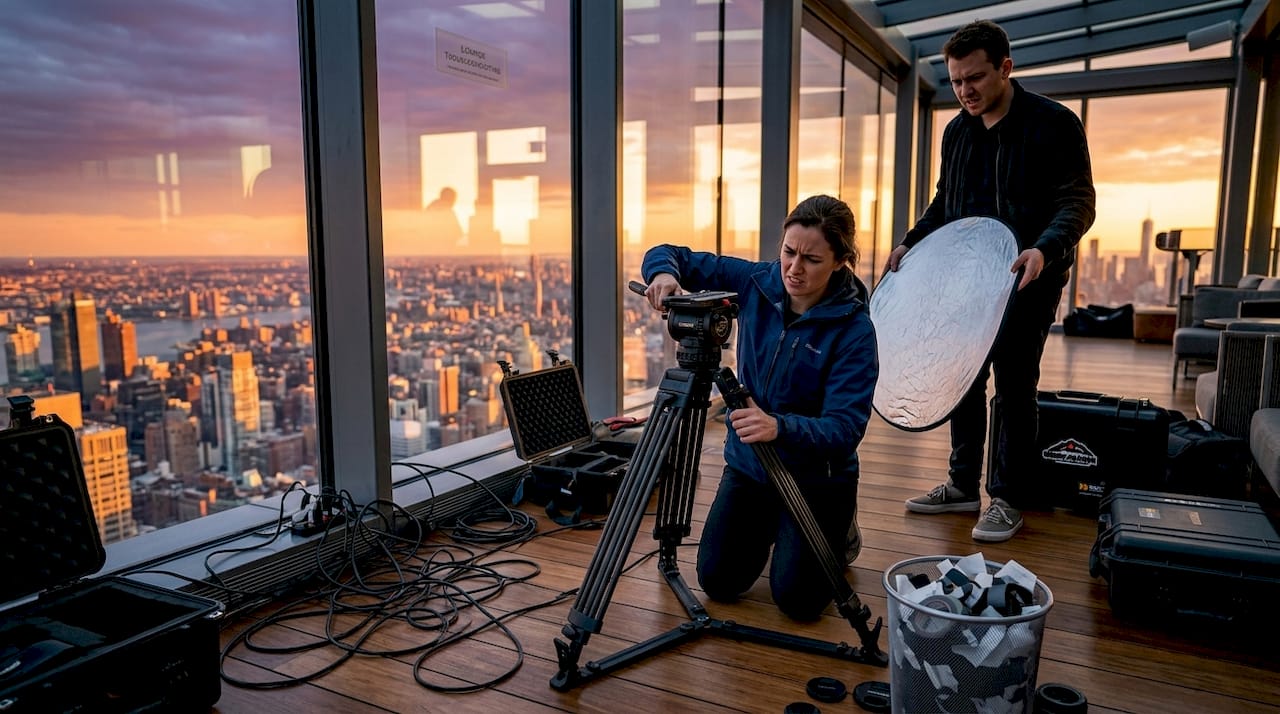
Switzerland’s natural light is stunning but unreliable. Alpine environments shift dramatically. Cloud cover at high altitude can change within minutes, moving from bright overcast to harsh direct sun to complete gray within a single hour. This means your exposure settings need constant adjustment if you’re shooting without artificial lighting control.
Common lighting and framing pitfalls when shooting commercial videos in Swiss locations include:
Backlighting from mountain snowfields or lake surfaces: Reflective Swiss landscapes can fool your camera meter into dramatically underexposing your subject.
Golden hour that lasts 20 minutes, not 90: At elevation, light quality shifts faster than at sea level. If your shot list assumes a long golden hour, you will miss it.
Indoor locations with mixed color temperature: Old Swiss buildings often mix tungsten and daylight through their windows. Without gel correction, your footage will have color inconsistencies that are expensive to grade out.
Shallow focus errors on wide aperture lenses: Using fast glass in tight interiors without precise focus pulling creates unusable footage that cannot be recovered.
Your on-set quality control checklist should include: a calibrated monitor on set, a dedicated focus puller for lens-intensive scenes, exposure verification against a gray card, and a lighting diagram prepared before arrival at each location. Referencing a solid production services guide can help you build this checklist before your shoot begins.
“Footage that looks slightly underexposed on a small monitor often looks completely unusable on a calibrated display. Check your monitor calibration on day one.”
Pro Tip: Schedule a tech scout at every major Swiss location before principal photography. Photograph the light at the planned shooting time of day, not just when you arrive for the scout. This saves enormous amounts of guesswork on shoot day.
Equipped with audio and visual best practices, it’s time to unpack logistical mistakes that trip up international teams in Switzerland.
Swiss-specific logistics: Permit, language, and weather pitfalls
Switzerland is not one unified permitting system. It is 26 cantons, each operating with significant autonomy. Underestimating canton-specific permitting rules and language requirements is the single biggest logistical failure mode for international teams arriving in Switzerland. And the consequences are severe: a shoot shut down by local authorities can mean 48 to 72 hours of lost production time while paperwork is sorted.
Here is what Swiss permit logistics actually involves, step by step:
Identify your canton: Each shooting location falls under a specific cantonal authority, and different cantons have different forms, timelines, and fees.
Determine language requirements: French-speaking cantons like Vaud and Geneva require all paperwork in French. German-speaking cantons like Zurich and Bern require German. Ticino requires Italian. Submitting in the wrong language will delay or invalidate your application.
Secure property permits separately: Public space permits from the canton do not cover privately owned buildings, parks, or landmarks. You need separate written authorization from property owners.
Allow lead time: Urban canton permits in major cities often require 10 to 15 business days minimum. Rural and mountain areas may take longer, especially for drone or aerial footage.
Budget for cantonal fees: These vary widely and are rarely listed publicly in English.
For detailed canton-by-canton guidance, review this film permit guide and these permit tips for seasonal considerations.
Weather adds another unpredictable layer. Extreme weather and remote-access constraints in Switzerland are not rare exceptions but predictable risks. Productions that fail to plan for them absorb overtime costs, rescheduling fees, and crew holding time that can inflate a budget by 15 to 30 percent.
Risk factor | Impact if unplanned | Mitigation strategy |
Mountain weather shift | Crew holding, lost footage | Build a 2-hour buffer per alpine shoot day |
Remote site road closure | Equipment cannot reach location | Pre-scout access routes, arrange backup transport |
Permit language mismatch | Shoot stopped on arrival | Use local coordinators fluent in canton language |
Drone airspace restrictions | No aerial footage obtained | File airspace clearance 3 weeks in advance |
Reviewing a comprehensive production challenges guide before finalizing your schedule will help you build contingency plans that actually match Swiss realities.
After examining Swiss logistics, let’s tackle scheduling mistakes that impact budgets, talent, and crew requirements.
Scheduling mistakes: Turnarounds, day/night flips, and cost impacts
One of the most expensive and overlooked scheduling errors is mishandling turnaround time and day/night scheduling flips, which can raise rental, crew, insurance, and union costs significantly and often without warning.
A turnaround is the minimum rest period required between a crew member’s dismissal from one shoot day and their call time for the next. Industry standards typically require 12 hours. In Switzerland, this matters because many productions attempt to schedule a late evening shoot in a city followed by an early morning alpine location the next day. That combination can legally prevent half your crew from showing up on time.
Day to night flips introduce a different problem. If your schedule moves talent and crew from a daytime interior shoot to a nighttime exterior shoot in the same week, your equipment packages change, your lighting requirements change, and your insurance coverage may need adjustment.
Scheduling error | Cost impact | Solution |
Ignoring 12-hour turnaround | Crew overtime, possible union fines | Build turnaround into scheduling software before locking |
Day/night flip mid-week | Lighting package upgrade needed | Plan all nights together or all days together |
No weather buffer day | Rescheduling fees for talent | Add 1 contingency day per 5 shoot days |
Remote location early call | Transport costs exceed estimate | Arrange on-location accommodation near shoot site |
Key statistic: Productions that schedule a weather buffer day use it more than 60 percent of the time in alpine Swiss environments. Skipping it is one of the most common and most avoidable budget overruns we see.
For teams managing accommodation alongside tight scheduling, detailed crew accommodation tips and these city filming guides will help you plan logistics that match your shooting schedule.
Next, let’s discuss why relying solely on production quality is no longer enough for project success.
Why content structure matters more than production polish
International brand teams often over-invest in production polish and under-invest in content structure. The evidence is clear: some performance benchmarks are driven more by content structure, pacing, and CTA systems than by production quality alone, especially in educational and business video contexts.
This does not mean production quality is irrelevant. But it does mean that a video with poor structural logic, no clear call to action, and segments that run 30 seconds too long will underperform a technically simpler video with tight pacing and a clear narrative arc. Every time.
Practical steps to improve content structure before your Swiss shoot even begins:
Map your CTA before scripting: Know exactly what action you want the viewer to take, and work backward from that moment.
Limit segments to 90 seconds or less: Audience retention research consistently shows drop-off points after 90 seconds of unbroken content.
Use pattern interrupts: A change in speaker, location cut, or graphic element every 60 to 90 seconds maintains attention.
Align structure to platform: A 3-minute brand film structured for cinema viewing will fail on LinkedIn. Know your distribution platform before locking your script.
“The production decisions that matter most are made in pre-production, not on set. A well-structured script filmed on a phone outperforms a poorly structured one filmed in a Swiss alpine meadow.”
With clarity on structure versus polish, let’s explore how local coordination can be a game changer for international productions in Switzerland.
Smart investments: Local fixers and multi-lingual coordination
The single highest-return investment an international crew can make in Switzerland is hiring a local fixer or production coordinator who is genuinely fluent in the relevant canton’s language. Using a local fixer fluent in the canton language helps prevent permit delays and miscommunications that cascade into costly shoot delays.
Here is what a skilled Swiss local coordinator actually does for your production:
Handles permit applications in the correct language and format for each canton on your shooting schedule.
Negotiates with property owners in their native language, which consistently results in faster approvals and lower fees than remote negotiation in English.
Monitors weather forecasts specific to each location using local knowledge, not just general apps, and advises on when to move shoot days.
Connects you with trusted local vendors for equipment rental, catering, and transport, avoiding the markup that comes with unfamiliar international booking channels.
Solves problems in real time on set, from a location access dispute to an unexpected crowd gathering that threatens your background continuity.
The return on investment is clear. A two-week Swiss production that invests in a senior local coordinator typically recovers those costs within the first two days through avoided delays alone. For teams ready to plan their shoot, scheduling a planning call early gives you access to exactly this kind of expert, proactive support.
Pro Tip: When selecting a fixer or coordinator, ask specifically about permit experience in the cantons on your schedule within the last six months. Permit rules and contacts change. Recent regional experience is not a bonus. It is a requirement.
Hard-won lessons: What most guides miss about Swiss video production
After years of supporting international crews across Switzerland, we want to share something most production guides skip entirely: perfect planning is a myth, and chasing it is itself a mistake.
The productions that come through Switzerland with the least stress are not the ones with the most detailed schedules. They are the ones with the most agile teams. The difference is building decision frameworks before problems arise, not just contingency lines in a spreadsheet.
Here is what that looks like in practice. A brand team arrives in Zermatt with a tight two-day schedule and a perfect shot list. On day one, a weather shift pushes the hero outdoor scene. The teams that have pre-agreed decision criteria (“if weather delays exceed two hours, we move to the interior backup location”) execute the change in 20 minutes. Teams without that framework spend two hours in debate and lose the day.
The other uncomfortable truth: local knowledge cannot be imported. Reading guides, including this one, builds awareness. But genuine Swiss production fluency, knowing which cantonal officer to call, which mountain road gets icy before the forecast says so, which rental house actually delivers on time, comes from relationship-based, boots-on-the-ground experience. That expertise is not something you can duplicate from abroad in the weeks before a shoot.
Build margin into your schedule. Not a single buffer day at the end. Real margin, distributed throughout your week. And overcoming the challenges that Switzerland specifically presents requires accepting that adaptability, not rigidity, defines a successful international production.
Mistakes will happen. What separates elite productions from exhausting ones is catching mistakes early, having a plan for them, and having the right local partner to execute that plan without drama.
Get expert support for your Swiss production, not just advice
Understanding the risks is step one. Having the right team to handle them is what actually protects your budget and your shoot days.
[
We specialize in full-service production logistics for international filmmakers and brand managers in Switzerland, covering everything from canton permit applications to multi-lingual crew coordination, location scouting, accommodation, and real-time problem solving. Our 20-plus years of Swiss market experience mean we have seen every version of the mistakes outlined above, and built systems to prevent them before they reach your set. Explore transparent production costs to plan your budget with confidence, then visit our full-service production platform to see how we can manage every detail of your next Swiss shoot.
Frequently asked questions
What are the biggest video production mistakes for international crews in Switzerland?
Permit paperwork, multilingual logistics, unpredictable weather, and failing to monitor audio are top pitfalls; canton-specific permitting rules alone cause more shoot shutdowns than any other single factor.
How can I avoid audio problems in my footage?
Use the right microphone for your environment, record in controlled spaces where possible, monitor sound with headphones throughout the shoot, and always run a backup recorder since audio problems are among the hardest to fix in post.
Why do Swiss permits require special attention?
Each Swiss canton operates its own permitting system with unique forms, language requirements, timelines, and fees, meaning a production crossing multiple cantons may need several separate permit applications filed in different languages.
What scheduling mistake most impacts Swiss productions?
Mishandling turnaround times and day/night scheduling flips increases rental, crew, and insurance costs dramatically, especially when combined with remote alpine locations that require early call times.
Does production quality affect audience engagement?
For educational and business videos, content structure and pacing consistently drive engagement more than technical production quality alone, making pre-production scripting decisions more valuable than on-set polish.
Recommended
