
Cost breakdown for video production in Switzerland

TL;DR:
Shooting in Switzerland offers stunning locations and exceptional talent but comes with high and unpredictable costs for international productions. Proper budgeting requires understanding local regulations, incentives like the PICS rebate, and engaging trusted local experts to avoid overspending and maximize incentives. Accurate cost breakdowns and local knowledge are essential for stress-free, compliant, and cost-effective Swiss shoots.
Shooting in Switzerland is a dream for many international production teams. The locations are stunning, the infrastructure is world-class, and the technical talent is exceptional. But here’s what catches most productions off guard: the costs are unlike anywhere else in Europe, and a single miscalculation can turn a tightly planned shoot into a financial crisis. This guide gives you a clear, practical breakdown of where your money goes, how to protect your budget, and what steps experienced productions take to keep Swiss shoots on track and stress-free.
Table of Contents
Key Takeaways
Point | Details |
Know all expense categories | Swiss video production costs include crew, equipment, permits, travel, local labor, and post-production. |
Leverage Swiss incentives | Eligible productions may reclaim 20–40% of local expenses through the PICS rebate program. |
Step-by-step budget planning | A structured process and local insights help build accurate, efficient budgets for Swiss shoots. |
Avoid costly mistakes | Anticipate legal, logistical, and cultural pitfalls for international productions in Switzerland. |
Expert support matters | Partnering with experienced Swiss professionals simplifies budgeting and compliance, reducing stress. |
Essential cost categories for video production in Switzerland
Before you dive into the specifics, it’s crucial to understand the core areas where your budget will go. Switzerland operates on a higher cost baseline than most European markets, and several categories carry unique local rules that can catch international teams completely off guard.
Here’s a quick look at the major cost categories and typical allocation ranges for a mid-size international production:
Cost category | Typical budget share | Swiss-specific note |
Crew and labor | 30–40% | Elevated union rates, strict overtime rules |
Equipment rental | 10–15% | Premium pricing, limited local inventory |
Location fees and permits | 8–12% | Cantonal regulations vary significantly |
Travel and accommodation | 15–20% | One of Europe’s most expensive hotel markets |
Post-production | 10–15% | High-quality local facilities available |
Insurance and legal | 3–6% | Local liability requirements are strict |
Contingency | 10–15% | Essential given Swiss market volatility |
To get a realistic sense of the production expenses overview you’re working with, treat each line item as its own project. Swiss labor law, for example, governs rest periods, maximum working hours, and mandatory contributions that are easy to underestimate if you’re used to budgeting in markets like the UK or Germany.
A few Switzerland-specific extras deserve their own attention:
Local insurance requirements: Many cantons require third-party liability insurance before a permit is approved. Factor this in early.
Elevated labor rates: Skilled Swiss crew members command rates noticeably higher than the European average, and rightly so. Quality is exceptional.
Currency exposure: Budgeting in CHF (Swiss francs) versus your home currency adds exchange rate risk, particularly on longer productions.
Cantonal permit fees: Unlike countries with a single national permitting framework, Switzerland’s 26 cantons each have their own rules. Fees and timelines differ meaningfully.
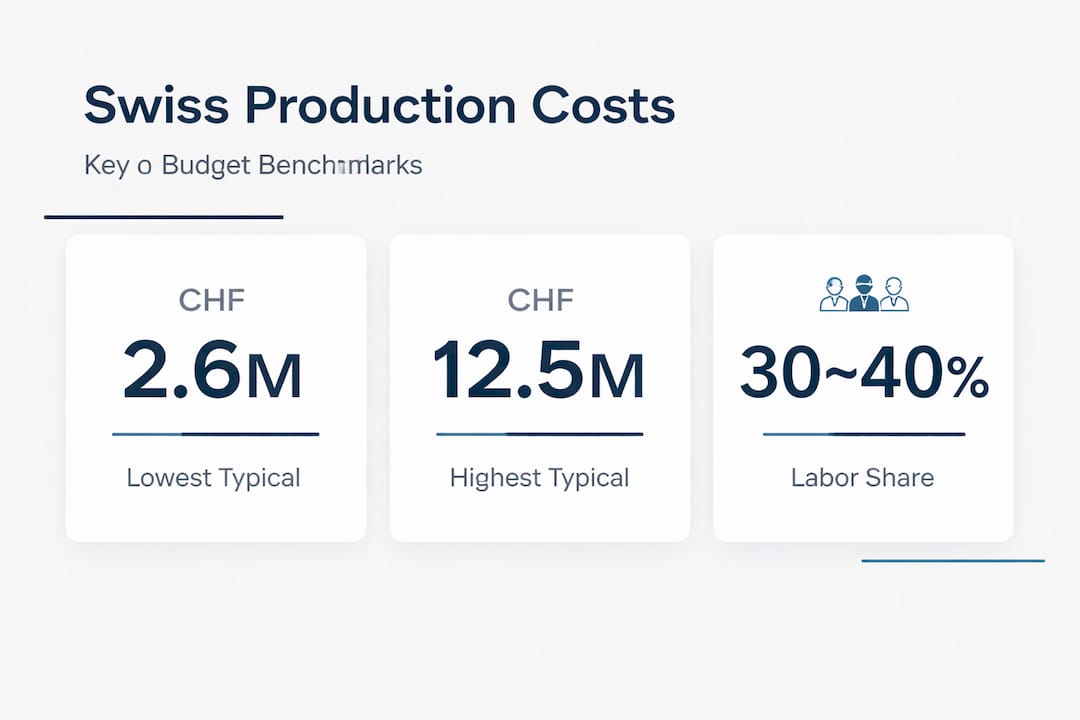
As a benchmark, the complete Swiss guide for co-production budgets shows figures ranging from CHF 2.6M to CHF 12.5M, with larger prestige projects reaching well above that range as Lex Netflix raised CHF 30M or more for Swiss content in 2024. These numbers frame the scale of spending this market supports and validate why getting your cost breakdown right from day one is so important.
Pro Tip: Always build a 10–15% contingency directly into your master budget, not as an afterthought. Swiss market volatility, from weather delays on alpine shoots to last-minute permit revisions, makes this buffer a practical necessity, not a safety net for sloppy planning.
Step-by-step process for accurate cost breakdowns
Once you know what to account for, you’re ready to build your initial budget. The difference between a well-prepared breakdown and a generic estimate is dramatic, especially when factoring in Swiss-specific rebates and labor structures.
Here is the step-by-step process we recommend for any international production planning a Swiss shoot:
Gather Swiss-specific quotes. Contact local vendors, rental houses, and crew agents directly. Generic European rate cards will underestimate Swiss costs by 20–35% in most categories.
Factor in union contracts and local labor agreements. Switzerland has both unionized and non-unionized crews. Understand which agreements apply to your production structure before signing any contracts.
Research the PICS rebate program. The PICS rebate offers 20–40% back on qualifying Swiss expenses for international co-productions. The minority co-production track offers 40% back, with a minimum spend of CHF 300,000 for minority fiction projects and a cap of CHF 600,000 per project. If your production qualifies, this rebate changes the financial picture significantly.
Review all contracts for hidden costs. Location agreements, equipment rentals, and accommodation contracts in Switzerland frequently include clauses for damage deposits, overtime penalties, and cancellation fees that don’t appear in headline rates.
Prepare formally for overages. Establish a formal overage approval process before the shoot starts. Know exactly who has authority to approve additional spending and at what threshold.
Cross-reference your cost breakdown steps with historical bids. If a line item looks significantly different from comparable past productions, investigate before locking the budget.
Here’s how a traditional cost breakdown compares to one that properly accounts for Swiss specifics and PICS rebates:
Budget area | Traditional approach | Swiss-optimized approach |
Crew costs | Estimate from home market + uplift | Quotes from Swiss agents with union compliance checked |
Rebates and incentives | Not accounted for | PICS rebate factored in from day one |
Location and permits | Single national estimate | Cantonal-specific research per shooting location |
Insurance | Standard production policy | Local liability verified per canton |
Contingency | 5–8% typical | 10–15% based on Swiss volatility |
Net effective cost | Higher (rebates missed) | 10–40% lower after incentive optimization |
Understanding staying within budget on a Swiss production is genuinely different from cost control in other markets. The rebate program alone can cover a substantial portion of your local spend, but only if you plan for it from the outset.

Common pitfalls and how to avoid overspending
Having a solid breakdown is just the start. Next, let’s help you avoid common mistakes that can threaten your bottom line.
International productions repeatedly make the same costly errors when shooting in Switzerland. Knowing them in advance puts you in control.
The most common budgeting mistakes:
Underestimating accommodation costs. Switzerland consistently ranks as one of the most expensive hotel markets in the world. A week’s accommodation for a 15-person crew in Zurich or Geneva can easily exceed what productions budget for two weeks in comparable European cities.
Missing PICS application deadlines. The rebate doesn’t apply automatically. Applications require advance preparation, documentation of qualifying spend, and submission within specific windows. Missing these deadlines means leaving real money on the table.
Ignoring Swiss labor law complexity. Overtime thresholds, mandatory rest periods, and mandatory contributions to social funds are strictly enforced. Productions that ignore these rules face unexpected payroll corrections after the shoot.
Assuming permits are simple. A permit needed in Geneva requires a different process than one needed in the Valais canton or in Graubünden. Timelines can range from a few days to several weeks depending on the location and what you’re filming.
Failing to verify invoices against actual usage. Equipment rental companies and location owners occasionally charge for unused hours or add fees that weren’t discussed upfront. Build invoice verification into your production management routine.
Important: The PICS minimum spend threshold for minority fiction co-productions is CHF 300,000, with a project cap of CHF 600,000. If you’re close to the threshold, intentional spend planning can determine whether you qualify at all.
Pro Tip: Bringing in a Swiss-based fixer or local production manager from pre-production onward is one of the highest-return investments you can make. They know which vendors are transparent, which locations have hidden fees, and how to structure your spend to maximize rebate eligibility. This local knowledge is genuinely hard to replicate from abroad, and the Switzerland video service guidance available through experienced local partners makes a measurable difference to your bottom line.
Insurance requirements also deserve a dedicated line in your risk planning. Third-party liability coverage must often meet cantonal minimums, and standard international production policies sometimes fall short. Verify your coverage before submitting any permit applications to avoid delays.
Verifying and validating your cost breakdown
Now that you’ve learned the risks, make sure your budget will stand up against real-world demands. Verification isn’t just a final check. It’s an ongoing process that starts the moment your first quotes come in.
Follow these steps to stress-test your Swiss cost breakdown:
Compare each line item against historical Swiss production data. If you have access to past bids or final cost reports from Swiss shoots, use them as your benchmark. Significant variances in either direction need explanation.
Use published co-production benchmarks as a calibration tool. Swiss co-production budgets typically range from CHF 2.6M to CHF 12.5M for feature-length projects. For branded content and shorter formats, scale these down proportionally and use them to validate your per-day or per-week cost assumptions.
Get at least three competitive quotes for every major cost category. Single-source quotes in Switzerland, especially for locations and equipment, can carry significant margin. Multiple quotes create transparency and give you negotiating leverage.
Ask your local production partner to review the full budget. Someone with ground-level Swiss market knowledge will spot outliers immediately, including overpriced location fees, inflated equipment rates, or crew quotes that don’t reflect current market rates.
Run a “red team” review. Have someone not involved in building the budget look for assumptions that might be optimistic. Swiss productions frequently face weather-related delays, logistical complications in alpine areas, and permitting revisions that push timelines.
Benchmark callout: CHF 30M raised for Swiss content in 2024 under Lex Netflix demonstrates the level of investment this market attracts. Even if your project is far smaller in scale, these figures confirm that Swiss productions operate with serious financial discipline and structured cost management.
Understanding Swiss quality benchmarks also helps frame why costs are where they are. Swiss crew, equipment, and facilities deliver exceptional output, and the pricing reflects that standard. A validated budget isn’t just about staying within limits. It’s about allocating resources where they generate the most creative and logistical value.
What most productions get wrong about budgeting for Switzerland
Here’s something most guides won’t tell you: Swiss crews and vendors are often more flexible on pricing than international productions expect. The assumption that “Switzerland is expensive, so there’s no room to negotiate” is a myth that costs productions real money. Experienced Swiss vendors value long-term relationships, repeat business, and smooth productions. When you show up well-prepared and professionally organized, the conversation often shifts from take-it-or-leave-it to genuine problem-solving.
The deeper issue is that most international productions treat the budget as a fixed document rather than a dynamic tool. In Switzerland, your budget needs to be a living conversation. Rebate eligibility shifts as spend categories are confirmed. Permit timelines affect crew scheduling. Accommodation availability in high-demand periods like ski season or major events can force last-minute changes that ripple through every other line item.
Failing to factor in local expertise is perhaps the most expensive mistake of all. Productions that rely entirely on home-market advisors for Swiss budgeting consistently pay above-market rates and miss incentive opportunities. A Swiss line producer isn’t just a logistics hire. They are a compliance guide, a negotiation asset, and a creative problem-solver rolled into one.
We’ve also seen productions overpay by assuming that cost transparency happens automatically. It doesn’t. Without someone local who knows the cost breakdown perspectives of every vendor and location, outside solutions that promise simplicity often deliver surprises instead.
The bottom line: treat your Swiss budget as a collaborative document built with local knowledge, not just an estimate assembled from a distance.
How we help you simplify Swiss video production costs
Getting your Swiss cost breakdown right is genuinely complex, but it doesn’t have to be a solo effort. At videoproductionswitzerland.com, we specialize in helping international production companies take the guesswork out of Swiss shoots. We connect you directly with trusted local line producers, fixers, and crew who know the market inside and out.
[
Whether you need a tailored cost estimate for a branded content shoot or full-scale logistical support for a co-production, we handle the details so you can focus on the creative. From permit management to rebate documentation, our team ensures your budget is accurate, your spend is optimized, and your shoot runs smoothly from day one. Reach out for a free consultation and let us show you what stress-free Swiss production looks like.
Frequently asked questions
What rebates are available for international productions in Switzerland?
The PICS program offers 20–40% rebates on qualifying Swiss expenses for international co-productions, with the 40% rate applying to minority co-production arrangements that meet specific spend and eligibility criteria.
How much does a typical Swiss video production cost?
Empirical benchmarks show that co-production budgets typically range from CHF 2.6M to CHF 12.5M, though branded content and shorter formats operate at significantly lower scales depending on scope and duration.
What common costs do international filmmakers underestimate in Switzerland?
Travel and accommodation are consistently underestimated, particularly for larger crews during peak seasons, and cantonal permitting complexity often adds both unexpected fees and timeline delays that affect overall production costs.
Can I access local Swiss support for budgeting and logistics?
Yes, experienced local fixers, line producers, and full-service production specialists are readily available for international projects and provide significant value in both cost optimization and on-the-ground execution.
Recommended
