
Overcoming common video production challenges in Switzerland

TL;DR:
Switzerland’s complex permit system, diverse cantonal regulations, and seasonal factors demand early, detailed planning for successful productions.
Aligning permit applications with crew bookings and building robust contingency plans are essential to avoid costly delays and logistical surprises.
Switzerland looks stunning on a location scout’s wish list. The problem is that many international crews arrive expecting a straightforward shoot and instead face a maze of cantonal permit requirements, tight crew availability windows, and logistical surprises that can blow a budget before the first camera rolls. This guide cuts through the confusion, giving you concrete strategies for permit management, local crew coordination, and contingency planning so your Swiss production runs on time and on budget.
Table of Contents
Key Takeaways
Point | Details |
Swiss permits need lead time | Apply for permits four weeks ahead to avoid delays and meet regulatory thresholds in Swiss cities. |
Integrate crew and permit planning | Coordinate crew bookings and permit approvals to ensure smooth access to locations and resources. |
Local knowledge saves time | Relying on Swiss-based support helps navigate unique regulations and unpredictable logistical hurdles. |
Prep for Alpine variables | Plan for transport, seasonal weather, and local holidays to prevent costly shoot overruns. |
Understanding Switzerland’s unique production landscape
Having set the stage, it’s critical to understand what makes the Swiss context surprisingly different, and often more demanding, than comparable destinations.
Switzerland is not one unified regulatory environment. It is a confederation of 26 cantons, each with its own administrative culture, permit offices, and enforcement priorities. What works in Zurich will not automatically transfer to Geneva or Bern. International crews who treat Switzerland as a single location often collide with this reality on day one.
Why Swiss cities enforce strict permit requirements
Urban locations like Zurich and Geneva are densely managed. Public spaces are heavily used, and local authorities protect residents and infrastructure with real enforcement power. A crew that sets up without the right paperwork can be stopped mid-shoot, fined, or forced to relocate entirely. That is not a minor inconvenience. It is a production-killing scenario.
Swiss city filming guides reveal just how granular these requirements can get. In Zurich, for example, a filming permit is required when a shoot lasts longer than an hour (including preparation time), when infrastructure such as roads, bridges, or public facilities is involved, or when more than five people are part of the crew. The application should ideally be submitted four weeks before filming begins. Many international teams simply do not know this threshold exists until they are already in trouble.
Geographic and seasonal complications
Beyond city rules, Switzerland’s geography adds another layer of complexity. Alpine locations require access coordination with local municipalities, mountain transport operators, and sometimes private landowners. Weather windows in high-altitude areas can be narrow, and conditions can shift within hours.
Seasonal factors matter enormously. Summer festivals, national holidays, and winter sports seasons all create resource bottlenecks. Permit offices may operate on reduced schedules. Local crew members may already be booked for other productions. Equipment rental houses can run low on key gear. Effective video management strategies account for these seasonal rhythms well in advance, not the week before the shoot.
“Switzerland rewards preparation. Teams that treat local regulations as an afterthought will spend far more time and money fixing problems than they ever would have spent planning properly.”
A realistic lead time for a complex Swiss production is eight to twelve weeks from initial location scouting to confirmed shoot date. That timeline surprises most international crews, who are used to faster turnarounds in less regulated markets.
Permit management: Navigating Swiss regulations and approvals
Now that you understand why Swiss rules matter, let’s unpack exactly how the permitting process works and what you can do to avoid last-minute setbacks.
Permitting thresholds by city
City | Key threshold triggers | Recommended lead time |
Zurich | Over 1 hour, 5+ crew, infrastructure use | 4 weeks minimum |
Geneva | Public space use, commercial shoots | 3 to 6 weeks |
Bern | Federal zone proximity, public events | 4 to 8 weeks |
Basel | Cultural site access, road closures | 4 to 6 weeks |
Each city’s permit office has its own submission format, required documentation, and review timeline. A reliable Swiss shoot plan treats permitting and staffing as interdependent workstreams because permit lead times directly affect when you can lock crew availability and location access. This is not a minor procedural note. It is the single most important operational insight for Swiss production planning.
Step-by-step permit application checklist
Identify all shoot locations and categorize them as public, private, or mixed-use.
Determine the relevant cantonal authority for each location.
Prepare a detailed shoot plan including crew size, equipment list, duration, and any infrastructure requirements.
Submit applications to each authority separately, since there is no single national permit system.
Follow up proactively at the two-week mark if you have not received confirmation.
Secure written approval before booking non-refundable crew or equipment.
Understanding the full Swiss film permit process is essential before you commit to any location. Skipping steps or assuming verbal approval is sufficient has cost productions significant money in last-minute scrambles.
Why permits and crew bookings must align
This is where many teams make a critical error. They book crew first, then apply for permits, assuming approvals will come through in time. When permits are delayed, the crew is already committed and the clock is ticking on day rates. Swiss film shoot timing requires that both workstreams move in parallel, not sequentially.
Pro Tip: Build a shared production calendar that shows permit submission dates, expected approval dates, and crew booking deadlines side by side. Any gap between expected permit approval and crew lock-in date is a risk that needs a contingency plan.
Also, be aware that filming during holidays in Switzerland requires extra planning. Permit offices may close entirely, and local crew availability drops sharply during national and cantonal holidays. Always cross-reference your shoot calendar with the Swiss public holiday schedule for the relevant canton.
Coordinating local crews and securing resources
With permit requirements mapped out, tight coordination with your crew and resources is the next linchpin of a successful Swiss shoot.
Critical Swiss crew roles and early booking
Switzerland has a skilled but relatively small pool of experienced film professionals. The most in-demand roles, including directors of photography, sound recordists, gaffers, and location managers, can be booked out weeks or months in advance during peak season. Waiting until permits are confirmed to start crew conversations is a strategy that routinely backfires.
Key roles to secure early:
Location manager: Essential for navigating local authorities and access negotiations.
Production coordinator: Manages the day-to-day logistics that international teams cannot easily handle remotely.
Camera and lighting crew: Top local talent books fast, especially for commercial productions.
Transportation coordinator: Swiss road and parking regulations require someone who knows the local rules.
Local vs. imported crew: A practical comparison
Factor | Local Swiss crew | Imported international crew |
Permit knowledge | Strong, current | Often limited |
Language skills | German, French, Italian | Varies widely |
Availability | Book 4 to 8 weeks out | Easier to schedule remotely |
Day rates | Competitive | May include travel and per diem |
Local contacts | Extensive | Minimal |
Problem-solving on location | Fast and effective | Slower without local context |
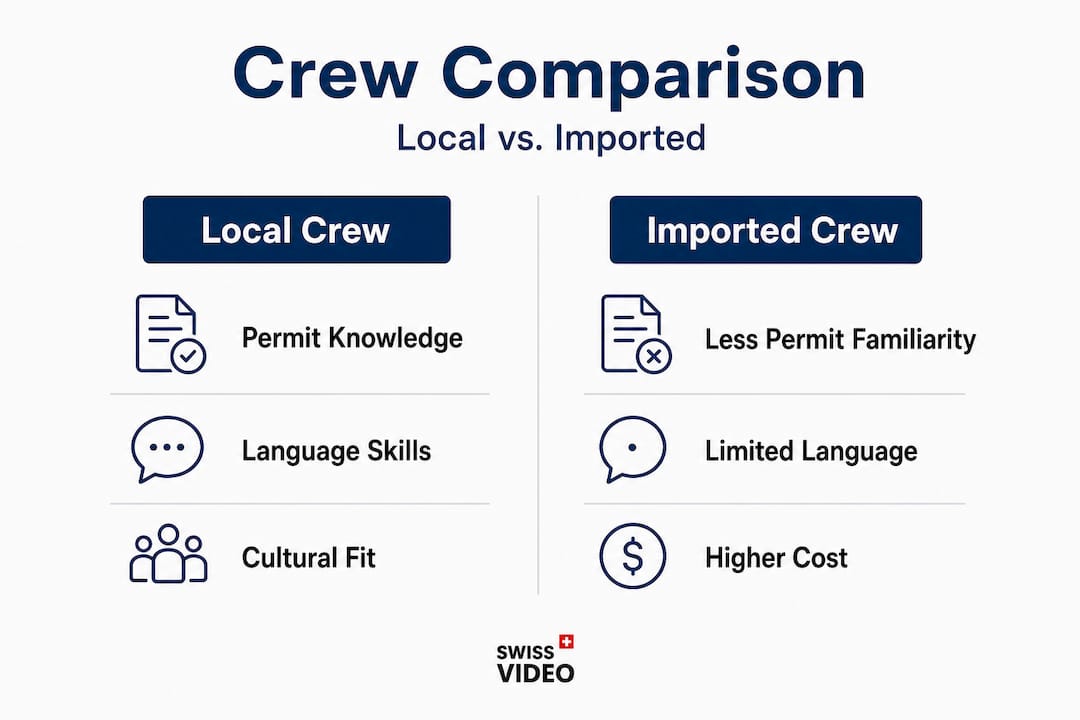
The case for local crew is strong. They know which permit officer to call, which roads are restricted on certain days, and which equipment rental house can deliver on short notice. That knowledge is worth more than the cost savings you might achieve by importing your entire team.

Scheduling software for shoots can help you visualize crew availability alongside permit timelines, reducing the risk of double-booking or leaving gaps in your schedule. Solid production management best practices treat crew coordination and permit management as a single integrated process, not two separate tasks.
Pro Tip: When sourcing local crew, ask specifically about their experience with cantonal permit processes in your target locations. A gaffer who has worked extensively in Zurich may have limited knowledge of Geneva’s requirements, and vice versa.
Equipment rentals and site access
Swiss equipment rental houses maintain high-quality inventory, but popular items, including specialty lenses, large format cameras, and specialized lighting rigs, can be reserved weeks in advance. Confirm rental availability at the same time you submit permit applications. Site access for private locations also requires separate negotiation, and property owners in Switzerland often have specific insurance requirements that international crews need to prepare for.
Timing, transport, and contingency planning
With your crew and permits aligned, it’s time to address the realities of Swiss transport, logistics, and backup strategies.
Common sources of timing overruns
Swiss productions face a specific set of timing risks that differ from other European locations:
Permit delays: Even a one-week delay in approval can cascade into crew rebooking fees and location rescheduling costs.
Alpine weather shifts: Mountain locations can experience fog, snow, or rain with very little warning, even in summer.
Traffic and parking restrictions: Swiss cities enforce parking and road use rules strictly, and a production vehicle parked in the wrong place can trigger fines and equipment delays.
Public event conflicts: Zurich alone hosts dozens of major public events annually, each of which can close streets, restrict permit approvals, and reduce crew availability.
A reliable Swiss shoot plan treats permitting and staffing as interdependent workstreams, which means contingency planning is built into the schedule from the start, not added as an afterthought.
Building a Swiss-specific contingency plan
A strong contingency plan for a Swiss shoot includes the following elements:
Identify at least one backup location for every primary outdoor shoot, with pre-confirmed permit eligibility.
Build a weather buffer of at least one additional shoot day for any alpine or outdoor-heavy production.
Maintain a short list of local crew members who can step in on short notice if a primary crew member becomes unavailable.
Confirm equipment rental terms that allow for date adjustments without full rebooking fees.
Establish a clear communication protocol with your local production coordinator for real-time problem-solving.
The Swiss production guide covers many of these scenarios in detail, and the broader Switzerland production services landscape has evolved to support international teams with exactly these contingency needs in mind.
Remote and digital adaptations
Modern productions increasingly rely on remote collaboration tools to manage real-time decisions across time zones. For Swiss shoots, this means your director or executive producer back home needs reliable access to location feeds, permit documentation, and crew status updates. Strong audio collaboration on set is one example of how digital tools are reducing the friction of managing international productions from a distance. Build your communication infrastructure before you arrive, not after problems surface.
What most guides miss about Swiss production logistics
Beyond the practical steps, let’s discuss what even experienced teams can miss, and how to truly avoid hard lessons on the ground.
Most guides focus on permits as a standalone checklist item. Submit the form, get the approval, move on. What they miss is the dynamic relationship between permit status and every other production variable. We have seen this play out repeatedly: a team secures a Zurich location permit but books their cinematographer based on an optimistic approval timeline. The permit comes in three days late. The cinematographer has another booking that starts immediately after. The production loses two shoot days and pays rebooking fees that were entirely avoidable.
The uncomfortable truth is that Swiss cantonal rules are not designed with international production schedules in mind. They are designed to protect local infrastructure and residents. That is a legitimate priority, and it means that the burden of adaptation falls entirely on the incoming production. Teams that accept this reality and plan accordingly almost always have smooth shoots. Teams that expect Swiss authorities to accommodate their timeline almost always face friction.
There is also a language dimension that guides rarely address honestly. Switzerland has four official languages, and permit offices in different cantons operate primarily in German, French, or Italian. An application submitted in English may be processed more slowly, or returned for translation. Working with a local partner who can communicate fluently with the relevant authorities is not a luxury. It is a practical necessity that protects your timeline.
We have also seen productions stumble on the Swiss film license requirements, which are distinct from location-specific permits and apply to certain types of commercial and broadcast productions. Missing this requirement can create legal exposure that no production manager wants to explain to their client.
The teams that consistently succeed in Switzerland are the ones that treat local expertise as a core production resource, not an optional add-on.
Need expert support for your Swiss production?
Planning a shoot in Switzerland does not have to feel like navigating a regulatory maze on your own. With the right local partner, the permits get handled, the crew gets booked, and the logistics fall into place so you can focus on what you came here to do: create exceptional content.
[
We have spent over 20 years managing Swiss productions for international filmmakers and brands, handling everything from complex multi-city permit applications to last-minute crew replacements. You can explore transparent Switzerland production costs to plan your budget with confidence, then connect with our team at Video Production Switzerland for a free consultation. We take the guesswork out of your Swiss shoot so every day on location is productive, compliant, and stress-free.
Frequently asked questions
How far in advance should I apply for a filming permit in Switzerland?
Permits should be submitted at least four weeks before filming begins to ensure approvals are processed in time, though complex locations or federal zones may require six to eight weeks.
What are the main permit thresholds for filming in Zurich?
A permit is required if your shoot lasts over an hour (including preparation), involves more than five people, or requires use of public infrastructure such as roads or bridges.
Can I book Swiss crew before having all permits approved?
It is best to run permitting and staffing as parallel workstreams since permit delays directly affect crew scheduling and location access, making sequential planning a significant financial risk.
How do local holidays or events impact Swiss video shoots?
Local holidays can cause permit office closures and sharp drops in crew availability, so always cross-reference your shoot calendar with cantonal public holiday schedules well in advance.
What are the top causes of shoot overruns in Switzerland?
Transport delays, unpredictable alpine weather, and misaligned permit and crew timelines are the most common culprits, all of which are manageable with proper advance planning and a local production partner.
Recommended
