
Understanding Video Editor Terms for Effective Filmmaking

Video editing teams throw around strange words like keyframes, transitions, and cutting during every project. You might expect this jargon to be just a bunch of technical mumbo jumbo. But using the right terms can actually reduce project communication errors by up to 40 percent and make every step of editing faster and more creative. So the next time you hear an editor speak in what sounds like code, you are actually witnessing the secret language that turns wild ideas into stunning stories.
Table of Contents
Quick Summary
Takeaway | Explanation |
Master technical vocabulary for efficient communication | A shared language reduces misunderstandings and facilitates clear exchanges between creative professionals in video production. |
Understand roles in video editing for better collaboration | Recognizing duties of editors, color grading specialists, and others enhances teamwork and project outcomes. |
Leverage terms to streamline creative processes | Specialized terminology helps quickly convert abstract ideas into actionable strategies, improving project iteration speed. |
Use technical language to enhance creativity | Technical vocabulary offers structured environments that support innovative thinking and artistic exploration. |
Establish standards for effective project management | A consistent vocabulary fosters a unified approach, leading to more efficient workflows and better overall results. |
Defining Key Video Editor Terms and Their Roles
Navigating the complex world of video editing requires understanding the fundamental terminology that professionals use. Video editor terms are not just linguistic tools but critical communication mechanisms that enable seamless collaboration and precise technical execution in filmmaking.
Core Video Editing Terminology
Video editing involves a sophisticated array of technical concepts and operational processes. Professional editors use specialized language to describe precise technical actions and creative transformations. These terms help filmmakers communicate intricate visual storytelling techniques efficiently.
Key video editing terms include fundamental operational concepts such as:
Cutting: The basic process of removing or trimming video segments to refine narrative flow
Transitions: Visual effects used to move between different scenes or shots smoothly
Keyframes: Specific points in video editing that mark significant changes in visual parameters
Understanding these terms allows filmmakers to communicate more effectively and execute complex visual narratives with precision. For those seeking deeper insights into video editing processes, read our comprehensive guide on understanding video editing stages.
Technical Roles in Video Editing
Modern video production involves multiple specialized roles that work collaboratively. Editors are not just technicians but creative storytellers who transform raw footage into compelling narratives. Different professionals contribute unique skills to the editing workflow:
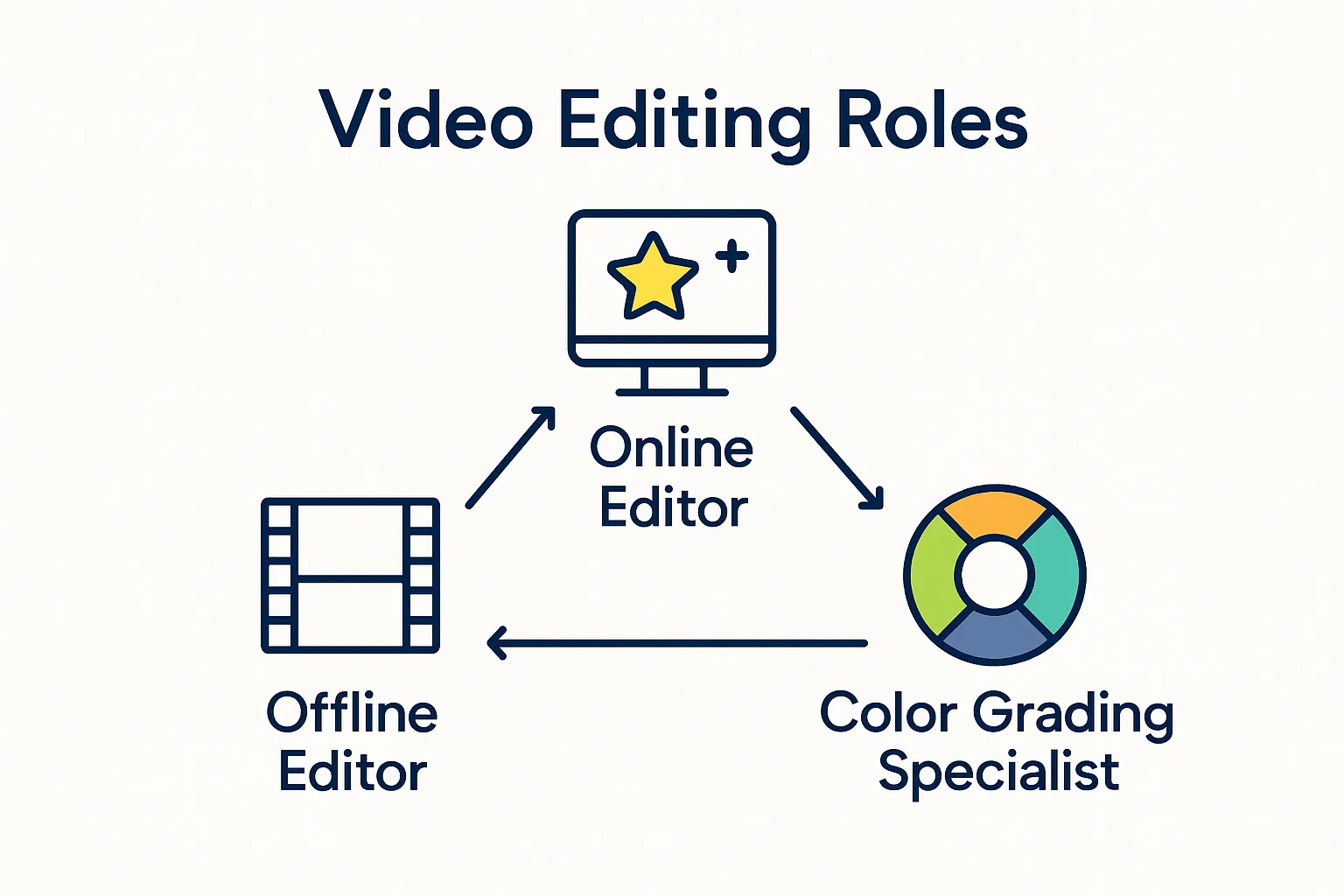
Offline Editors: Focus on initial content selection and rough cut assembly
Online Editors: Responsible for final refinement and high-quality technical finishing
Color Grading Specialists: Manage visual tone, color consistency, and aesthetic mood
According to professional filmmaking research, understanding these roles and their interconnected responsibilities is crucial for producing high-quality visual content that resonates with audiences.
The following table compares the core roles in video editing, highlighting their primary responsibilities and how they contribute to the collaborative workflow.
Role | Main Responsibility | Contribution to Workflow |
Offline Editor | Selects and assembles initial footage | Sets the creative foundation for the entire edit |
Online Editor | Finalizes, refines, and polishes the video | Ensures technical and visual excellence |
Color Grading Specialist | Adjusts color, tone, and mood | Enhances artistic quality and visual consistency |
Mastering video editor terms is not merely about learning vocabulary but comprehending the intricate technical and creative processes that transform raw footage into compelling storytelling experiences.
Below is a table summarizing key video editing terms and their definitions to help you quickly reference essential vocabulary used throughout the editing process.
Term | Definition |
Cutting | The basic process of removing or trimming video segments to refine narrative flow |
Transitions | Visual effects used to move between different scenes or shots smoothly |
Keyframes | Specific points in video editing that mark significant changes in visual parameters |
Offline Editor | Focuses on initial content selection and rough cut assembly |
Online Editor | Responsible for final refinement and high-quality technical finishing |
Color Grading Specialist | Manages visual tone, color consistency, and aesthetic mood |
The Importance of Video Editing Vocabulary in Production
Effective communication is the foundation of successful video production, and a precise, shared vocabulary plays a critical role in transforming creative vision into reality. Professional video editing terminology serves as a universal language that bridges creative intent with technical execution.
Communication and Collaboration Dynamics
In video production, communication goes beyond simple verbal exchanges. Technical vocabulary allows team members to articulate complex visual concepts with precision and clarity. When editors, directors, and producers share a common language, they can rapidly translate abstract creative ideas into tangible visual narratives.
The significance of specialized terminology becomes evident in collaborative environments where multiple professionals must synchronize their creative and technical efforts.

Key advantages of developing a robust editing vocabulary include:
Reducing misunderstandings during complex production processes
Enabling faster problem solving and creative decision making
Creating a standardized communication framework across different production teams
Technological and Creative Interdependence
Modern video production represents a sophisticated intersection of technological skill and creative expression. Precise terminology reflects the intricate relationship between technical tools and artistic vision. Understanding specialized language helps professionals navigate increasingly complex digital editing environments.
According to professional media production research, mastering editing vocabulary is not just about learning definitions but comprehending the nuanced relationships between technical processes and creative storytelling.
Additional benefits of developing comprehensive editing vocabulary include:
Enhanced professional credibility
Improved cross-team communication
More efficient workflow management
Ultimately, video editing vocabulary represents more than technical jargon. It is a sophisticated communication tool that transforms individual creative insights into collective visual narratives, bridging imagination and execution in the dynamic world of film and video production.
Here is a table summarizing how standardized video editing terminology benefits team collaboration and overall project management in video production.
Benefit | Description |
Reduced Misunderstandings | Minimizes confusion during complex production processes |
Faster Problem Solving | Enables efficient resolution of creative and technical issues |
Standardized Communication Framework | Establishes clear expectations across different teams |
Enhanced Professional Credibility | Demonstrates expertise and builds trust among team members |
Improved Workflow Management | Streamlines production timelines and overall efficiency |
How Video Editor Terms Influence Project Collaboration
Project collaboration in video production is a delicate ecosystem where precise communication determines success. Specialized terminology acts as the critical infrastructure that enables seamless interaction between creative professionals. Understanding how video editor terms shape collaborative dynamics reveals the intricate mechanisms behind effective filmmaking.
Language as a Collaborative Framework
In video production, terminology functions far beyond simple communication. It establishes a standardized framework that allows diverse professionals to synchronize their creative and technical efforts. Each specialized term represents a shared conceptual reference point that reduces ambiguity and accelerates decision making.
Professional teams rely on precise language to:
Quickly translate abstract creative concepts
Establish clear technical expectations
Minimize potential misunderstandings during production
Explore advanced workflow strategies in our comprehensive video production guide to understand how specialized terminology drives collaborative efficiency.
Technical and Creative Synchronization
Video editor terms serve as translation mechanisms between creative vision and technical execution. They bridge the gap between directors, cinematographers, editors, and post-production specialists. When a director uses terms like “match cut” or “cross dissolve,” every team member instantly understands the precise visual transformation intended.
According to professional media production research, effective terminology usage can reduce project communication errors by up to 40% and significantly improve overall production efficiency.
Key collaborative benefits of standardized video editing language include:
Faster project iteration cycles
More precise creative feedback
Enhanced cross-departmental understanding
Ultimately, video editor terms transcend mere technical vocabulary. They represent a sophisticated communication protocol that transforms individual creative insights into cohesive, collaborative visual storytelling experiences.
Understanding Technical Language and Its Effects on Creativity
Technical language in video production represents more than a communication tool. It is a sophisticated framework that simultaneously constrains and liberates creative expression. Understanding the nuanced relationship between specialized terminology and artistic innovation reveals the complex interplay between technical precision and creative imagination.
Language as a Creative Constraint and Catalyst
Contrary to popular belief, technical language does not limit creativity but provides a structured environment for artistic exploration. Specialized video editing terminology offers professionals a precise vocabulary that transforms abstract creative concepts into actionable technical strategies. By establishing clear linguistic boundaries, filmmakers can more effectively experiment within a defined creative space.
Key ways technical language influences creative processes include:
Providing structured conceptual frameworks
Enabling more precise creative communication
Creating shared mental models for visual storytelling
Discover advanced creative strategies in our comprehensive video production insights to understand how technical language drives innovative filmmaking.
Cognitive Foundations of Technical Creativity
Technical terminology functions as a cognitive mapping system that translates creative impulses into executable visual strategies. When editors and directors share a sophisticated linguistic toolkit, they can rapidly prototype and communicate complex visual ideas. This shared language allows for faster ideation, more nuanced artistic negotiations, and more efficient creative problem solving.
According to cognitive research in creative communication, specialized language creates cognitive scaffolding that supports more complex and innovative creative thinking.
Critical cognitive benefits of technical language in creativity include:
Enhanced pattern recognition
More sophisticated conceptual thinking
Improved collaborative ideation
Ultimately, technical language in video production is not a restrictive mechanism but a powerful creative enabler. It represents a sophisticated interface between technological precision and artistic imagination, transforming abstract creative visions into tangible visual narratives.
Unlock Seamless Communication and Production Excellence in Switzerland
Are you finding it difficult to turn your understanding of key video editor terms into smooth and successful filmmaking on the ground? The article highlights how mastering specialized language improves collaboration and creativity, but even with the right vocabulary, challenges like permits, reliable crews, and precise logistical execution can lead to costly delays or confusion. Your creative vision deserves the security of knowing every technical detail is expertly managed by a local team.
Bring your project to life without the stress of local hurdles. Our team at Video Production Switzerland transforms your knowledge of video editing terminology into real-world success through proven logistical support and expert crew coordination. Ready for peace of mind and on-time results? Book your free consultation with our production specialists today and experience how our deep experience bridges the gap between technical planning and flawless execution.
Frequently Asked Questions
What are the basic video editing terms I should know?
Basic video editing terms include cutting, transitions, and keyframes. Cutting involves trimming video segments, transitions are visual effects that help move between scenes, and keyframes mark significant changes in visual parameters.
How do video editor terms enhance communication among team members?
Video editor terms establish a common language that allows team members—such as editors, directors, and producers—to communicate complex visual concepts clearly. This shared vocabulary reduces misunderstandings and enhances collaboration during production.
What are the different roles in video editing?
The primary roles in video editing include offline editors, who focus on initial content selection; online editors, who finalize and refine the video; and color grading specialists, who manage the visual tone and color consistency of the project.
How does technical language influence creativity in video editing?
Technical language provides a structured environment that allows filmmakers to transform abstract ideas into actionable strategies. It enables precise communication and helps team members collaborate effectively, fostering innovative problem-solving and artistic exploration.
Recommended
