
Transport Services for Video Production: A 2026 Guide


TL;DR:
Transport services for video production involve specialized logistics that move crew, cast, and equipment efficiently and safely between locations. Proper planning includes understanding available vehicle options, costs, permits, and route scouting to prevent costly delays and equipment damage on set.
Transport services for video production are specialized logistics solutions that move crew, cast, and equipment safely between locations to keep shoots on schedule and within budget. Unlike standard corporate travel, production transport must account for fragile gear, tight call times, permit requirements, and the reality that a delayed truck can cost thousands of dollars per hour in idle crew time. Production managers who treat transportation as an afterthought consistently face the most expensive surprises on set. Getting this right starts with understanding your options, your costs, and your coordination responsibilities before the first shoot day arrives.
For international productions shooting in Switzerland, full-service production support from Videoproductionswitzerland integrates transport coordination directly into the overall logistics plan, so you never have to juggle vendors across time zones.
What transport services are available for video productions?
Production transport falls into three distinct categories: crew movement, talent movement, and equipment movement. Each has different vehicle requirements, licensing needs, and cost structures.
Crew and talent vehicles
Full-size charter coaches handle large crews efficiently and cost between $900 and $2,500 per day in major urban markets. Minibuses, which seat 15–25 passengers, typically run $500–$1,200 per day and work well for mid-size units. Sprinter vans and passenger vans cover smaller groups and offer more flexibility for multi-location days.
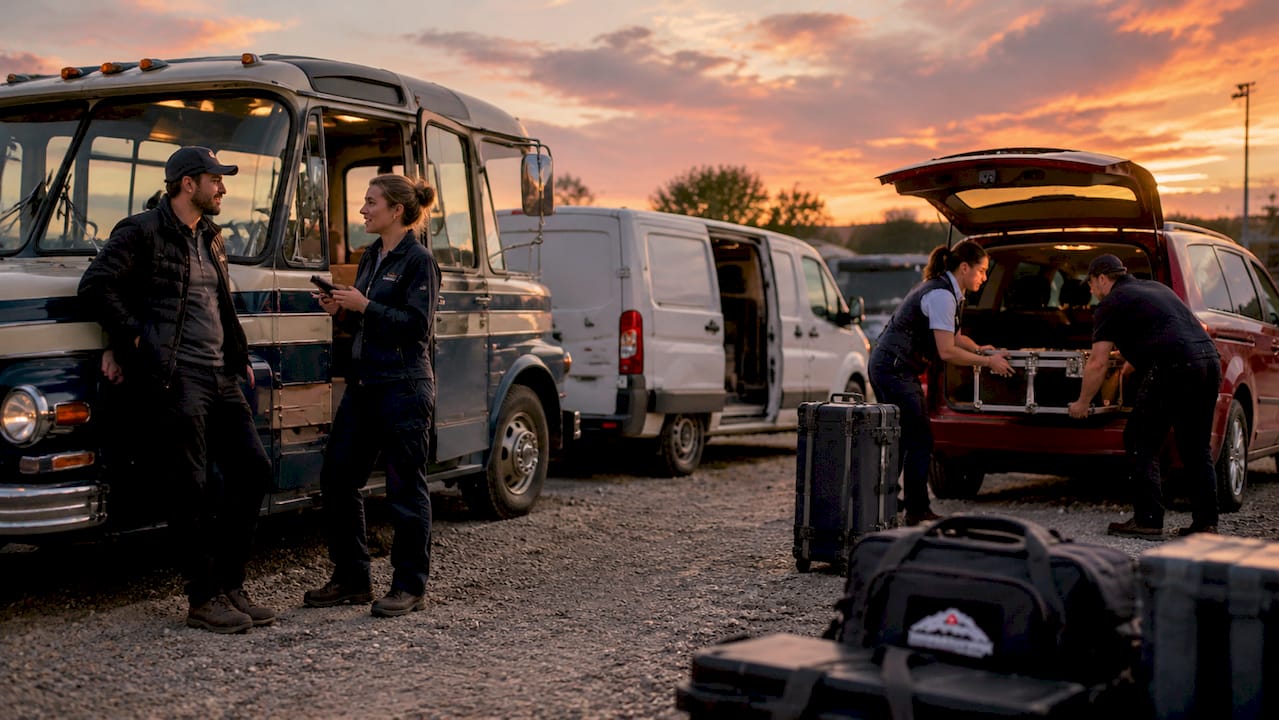
Rideshare apps like Uber are a common fallback, but they create real problems on set. Surge pricing adds roughly 18% to base fares, plus congestion fees in dense cities, and the vehicles rarely have space for production bags, lighting kits, or camera cases. Dedicated shuttle services give you fixed pricing, guaranteed capacity, and a driver who knows the call sheet.
For talent, black-car services and executive vans provide the comfort and privacy that talent contracts often require. These vehicles are bookable through vetted transportation vendors who carry commercial insurance, which your production’s insurance policy will require.
Equipment vehicles
Vehicle type | Capacity | Typical use | Approx. daily cost |
Cargo van | 200–300 cu ft | Small gear, lighting kits | $150–$350 |
Box truck (16–24 ft) | 1,000–1,500 cu ft | Camera packages, grip gear | $300–$600 |
Lift-gate truck | 1,200–2,000 cu ft | Heavy equipment without a dock | $450–$800 |
Climate-controlled van | 200–400 cu ft | Sensitive electronics, film stock | $250–$500 |
4x4 or off-road vehicle | Varies | Remote terrain, mountain locations | $200–$500 |
Climate-controlled vans matter more than most production managers realize. Camera sensors, batteries, and certain lenses degrade in extreme heat or cold, and a single damaged lens can cost more than a week of proper transport.
Pro Tip: Always confirm that equipment vehicles carry commercial cargo insurance, not just standard auto coverage. Standard policies exclude production gear by default.
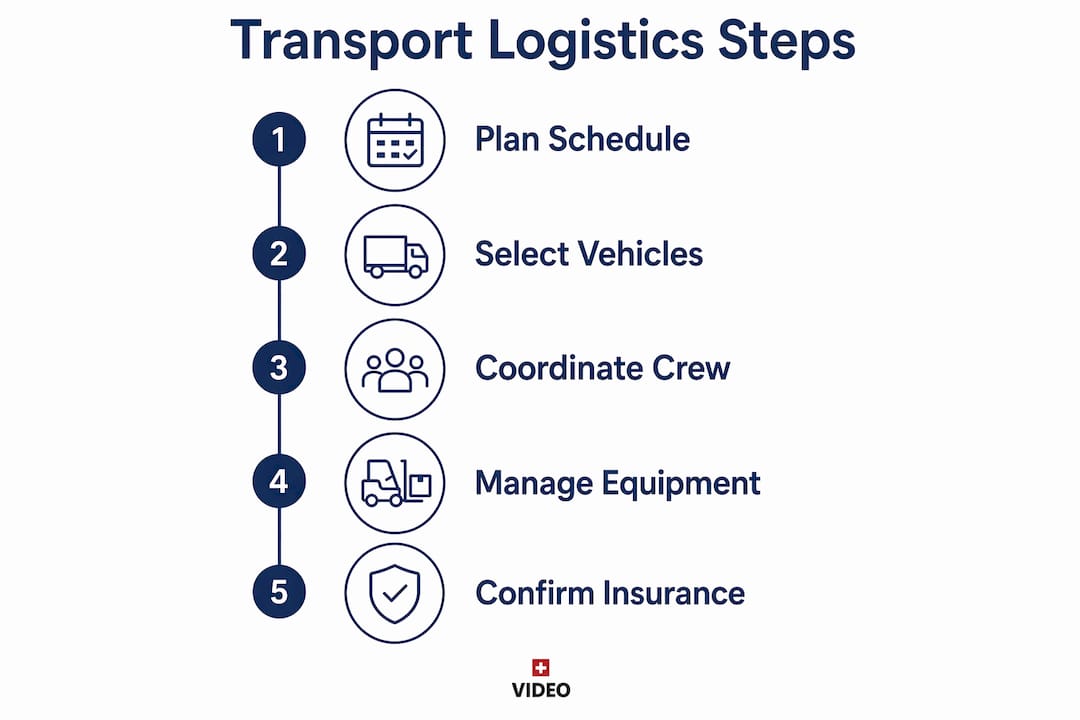
How to plan and coordinate transport logistics for smooth production days
Logistics planning for film set transportation services is not a one-day task. It runs parallel to location scouting, permit applications, and crew contracting from the moment pre-production begins.
Build the transport plan from the call sheet outward. The call sheet is the single most critical logistical document on any production. Every transport decision, from departure times to vehicle assignments, flows from it.
Send call sheets at least 48 hours in advance. Detailed call sheets with load-in addresses, parking instructions, and emergency contacts sent 48+ hours before the shoot day prevent late arrivals and costly idle time. Drivers need this information to plan routes, especially in cities with restricted access zones.
Build in schedule buffers. Multi-day shoots require 15–30 minutes of buffer between setups at the same location and roughly 60 minutes when moving the entire production to a new site. These buffers are not padding. They absorb the real-world friction of loading, traffic, and parking.
Assign a dedicated transport coordinator. On productions with more than 20 crew members or multiple locations, a transport coordinator is not optional. This person manages driver schedules, vehicle assignments, and real-time communication when plans change. Without one, the production manager absorbs that work, which pulls focus from everything else.
Plan for multi-day and multi-location shoots separately. Each location move requires its own vehicle manifest, route confirmation, and load-out schedule. Treating day two as a repeat of day one is how productions lose hours.
Pro Tip: For scheduling production planning on complex shoots, map every location move on a physical timeline before finalizing the call sheet. Visual timelines catch conflicts that text-based schedules miss.
What are the cost factors for transport services in video production?
Production vehicle rental pricing varies by market, season, and vehicle type, but the line items that catch budgets off guard are rarely the base rental rates.
Hidden costs that inflate transport budgets
Driver minimums: Most charter and specialty vehicle vendors require 8–10 hour minimums per driver per day, even if you only need 4 hours of active transport.
Overtime rates: Drivers working beyond the contracted window bill at 1.5x or 2x the hourly rate, which adds up fast on long shoot days.
Permits and access fees: Urban locations often require film transport permits, loading zone permits, and in some cities, congestion zone fees.
Peak season surcharges: Rates increase during peak season, particularly april through june, when demand from commercial and event productions competes with film work.
Insurance riders: Your production insurer may require additional coverage on rented vehicles carrying production equipment.
Equipment transport typically costs more per unit than crew transport because of cargo insurance, specialized vehicles, and the labor involved in loading and securing gear. Budget these two line items separately. Combining them into a single transport figure makes it impossible to identify where overruns occur.
Pro Tip: Always get written quotes with itemized line items before signing any transport contract. Verbal agreements on driver minimums and overtime rates are the most common source of invoice disputes.
How do specialized transport services solve challenges on remote locations?
Remote and unconventional locations create logistics problems that standard rental vehicles cannot solve. Lift-gate trucks and 4x4 vehicles are essential for shoots without loading docks or on rough terrain, and using the wrong vehicle upfront costs far more in delays and damage than the upgrade would have.
The physical environment of a location determines your vehicle choices as much as your gear list does. Key challenges include:
Bridge weight limits: Heavy grip trucks and generators can exceed posted bridge limits on rural roads. Route scouting must include checking posted weight limits and, when in doubt, contacting local transport authorities.
Low clearance heights: Box trucks with standard 13.5-foot clearance fail under historic bridges, parking structures, and urban overpasses. Physical constraints like low clearance cause last-minute logistics failures when routes are not scouted in advance.
Narrow alleys and historic districts: Many European cities, including Swiss towns, have streets that predate motor vehicles. A 24-foot truck that works perfectly in a suburban industrial park becomes a liability in a medieval town center.
Mountain and off-road terrain: High-altitude shoots in locations like the Swiss Alps require 4x4 vehicles and drivers with experience on unpaved mountain roads. Standard cargo vans are not rated for this terrain.
International gear transport: Moving equipment across borders requires an ATA Carnet secured 4–6 weeks before the shoot. This document allows temporary duty-free import and export of production equipment for up to 12 months and costs from $500 depending on gear value. Without it, customs delays can ground an entire production.
Route scouting is not optional on location shoots. The most common cause of last-minute logistics failures is an unvetted route with a physical constraint the production team did not know existed. Scout the route with the actual vehicle, not a passenger car.
Professional drivers with commercial licenses and film set experience handle these variables as a matter of course. They know to check clearances, confirm parking arrangements with location managers, and communicate delays before they cascade. For productions working in Switzerland, transporting heavy film equipment safely across mountain terrain requires this level of expertise, not a general-purpose rental driver.
For group transfers between airports, hotels, and remote shoot locations, vetted transport partners like Go Transfer Peak offer reliable crew shuttles with local route knowledge built in.
Key Takeaways
Reliable film crew transportation requires early planning, the right vehicles, and a dedicated coordinator to prevent costly delays and equipment damage.
Point | Details |
Match vehicle to task | Use lift-gate trucks for heavy gear, climate-controlled vans for sensitive electronics, and charter coaches for large crews. |
Budget beyond base rates | Account for driver minimums, overtime, permits, insurance riders, and peak-season surcharges in every transport budget. |
Send call sheets 48 hours early | Include load-in addresses, parking notes, and emergency contacts to prevent late arrivals and idle set time. |
Scout routes before shoot day | Check bridge weight limits, clearance heights, and road conditions with the actual production vehicle, not a passenger car. |
Secure ATA Carnets early | International productions must apply 4–6 weeks before the shoot to move gear across borders duty-free. |
What I’ve learned about transport coordination after years on set
The single most expensive mistake I see production managers make is treating transport as a vendor problem rather than a planning problem. They book the vehicles, hand off the call sheet, and assume the rest handles itself. It does not.
The detail that causes the most damage is the load-in address. Production managers often forget to list a separate load-in address on the call sheet, so crew and equipment trucks arrive at the public-facing shoot address, which is often a front entrance with no truck access, no parking, and a location manager who is already managing something else. The resulting congestion costs 30–45 minutes on a good day.
The second mistake is relying on rideshares for crew moves on shoot days. I understand the appeal. No contracts, no minimums, instant booking. But when you have 15 crew members moving from a hotel to a mountain location at 5:00 AM, rideshare availability is not guaranteed, surge pricing is real, and the first driver who cancels sets off a chain reaction. A chartered minibus with a confirmed driver costs more upfront and saves you the morning.
My recommendation is to book transport vendors the same week you lock locations. The best drivers and specialty vehicles in any market book out quickly, especially during peak production season. Written contracts with itemized rates protect both sides. And if your production is working in an unfamiliar country, partner with a local fixer or production service company that already has vetted transport relationships in place.
— Pieter
How Videoproductionswitzerland handles your production transport
Planning a shoot in Switzerland means navigating mountain roads, historic town centers, and cross-border logistics that require local knowledge most international productions simply do not have.
[

Videoproductionswitzerland integrates transport coordination into every production package, from airport pickups and crew shuttles to specialized equipment vehicles for alpine locations. With over 20 years of experience managing shoots across Switzerland, the team handles route scouting, driver vetting, permit applications, and scheduling so your crew arrives on time and your gear arrives intact. For a clear picture of what full-service production support costs, the video production pricing page breaks down transport and logistics line items with full transparency. Contact Videoproductionswitzerland to build a transport plan that fits your shoot.
FAQ
What are transport services for video production?
Transport services for video production cover the organized movement of crew, cast, and equipment between locations using vehicles suited to production needs. These services include charter coaches, equipment trucks, talent vehicles, and specialty transport for remote or international shoots.
How much does film crew transportation cost per day?
Full-size charter coaches run $900–$2,500 per day in major markets, while minibuses cost $500–$1,200 per day. Hourly rates for coaches range from $125–$250, with peak-season surcharges applying april through june.
Why are rideshares a poor choice for film set transportation?
Rideshares add surge pricing, congestion fees, and lack the cargo space needed for production gear. Dedicated shuttle services provide fixed pricing, guaranteed capacity, and drivers familiar with production call times.
What is an ATA Carnet and when do I need one?
An ATA Carnet is a customs document that allows temporary duty-free import and export of production equipment across international borders for up to 12 months. Productions must apply 4–6 weeks before the shoot, with costs starting from $500 depending on gear value.
What should a production call sheet include for transport?
A production call sheet must include the load-in address (separate from the public shooting address), parking instructions, driver contact numbers, and emergency contacts. Sending it 48+ hours before the shoot day prevents late arrivals and costly idle time on set.
Recommended
