
Production Support for International Crews: A 2026 Guide


TL;DR:
International production support ensures compliance, scheduling, and budgeting through local permits, crew, and logistics management. Reliable providers with strong local ties and single points of contact prevent delays, legal issues, and budget overruns. Matching support scope to project size and trusting experienced partners lead to smoother international shoots.
Production support for international crews is the integrated, on-the-ground management system that keeps foreign shoots compliant, on schedule, and within budget by handling permits, crew coordination, equipment logistics, and local resource management. Without it, even well-funded productions lose days to permit delays, miscommunication, and vendor failures. The industry term for the specialist who delivers this support is a “fixer,” though full-service production companies now offer the same functions at greater scale. This guide breaks down the top service categories, global models that work, and the criteria that separate reliable partners from costly mistakes.
1. Production support for international crews: what it actually covers
Production support services go far beyond booking a local crew. The full scope includes permit acquisition, visa assistance, location scouting, equipment rental, customs clearance, travel logistics, accommodation, and on-set catering coordination. Each function is interdependent. A delayed equipment import, for example, can stall a crew of 30 people waiting on set.

The Ministry of Information and Broadcasting in India is one example of a government body that requires formal media liaison before foreign crews can film. Providers with established government relationships cut through that process in days rather than weeks. That kind of access is not something you can build from scratch on a tight production timeline.
Understanding the full scope upfront helps production managers budget accurately and avoid gaps in coverage. A provider that handles permits but not customs clearance leaves a critical gap. The strongest support packages cover every operational layer from pre-production through wrap.
2. Local film fixing and permit management
Permit management is the single most common failure point for international shoots. Local fixers with 15+ years of presence in markets like Thailand, Vietnam, and Singapore report that foreign crews consistently underestimate permit lead times. That underestimation causes last-minute scrambles that cost money and damage relationships with local authorities.
A qualified fixer knows which locations require national permits versus municipal ones, which government offices move quickly, and which require personal relationships to expedite. That knowledge is not in any guidebook. It lives in years of on-the-ground work.
Permit management also covers insurance documentation, location releases, and noise ordinance compliance. Skipping any one of these creates legal exposure that can shut down a shoot mid-day.
3. Crew recruitment and coordination
Hiring local crew without a trusted intermediary is one of the fastest ways to blow a production budget. Vetting, contracts, payroll compliance, and on-set communication all require local knowledge. Crew management firms that operate with a single point of contact (PIC) manage all requests internally, covering both operational and financial needs, with global offices providing quality control.
The PIC model matters because it eliminates the coordination gaps that appear when a production manager tries to manage five separate local vendors at once. One contact, one chain of accountability.
For international shoots, bilingual crew coordination is non-negotiable. Fixers fluent in English and regional languages help foreign crews navigate local contexts and liaise directly with government officials. That fluency prevents the kind of miscommunication that turns a simple permit question into a two-day standoff.
4. Equipment rental and technical logistics
Equipment logistics for international shoots involve more than finding a rental house. Customs documentation, carnet processing, import permits, and in-country transport all require coordination. A missing carnet can hold a camera package at customs for three days.
The best production support providers maintain relationships with bonded warehouses and freight forwarders. They know which equipment categories trigger additional scrutiny at specific borders. That knowledge saves time and prevents costly delays before a single frame is shot.
Technical logistics also include on-set equipment management: backup gear sourcing, generator rental, and last-minute replacements. A provider who can source a replacement lens in four hours in an unfamiliar city is worth more than one who simply hands you a rental catalog.
5. Location scouting and on-location management
Location scouting for international productions requires more than visual appeal. Access rights, structural safety, ambient noise levels, power availability, and proximity to base camp all affect shoot viability. A location that looks perfect in photos can fail on three of those criteria.
On-location management during the shoot day covers crowd control, local authority liaison, and real-time problem solving. When a location owner changes terms at 6 a.m. on shoot day, a local manager with relationships resolves it. A remote production manager on a different time zone cannot.
Pro Tip: Always request a location scout report that includes power access, nearest hospital, and local authority contact before committing to any international location.
6. Visa assistance and government media liaison
Specialized media visas are a separate category from standard tourist or business visas. Many countries require a journalist or production visa for commercial filming, and the application process involves government media bodies. Providers in North India with over two decades of experience handle visas and permits directly with the Ministry of Information and Broadcasting, cutting processing time significantly.
Government liaison is a relationship business. Providers who have worked with the same officials for years get faster responses and clearer guidance on edge cases. That speed translates directly into production days saved.
Visa processing timelines vary by nationality and destination. A production support provider should give you a realistic timeline at the outset, not an optimistic estimate that collapses under real conditions.
7. Travel, accommodation, and catering coordination
Logistics for a crew of 20 or more people across multiple shoot days require military-level coordination. Flight schedules, hotel blocks, ground transport, and meal planning all interact. A delayed flight that cascades into a missed hotel check-in and a hungry crew on day one sets a terrible tone for the entire shoot.
Experienced production support providers manage travel logistics as a single integrated system. They build buffer time into schedules, hold contingency hotel rooms, and have catering vendors on standby. That preparation is invisible when things go right and critical when anything goes wrong.
Catering is often underestimated as a logistics function. Dietary requirements, local food safety standards, and on-location delivery windows all require active management. A crew that eats well and on time performs better. That is not a soft benefit. It shows up in the footage.
8. Customs clearance and equipment import support
Equipment crossing international borders requires a carnet ATA, the international customs document that allows temporary import of professional gear without paying duties. Managing that document correctly, with accurate gear lists and proper endorsements at each border, is a specialized skill. Errors result in fines or confiscated equipment.
Production support providers with customs experience maintain relationships with freight forwarders and customs brokers in their markets. They know which categories of equipment face additional scrutiny and prepare documentation accordingly. That preparation prevents the kind of border delays that cost a production its first shoot day.
9. Budget transparency and financial management
Transparent budget management from dedicated local fixer services eliminates cost surprises for international crews and producers. That transparency matters because international productions routinely encounter unexpected costs: local taxes, overtime regulations, location damage deposits, and government fees that do not appear in standard budget templates.
A production support provider who gives you a clear, itemized budget at the start and flags changes in real time is protecting your production. One who presents a final invoice with unexplained line items is a liability.
Pro Tip: Request a line-item budget breakdown before signing any production support agreement. Any provider who resists that request is a red flag.
10. How to evaluate and choose a production support provider
Choosing the right provider requires comparing specific criteria, not just reviewing a website. The table below covers the key feature categories to assess.
Feature category | What to look for |
Local presence | Years of active operation in the target country, not just regional coverage |
Service range | Full-scope coverage from permits to wrap logistics, not partial packages |
Crew quality | Vetted, documented crew with clear contracts and compliance records |
Communication | Bilingual support and a single point of contact for all requests |
Budget management | Itemized quotes, real-time tracking, and no surprise invoicing |
Contingency planning | Documented backup plans for equipment failure, weather, and permit issues |
Pro Tip: Ask any prospective provider for two references from productions of similar scale in the same country. A provider who cannot supply references has not done the work.
11. Matching support type to your project
Not every production needs the same level of support. Matching the service scope to your project type saves money and avoids over-engineering simple shoots.
Small documentary or commercial shoot: A local fixer with permit experience and a trusted crew of 3–5 people covers most needs. Multi-location fixer services coordinate permits, crews, and equipment movement with transparent budgets, even for lean productions.
Large multi-country shoot: You need an integrated line production company with offices or vetted partners in each country. Crew management firms with global offices and a PIC model handle the complexity without losing accountability.
Government-regulated locations: Projects filming in restricted zones or requiring government cooperation need providers with direct ministry relationships. This is non-negotiable in markets like India, China, and the UAE.
Emergency or last-minute support: Look for providers with 24-hour response capability and pre-vetted vendor networks. A provider who needs 48 hours to source a replacement camera is not built for emergencies.
Multi-week shoots with large crews: Welfare, retention, and compliance matter at scale. Crew management services that include training, certification, and performance evaluation reduce turnover and maintain quality across long productions.
Key takeaways
Reliable production support for international crews depends on local expertise, a single point of contact, transparent budgeting, and full-scope service coverage from permits through wrap logistics.
Point | Details |
Permits require local relationships | Government access built over years cannot be replicated by a new vendor on a tight timeline. |
Single point of contact reduces risk | One accountable contact eliminates the coordination gaps that appear when managing multiple vendors. |
Budget transparency is non-negotiable | Itemized quotes and real-time tracking prevent the cost surprises that derail international productions. |
Match support scope to project size | Small shoots need a local fixer; large multi-country productions need integrated line production companies. |
Bilingual coordination prevents delays | Fixers fluent in local languages resolve permit and authority issues that remote managers cannot. |
What I’ve learned about production support after years in the field
The biggest mistake I see international production managers make is treating local support as a commodity. They send the same RFP to five providers, pick the lowest quote, and then spend the first shoot day managing a crisis that a more experienced partner would have prevented.
Local expertise is not interchangeable. A fixer who has worked with the same permit office for a decade gets a phone call returned in two hours. A new provider gets a form letter and a three-week wait. That difference does not show up in a quote comparison.
Digital communication tools have improved coordination significantly. Real-time messaging, shared production calendars, and cloud-based document management mean that a production manager in New York can track a permit application in Zurich in real time. But those tools only work when the local partner is disciplined enough to use them consistently.
The productions I have seen run smoothly share one trait: they committed to a single, experienced local partner early and gave that partner the authority to make decisions on the ground. The ones that struggled tried to manage everything remotely or split responsibilities across too many vendors.
My recommendation is simple. Find a provider with verifiable local presence, check their references, and give them a clear brief. Then trust them to do the work. That trust, backed by a transparent contract, is what keeps international shoots on time and on budget.
— Pieter
Videoproductionswitzerland: full-service support for your Swiss shoot
International productions filming in Switzerland face a specific set of challenges: cantonal permit systems, multilingual crew coordination, Alpine location logistics, and strict local regulations. Videoproductionswitzerland handles all of it.
[
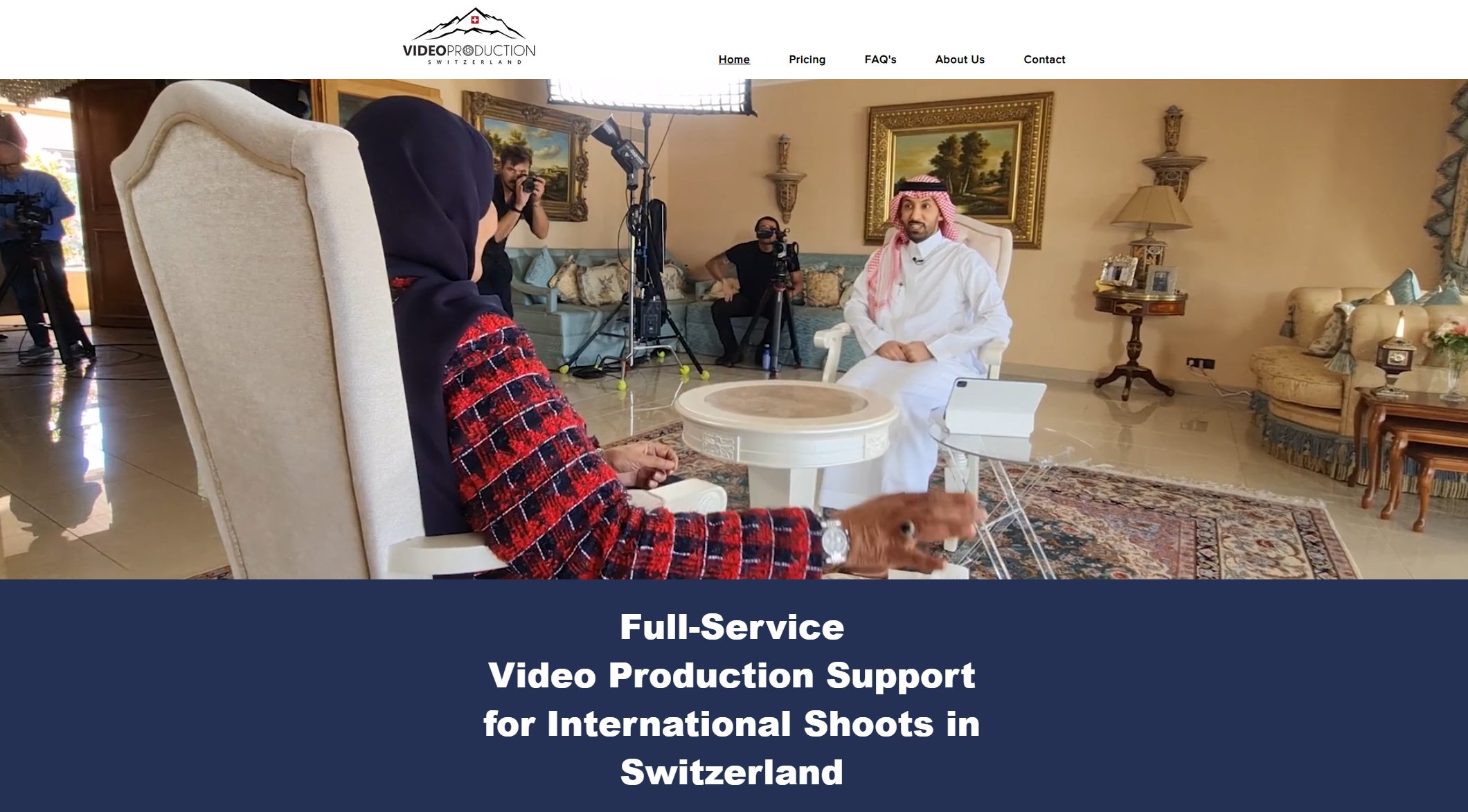
With over 20 years of experience supporting foreign crews, Videoproductionswitzerland manages permits, crew sourcing, equipment rental, location scouting, and transportation as a single integrated service. You get one point of contact, transparent pricing, and a team that has solved every logistical problem Switzerland can throw at a production. Review the full production costs upfront, then contact Videoproductionswitzerland to plan your shoot with zero surprises.
FAQ
What does production support for international crews include?
Production support for international crews covers permit acquisition, crew hiring, equipment logistics, customs clearance, location management, travel coordination, and on-set problem solving. The full scope varies by provider, but the strongest packages handle every operational layer from pre-production through wrap.
How do I find a reliable local fixer for an international shoot?
Look for providers with verifiable local presence of at least several years, bilingual capability, and references from productions of similar scale. Fixer firms in Southeast Asia with 15+ years of on-the-ground experience demonstrate the kind of track record worth prioritizing.
Why is a single point of contact important for international crew management?
A single point of contact eliminates the coordination gaps that appear when a production manager tries to manage multiple local vendors simultaneously. Crew management firms that operate with one PIC handle all operational and financial requests internally, keeping accountability clear.
How do specialized media visas differ from standard business visas?
Media or journalist visas are required in many countries for commercial filming and involve government media bodies rather than standard immigration channels. Providers with direct relationships with bodies like the Ministry of Information and Broadcasting process these applications faster and with fewer complications.
What is the most common budget mistake on international productions?
The most common mistake is accepting a quote without a line-item breakdown. Transparent budgets from experienced local providers eliminate surprise expenses. Always request itemized quotes and confirm what is and is not included before signing any production support agreement.
Recommended
