
Accommodation Services for Video Production Teams


TL;DR:
Accommodation services for video production provide fully furnished housing with high-speed internet near filming sites to meet crew needs. These specialized solutions ensure flexibility, privacy, and operational essentials, reducing delays and improving productivity on set. Choosing dedicated providers over standard rentals is crucial for successful, cost-effective production logistics.
Accommodation services for video production are defined as specialized housing solutions designed to meet the logistical, comfort, and connectivity demands of filmmakers and production crews during active shoots. Unlike standard short-term rentals, these services provide fully furnished spaces with high-speed internet, flexible lease terms, and proximity to filming locations. For international teams shooting in unfamiliar markets, the quality of their housing directly affects crew morale, scheduling reliability, and overall production output. Getting this right from day one is not a luxury. It is a core part of production logistics that separates smooth shoots from costly ones.
What are the essential features of accommodation services for video production?
Production-ready housing is not the same as a furnished apartment listed on a general rental platform. Most furnished housing for the general public lacks the separate bedrooms, dedicated laundry, and full kitchens that production teams need for multi-week shoots. That gap matters because crew members working 12-hour days need a home-like environment to recover, not a hotel room with a mini-fridge.
The non-negotiable features for film crew accommodations include:
Minimum stay alignment: Most corporate-rate housing for production teams requires a 30-day minimum to unlock flexible lease terms and volume pricing. Booking shorter stays typically means paying consumer rates with no flexibility for extensions.
High-speed internet: Production housing must deliver at least 100 Mbps connectivity, with 300+ Mbps increasingly cited as the standard for remote editing, daily footage uploads, and simultaneous data transfers across departments.
Full kitchen and laundry: These are not amenities. They are operational necessities for crews on long schedules who cannot sustain restaurant meals or laundromat runs without losing time.
Separate bedrooms: Privacy between crew members prevents fatigue-driven conflict and supports the recovery that long shooting days demand.
Flexible lease terms: Open-ended extension clauses protect productions against schedule overages without triggering eviction risk or penalty fees.
Location proximity: Housing within a short commute of the primary filming location reduces daily transit time and keeps crew alert for early call times.
Pro Tip: When evaluating housing providers, ask specifically whether the unit has been used by a production crew before. Properties with prior production tenants are far more likely to have the electrical capacity, internet infrastructure, and wear tolerance that film teams require.
How do different accommodation types compare for video production crews?

The right housing format depends on production length, crew size, and how much logistical control your team needs on location. Hotels, serviced apartments, and modular on-site units each serve a different production profile.
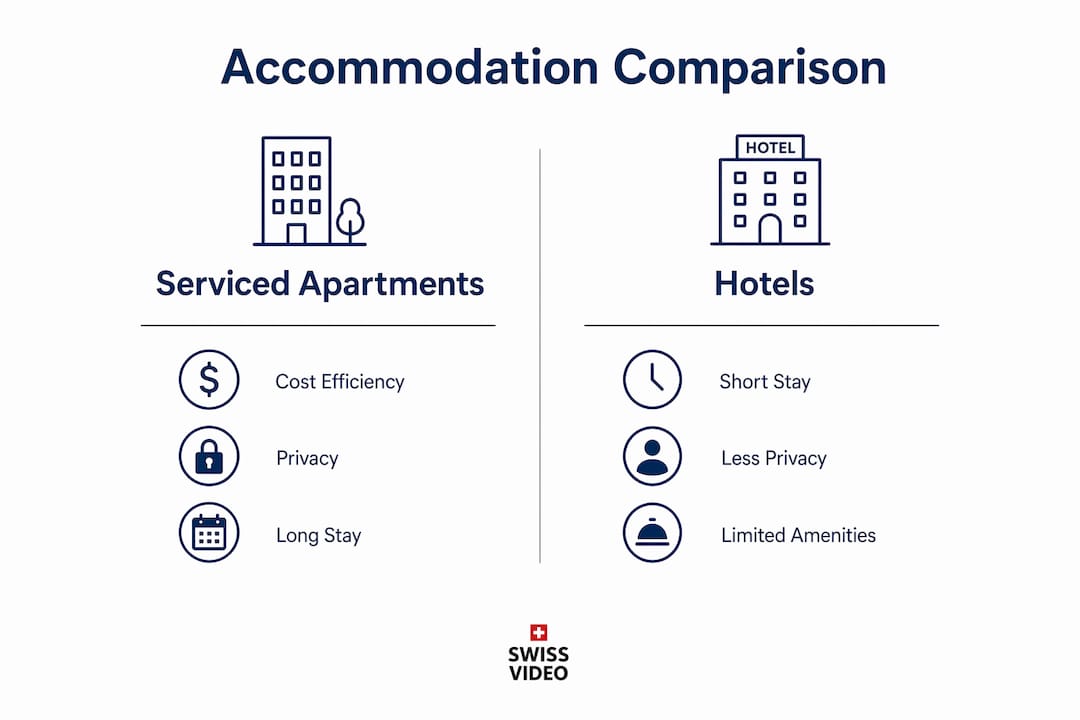
Serviced apartments are the preferred choice for shoots exceeding 7–14 days because they offer better cost efficiency, privacy, and residential amenities than hotels. A hotel room works for a two-day scout trip. It does not work for a six-week commercial campaign with a crew of 20.
Accommodation type | Cost | Privacy | Amenities | Flexibility | Lease length |
Hotel | High per night | Low | Limited | Low | Nightly |
Serviced apartment | Moderate | High | Full kitchen, laundry | Moderate | Weekly or monthly |
Corporate housing | Lower long-term | High | Full residential | High | 30+ days |
Modular on-site units | Variable | High | Basic to full | High | Project-based |
Modular solutions represent the most specialized end of the spectrum. Purpose-built units like RestPods or double-stacked cabins are deployed directly on or near set, with up to 15+ units managed on a single site for large productions. This format works best for remote locations, secure sets where talent cannot leave freely, or productions with strict confidentiality requirements.
For international teams, reliable connectivity in accommodations is a deciding factor regardless of housing type. A serviced apartment with slow internet is a worse choice than a hotel with a dedicated fiber connection.
Pro Tip: For productions running longer than three weeks, negotiate a blended arrangement: serviced apartments for the core crew and a small block of hotel rooms for rotating talent and visiting executives. This keeps costs down while maintaining flexibility.
What logistical challenges does production accommodation solve?
Housing for filmmakers solves problems that go well beyond where people sleep. The most costly production delays often trace back to accommodation failures: a crew member who cannot commute to a 5:00 AM call, a director who cannot upload dailies because the internet failed, or a department head who quit mid-shoot because the living conditions were unacceptable.
Specialized production accommodation addresses these challenges through four core mechanisms:
Scalable housing for fluctuating crew sizes. Productions rarely run with the same headcount from pre-production through wrap. Specialized providers handle rapid crew changes, additions, and departures without the penalties that standard landlords impose for early termination or last-minute additions.
Residential stability for long shoots. The primary goal of purpose-built production housing is residential stability, which creates a home-like environment that reduces stress during extended schedules. Crews that feel settled perform better and call in sick less often.
Month-to-month lease protection. Experienced production managers negotiate open-ended extension clauses before signing any lease. When a shoot runs three weeks over schedule, a standard fixed-term lease becomes a legal and financial crisis. A month-to-month clause makes it a phone call.
Consolidated invoicing and dedicated contacts. Production accounting teams cannot process 15 separate hotel invoices across three properties. Specialized housing providers issue consolidated billing and assign a single point of contact who understands production schedules, not standard check-in policies.
Pro Tip: Always loop in your production accountant before signing a housing agreement. Lease structures that look flexible on paper can create tax complications or budget reporting issues that slow down post-production approvals.
How to select and book accommodation services for video production
Selecting the right temporary lodging for videographers and production teams requires more than comparing nightly rates. The booking process should start at least four to six weeks before principal photography, and for large international productions, three to four months ahead is more realistic.
The criteria that matter most when evaluating providers:
Production specialization: A provider who has housed film crews before understands call sheets, wrap dates, and why a lease needs an extension clause. General real estate firms do not.
Internet verification: Request documented speed test results for the specific unit, not the building average. Speeds vary significantly floor by floor and unit by unit.
Furnishing standards: Confirm that the unit includes a full kitchen, in-unit laundry, and enough bedrooms to give key crew members private space. Ask for a floor plan, not just photos.
Location mapping: Plot the housing address against your primary filming locations, equipment storage, and the nearest airport. A 20-minute commute versus a 60-minute commute compounds across a six-week shoot into dozens of lost crew-hours.
Extension terms: Read the extension clause before signing. Confirm the notice period required to extend and whether the rate locks in or resets to market pricing.
Accounting compatibility: Verify that the provider issues consolidated invoices and can accommodate purchase orders, which most production accounting systems require.
For international productions, working with a local agency that specializes in production support for international crews removes the risk of navigating unfamiliar housing markets alone. Local specialists know which neighborhoods work for production logistics and which providers have a track record with film teams.
Key Takeaways
Specialized accommodation services for video production are a logistical requirement, not an optional comfort, and the quality of housing directly determines crew performance and schedule reliability.
Point | Details |
30-day minimum for corporate rates | Book housing with a 30+ day minimum to access flexible lease terms and volume pricing. |
Internet speed is non-negotiable | Verify 100 Mbps minimum, with 300+ Mbps as the current standard for remote editing and uploads. |
Serviced apartments beat hotels past two weeks | For shoots longer than 7–14 days, serviced apartments deliver better cost, privacy, and amenities. |
Flexible lease terms prevent costly overages | Negotiate month-to-month extension clauses before signing to protect against schedule delays. |
Specialized providers outperform general landlords | Production-focused housing vendors handle crew changes and schedule shifts without penalties. |
Why I think most productions underestimate the housing decision
After working with international production teams across multiple markets, the pattern is consistent: housing gets treated as a line item rather than a strategic decision. Teams spend weeks selecting camera packages and days selecting where their crew will sleep.
The real cost of poor accommodations shows up in ways that never appear on a housing invoice. A director of photography who cannot upload dailies because the apartment internet maxes out at 15 Mbps costs you a full editing day. A gaffer who lives 90 minutes from set because the “cheaper” option was farther out costs you overtime on every early call. These are not hypothetical scenarios. They happen on productions that did not treat housing as part of their logistics plan.
The emerging shift toward modular on-site units for large or secure productions is the most interesting development in this space right now. Keeping talent and key crew within walking distance of set eliminates commute variables entirely and gives productions a level of schedule control that off-site housing simply cannot match.
My honest advice: treat your accommodation budget the same way you treat your equipment budget. Cutting corners on either one costs you more in the end. And always, always negotiate the extension clause before you sign.
— Pieter
How Videoproductionswitzerland handles accommodation for international crews
International productions shooting in Switzerland face a specific challenge: a high-cost market with strict local regulations and limited production-experienced housing providers. Getting the accommodation piece wrong in Switzerland is expensive and hard to fix mid-shoot.
[
Videoproductionswitzerland coordinates film crew accommodations as part of its full-service production support, handling everything from sourcing production-ready housing to managing lease logistics and proximity planning relative to your shooting locations. With over 20 years of experience in the Swiss market, the team knows which housing options meet production standards and which ones look good on paper but fail on set. For teams planning a shoot in Switzerland, reviewing production costs and logistics early in pre-production makes the accommodation decision significantly easier and more cost-effective.
FAQ
What is the minimum stay for production housing?
Most corporate-rate production housing requires a 30-day minimum to qualify for flexible lease terms and volume pricing. Shorter stays typically revert to standard consumer rates with no extension options.
What internet speed does a film crew need in accommodations?
Production teams need at least 100 Mbps, with 300+ Mbps recommended for remote editing, footage uploads, and simultaneous data transfers across multiple departments.
When should a production choose serviced apartments over hotels?
Serviced apartments are the better choice for any shoot lasting longer than 7–14 days, offering better cost efficiency, privacy, and full residential amenities that hotels cannot match at scale.
How do productions handle unexpected schedule extensions?
Experienced production managers negotiate month-to-month lease options or open-ended extension clauses before signing any housing agreement. This protects the production from penalties or eviction risk when shoots run over schedule.
Why use a specialized production housing provider instead of a general rental agency?
Specialized providers understand volatile film schedules and adapt to rapid crew changes without the penalties that standard landlords impose. They also offer consolidated invoicing and dedicated contacts familiar with production workflows.
Recommended
