
Production Services for Foreign Companies Filming in Switzerland


TL;DR:
Production services for foreign companies include multi-layered support systems that manage permits, crew, logistics, and budgets for international shoots. A trusted local partner is essential in Switzerland due to complex permit requirements, linguistic needs, and incentive programs, ensuring smooth operations across regions. Using a single point of contact reduces delays, improves communication, and optimizes costs throughout multi-location productions.
Production services for foreign companies are specialized, multi-layered support systems that manage everything from crew sourcing and permit acquisition to budget compliance and on-set logistics, ensuring film shoots cross borders without operational delays. The industry term for this role is “line production services,” and it covers far more than simply hiring local crew. For international filmmakers and production managers targeting Switzerland, the stakes are high: Swiss municipalities enforce strict filming regulations, cantonal incentive programs require precise documentation, and cultural nuances shape every vendor relationship. Getting these details wrong costs time, money, and creative momentum. Getting them right requires a trusted local partner who knows the terrain.
What are the core components of production services for foreign companies?
International production services consist of four integrated layers that operate simultaneously from the first budget draft through post-production audit closeout. Understanding each layer helps you evaluate any production partner before you commit.
Line production execution. This covers crew hiring, shoot scheduling, vendor management, and daily budget tracking. A strong line producer keeps your shoot on time and your spend visible at every stage.
Permit and compliance governance. This layer handles multi-jurisdictional permissions, location agreements, visa support, and customs documentation for foreign equipment. In Switzerland, cantonal authorities each have their own approval processes, which means permit timelines vary significantly by location.
Incentive engineering. This is the practice of mapping local spend against national and regional rebate programs starting in the initial budget draft. Eligibility gaps discovered during a post-production audit are expensive and largely avoidable with early planning.
IP and rights structuring. This layer manages chain-of-title documentation, co-production treaty compliance, and remake rights. Foreign companies often underestimate how much legal exposure sits in this area.
These four layers do not operate in sequence. They run in parallel, which is why production outsourcing for companies works best when a single experienced team manages all of them together.
Pro Tip: Ask any production partner to show you how their incentive planning integrates with their scheduling process. If they treat those as separate workstreams, budget overruns are likely.
How do production service providers support foreign companies in Swiss filming logistics?
Switzerland presents a specific set of logistical challenges that generic production support cannot solve. Local knowledge is not a bonus here. It is the product.
Crew and vendor sourcing. Vetted local crews with experience on international projects are not easy to find through general listings. Reliable production partners maintain networks built over years, connecting you with directors of photography, gaffers, sound engineers, and production assistants who understand both Swiss working standards and international creative briefs.
Location scouting and permit facilitation. Swiss municipalities require formal applications, often in German, French, or Italian depending on the canton. A local partner handles the paperwork, communicates directly with authorities, and tracks approval timelines so your shoot schedule stays intact.
Equipment logistics and customs clearance. Professional production services manage customs clearance and temporary import permits for foreign gear. This prevents equipment from sitting in customs while your shoot day burns through the budget.
Bilingual coordination. Bilingual producers and vetted crews fluent in English reduce miscommunication between your international team and local vendors. This matters most during fast-moving shoot days when a misunderstood instruction can cost an hour of setup time.
Real-time contingency management. Weather changes, permit revisions, and vendor cancellations happen on every production. A local partner with established relationships resolves these issues faster than any remote coordinator can.
Pro Tip: Share a rough draft timeline and a clear scope with your local coordinator before the first call. Early timeline sharing enables precise permit planning, which can take anywhere from days to months depending on the location.
Videoproductionswitzerland provides all five of these functions under one roof, with over 20 years of Swiss market experience. Their team handles Swiss film production logistics from the first consultation through wrap day.
Why is a single point of contact critical for complex international productions?
Fragmented vendor management in multi-city or multi-location productions increases the risk of permit bottlenecks, continuity failures, and logistics miscommunication. This is the most common and most costly mistake foreign companies make when organizing shoots abroad.
The contrast between fragmented and integrated management is stark:
Factor | Fragmented vendors | Integrated partner |
Permit coordination | Each vendor tracks their own approvals | One team manages all approvals centrally |
Budget visibility | Costs reported separately, often late | Single budget view updated in real time |
Continuity between locations | High risk of gaps and miscommunication | Consistent crew and process across sites |
Problem resolution | Delayed by vendor finger-pointing | Resolved by one accountable contact |
Compliance exposure | Higher risk of overlooked requirements | Monitored throughout by one team |
The advantages of a single point of contact go beyond convenience. When one partner coordinates crew movement, equipment logistics, and permit renewals across multiple Swiss cantons, approvals accelerate because the same team has existing relationships with local authorities. Continuity holds because the same people manage every location. And when something goes wrong, there is no confusion about who owns the fix.
Global production networks now coordinate shoots across 43 countries from a single point of contact. That scale reflects how seriously experienced producers take integrated management. The principle applies directly to Switzerland, where a shoot spanning Zurich, Geneva, and the Alps involves three distinct regulatory environments.
How do international productions optimize budgets through incentive engineering?
Budget optimization in international production is not about cutting costs. It is about capturing money you are already entitled to. Switzerland offers both federal and cantonal production incentives, but eligibility depends on how spend is categorized from the very first budget draft.
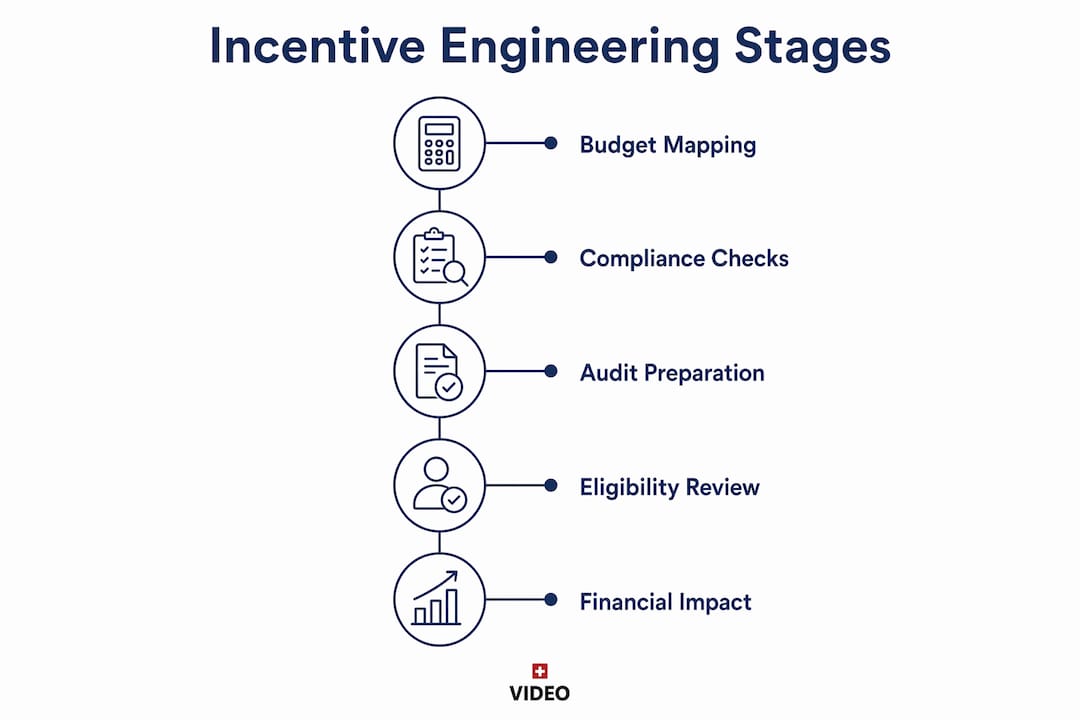
Incentive engineering works in three stages:
Stage 1: Budget mapping. At the initial budget stage, a qualified production partner identifies which line items qualify for Swiss federal support and which cantonal programs apply to your specific shooting locations. This mapping shapes how contracts are structured and how vendor invoices are categorized.
Stage 2: Ongoing compliance checks. As the production moves forward, spend must be tracked against the original incentive plan. Deviations, such as switching a local vendor for a foreign one, can disqualify entire budget categories. A local partner monitors these changes in real time.
Stage 3: Post-production audit preparation. Incentive claims require documentation that meets specific standards. Proper incentive planning from the start means your audit file is built throughout production, not assembled in a panic after wrap.
The financial impact is real. Productions that skip early incentive planning often discover eligibility gaps only during the audit, at which point the spend has already been made and the opportunity is gone. Local expertise in Swiss documentation standards is what separates a clean audit from a costly one. Videoproductionswitzerland’s team integrates incentive planning directly into production scheduling, so financial compliance and creative execution stay aligned throughout the shoot. You can review their production cost structures to understand how this planning affects your overall budget.
Key takeaways
Production services for foreign companies require four integrated layers, local expertise, and a single point of contact to protect budget, compliance, and creative output in Switzerland.
Point | Details |
Four integrated layers | Line production, permits, incentive engineering, and rights structuring must run simultaneously from day one. |
Single point of contact | One coordinating partner reduces permit delays, continuity failures, and budget surprises across locations. |
Early incentive mapping | Mapping spend against Swiss rebate programs at the budget stage prevents costly eligibility gaps at audit. |
Bilingual local crews | Vetted crews fluent in English and local languages reduce miscommunication and protect your shoot schedule. |
Swiss-specific permit complexity | Each Swiss canton has its own approval process, making local relationships more valuable than general production knowledge. |
What I’ve learned about trusting local expertise over remote coordination
By Pieter
After years of working on international productions in Switzerland, the lesson I keep coming back to is this: the productions that run smoothly are the ones where the foreign team trusted their local partner early and completely. The ones that struggled almost always tried to manage too much remotely.
Cultural navigation and local authority relationships matter more than budget size. I have seen well-funded productions stall for days because a production manager in another country tried to handle a cantonal permit application by email, without understanding the local protocol. A local partner with an existing relationship with that same authority would have resolved it in hours.
The other misconception I see constantly is about staffing timelines. Foreign production managers often assume they can finalize crew two weeks before a shoot. In Switzerland, the best local crew books out months in advance, especially for summer shoots in high-demand locations like the Alps or Zurich’s old town. Early scoping is not just good practice. It is the difference between getting the crew you want and settling for whoever is available.
My honest advice: treat your local production partner as a co-producer, not a vendor. Share your creative brief, your budget constraints, and your timeline concerns from the first conversation. The more context they have, the better they can protect your production from the risks you have not thought of yet.
— Pieter
Why Videoproductionswitzerland handles what remote coordination cannot
Foreign production managers who have tried to coordinate Swiss shoots from abroad know how quickly logistics can unravel without a trusted local team on the ground.
[
Videoproductionswitzerland provides full-service production support in Switzerland for international film and media clients, covering permits, crew sourcing, equipment logistics, location scouting, and on-set coordination under one experienced team. With over 20 years of Swiss market knowledge and a bilingual crew network vetted for international standards, they remove the operational risks that derail foreign shoots. Their process starts with a free consultation and moves through a detailed needs assessment before any execution begins. For a clear picture of what this support costs, their pricing page breaks down service tiers and budget planning options.
FAQ
What are production services for foreign companies?
Production services for foreign companies are end-to-end logistical and compliance support systems that cover crew sourcing, permits, equipment logistics, and budget management for international film shoots. They are also called line production services and operate across four integrated layers from budget planning through post-production audit.
How long does it take to get filming permits in Switzerland?
Permit timelines in Switzerland vary significantly by canton and location, ranging from a few days for straightforward locations to several months for complex or high-traffic sites. Sharing a draft timeline with a local production partner early in the process is the most reliable way to avoid delays.
Why should foreign companies use a single production partner instead of multiple vendors?
A single production partner reduces permit bottlenecks, budget fragmentation, and continuity failures that commonly occur when multiple vendors manage different parts of a shoot. Integrated management means one team is accountable for every moving part.
What is incentive engineering in film production?
Incentive engineering is the practice of mapping production spend against national and regional rebate programs from the first budget draft. It prevents eligibility gaps that are only discovered during post-production audits, when the spend has already been made.
Does Videoproductionswitzerland support multi-location shoots across Switzerland?
Yes. Videoproductionswitzerland coordinates crew, permits, and logistics across multiple Swiss cantons, providing a single point of contact for productions that span different regions and regulatory environments.
Recommended
