
Multilingual Video Production Support for Global Creators


TL;DR:
Multilingual video production involves translating and culturally adapting content using speech, subtitles, and visuals. AI speeds up this process, supporting over 80 languages, but human review remains essential for cultural accuracy. Combining AI tools with native expertise produces effective, localized videos that engage global audiences.
Multilingual video production support is the process of transforming video content into multiple languages through synchronized voiceovers, subtitles, and culturally adapted visuals to engage international audiences authentically. For content creators targeting diverse markets, this process goes far beyond simple translation. It combines audio localization solutions, bilingual video editing, and cross-cultural video strategies into one coordinated workflow. Modern platforms now support 80+ languages with native voiceovers and deliver fully localized assets in under 10 minutes. That speed changes what is possible for independent creators and global brands alike.
What are the core components of multilingual video production support?
Multilingual video production support covers four interconnected disciplines: transcription, translation, dubbing, and caption styling. Each step depends on the one before it. A mistranslated transcript creates sync errors in the dubbed audio, which then forces expensive re-edits downstream.

AI-powered platforms now handle voiceover generation, lip-syncing, and captioning within a single workflow. Integrated transcription and translation platforms prevent repeated re-imports and reduce rework significantly. That integration is the single biggest efficiency gain available to creators working across multiple markets.
Voice cloning is one of the most underused tools in multilingual content production. A creator records one master voiceover, and the platform generates native-sounding versions in 30+ languages while preserving the original vocal tone and pacing. Voice cloning for native voiceovers maintains brand identity without re-recording sessions for every language.
Traditional vs. AI-powered multilingual production
Process step | Traditional workflow | AI-powered workflow |
Transcription | Manual, 2–4 hours per video | Automated, minutes |
Translation | Human translator, 1–3 days | AI draft in seconds, human review optional |
Dubbing | Studio recording per language | Voice cloning, no studio required |
Caption styling | Manual sync and formatting | Auto-generated, RTL-ready |
Total turnaround | Days to weeks | Under 10 minutes for basic output |
Pro Tip: Always run a human review pass on AI-generated translations before publishing. AI handles speed; humans catch cultural nuance that algorithms still miss.
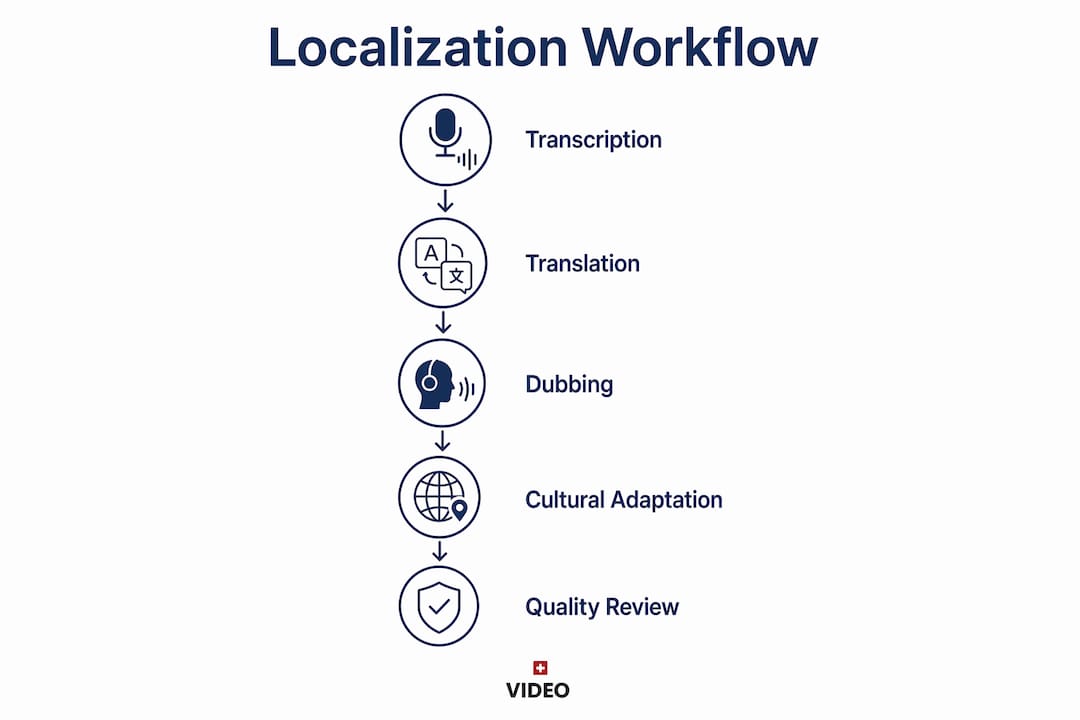
How to ensure cultural adaptation and linguistic accuracy in multilingual videos?
Cultural adaptation is the difference between a video that converts and one that confuses. Focusing solely on translation results in low audience impact even when the linguistics are technically accurate. The words may be correct, but the meaning lands wrong.
Effective localization requires modifying script, visuals, and speech style to match local customs. A hand gesture that signals approval in one culture signals offense in another. Color choices carry different emotional weight across markets. These details are not cosmetic. They directly affect whether a viewer trusts the content.
Matching visual style to target culture builds stronger trust and improves conversion rates in global video localization. This means reviewing B-roll footage, on-screen graphics, and even background music for cultural fit. A production that gets this right feels local, not translated.
Common pitfalls in foreign language video services include:
Literal translation of idioms. Phrases like “break a leg” or “hit the nail on the head” translate as nonsense in most languages. Replace them with locally understood equivalents.
Ignoring regional dialects. Spanish spoken in Mexico differs significantly from Spanish spoken in Spain. Using the wrong variant signals to viewers that the content was not made for them.
Overlooking on-screen text. Titles, lower thirds, and graphic overlays need translation too. Creators frequently localize audio but leave English text on screen.
Skipping a native review. AI translation is fast, but a native speaker catches register errors, formality mismatches, and tone problems that automated tools miss.
Pro Tip: Build a cultural review checklist for each target market before production begins. Include script idioms, visual references, color palette, and music style. Reviewing these before shoot day costs far less than fixing them in post.
For creators working on effective localized video production, cultural preparation before the camera rolls saves significant time and budget.
What are best practices for managing multilingual subtitles and bilingual video content?
Bilingual subtitles display the original language and the translated language simultaneously on screen. Bilingual subtitles improve retention and comprehension for training and educational videos by letting viewers compare meanings in real time. This format is especially effective for corporate learning content distributed across multilingual teams.
Accessibility compliance is not optional for professional distribution. Professional providers meet WCAG 2.1 and ADA standards for accessibility, along with FCC and SDH requirements for captioning. Meeting these standards opens distribution on broadcast platforms and enterprise learning management systems that require compliance documentation.
Right-to-left language support is a technical requirement that many creators overlook. RTL languages like Arabic and Hebrew require explicit layout-correct text rendering to avoid visual errors in final exports. A subtitle file that renders correctly in English will break visually when applied to Arabic without RTL-specific tooling.
Key practices for subtitle and caption workflows:
Synchronize original and translated captions in a single timeline to catch timing mismatches early.
Use a dedicated subtitle editor that supports both LTR and RTL text simultaneously.
Export captions in multiple formats (SRT, VTT, SCC) to cover all distribution platforms.
Test final output on mobile screens, where subtitle readability is most likely to fail.
For creators planning global video distribution, subtitle accuracy and accessibility compliance are the two factors that most directly affect platform eligibility and viewer retention.
How do AI tools transform the efficiency of multilingual video production?
AI localization tools deliver 80+ languages in under 10 minutes from upload to finished asset. That turnaround time was impossible with traditional dubbing studios, where a single language version could take days. The speed difference is not incremental. It changes the economics of international video distribution entirely.
Parallel processing is the key mechanism. AI platforms generate multiple language outputs simultaneously rather than sequentially. A creator who previously needed separate production runs for English, German, French, and Japanese can now produce all four versions in a single export. That reduction in production time directly reduces cost per market.
AI tools support 70–80+ languages and 100+ regional dialects for targeted localization. Regional dialect support matters because audiences notice when a platform uses the wrong variant of their language. A Brazilian Portuguese speaker immediately recognizes European Portuguese, and that mismatch signals that the content was not produced with them in mind.
Branding consistency across markets is another area where AI tools outperform traditional workflows. Voice cloning preserves a speaker’s vocal identity across every language version. A CEO who records one English message can deliver that same message in German, Mandarin, and Arabic with consistent tone, pacing, and authority. No additional recording sessions are required. For brands investing in multilingual SEO content alongside video, this consistency across formats reinforces recognition in every market.
Key Takeaways
Effective multilingual video production support requires integrating AI speed, human cultural expertise, and accessibility compliance to reach global audiences without losing message accuracy or brand identity.
Point | Details |
AI enables rapid localization | Modern platforms deliver 80+ language versions in under 10 minutes, cutting traditional timelines dramatically. |
Cultural adaptation is non-negotiable | Translating words without adapting visuals, idioms, and tone reduces audience engagement and trust. |
Bilingual subtitles improve retention | Displaying original and translated captions simultaneously increases comprehension in training and educational content. |
Accessibility compliance opens distribution | Meeting WCAG 2.1, FCC, and SDH standards is required for broadcast and enterprise platform eligibility. |
Integrated workflows prevent errors | Combining transcription, translation, and styling in one platform eliminates sync errors and re-import cycles. |
Why AI alone is not enough for global video success
I have watched creators invest in AI localization tools and then wonder why their international content underperforms. The technology works. The problem is almost always the same: they skipped the cultural layer.
AI handles speed and scale exceptionally well. It does not handle the moment when a German audience finds a joke tone-deaf, or when a Middle Eastern viewer sees a visual that signals disrespect in their culture. Those failures do not show up in a subtitle accuracy report. They show up in watch time and drop-off rates.
The creators who get international video right treat AI as the first draft, not the final product. They use AI to generate the translation and voiceover quickly, then route that output through a native-speaking reviewer who checks register, tone, and cultural fit. That combination, AI speed plus human judgment, is what actually produces content that resonates.
The other mistake I see consistently is treating all markets as one. A single “Spanish” version does not serve Mexico, Spain, Argentina, and Colombia equally. Each market has distinct idioms, formality expectations, and cultural references. The creators who build market-specific review steps into their workflow see measurably better engagement than those who publish a single localized version globally.
The future of multilingual content production is not fully automated. It is a tighter collaboration between AI tools and cultural experts, with creators who understand both sides well enough to manage the handoff.
— Pieter
How Videoproductionswitzerland supports your international production needs
International productions face enough complexity without adding language and localization headaches to the mix. Videoproductionswitzerland brings over 20 years of experience supporting international crews shooting in Switzerland, handling permits, crew sourcing, equipment, locations, and logistics so your team stays focused on the creative work.
[
Whether you need full production coordination or targeted support for a specific shoot day, Videoproductionswitzerland builds a solution around your actual requirements. Transparent video production pricing in Switzerland means no surprises when the invoice arrives. For international teams ready to shoot in Switzerland without the coordination stress, full-service production support is available from the first consultation through final wrap.
FAQ
What is multilingual video production support?
Multilingual video production support is the process of translating, dubbing, and culturally adapting video content for multiple language markets. It includes voiceovers, subtitles, caption styling, and visual localization to ensure authentic audience engagement.
How many languages can AI video localization tools handle?
Current AI localization platforms support 80+ languages with native voiceovers and 100+ regional dialects. Turnaround for a fully localized video is frequently under 10 minutes from upload to finished asset.
Why do bilingual subtitles improve viewer comprehension?
Bilingual subtitles display original and translated text simultaneously, allowing viewers to compare meanings in real time. This format increases retention and comprehension, particularly in training and educational video content.
What accessibility standards apply to multilingual video captions?
Professional video localization must meet WCAG 2.1, ADA, FCC, and SDH standards for captioning and accessibility. Compliance with these standards is required for distribution on broadcast platforms and enterprise learning systems.
What is the biggest mistake creators make with video localization?
The most common mistake is translating words without adapting cultural context. Effective localization requires modifying script tone, visual references, and idiomatic speech to match local audience expectations, not just converting language.
Recommended
