
How Do I Become a Location Scout for Film Shoots

Stepping into film production in Switzerland means learning to balance creative vision with practical realities every day. If you aim to break in as a location scout or production coordinator, understanding both storytelling and on-the-ground logistics is key. This guide reveals how developing strong local knowledge, building connections, and mastering permitting rules help you stand out in international video projects. Find out how strategic local knowledge transforms scouting into creative problem-solving and sets the foundation for a successful career.
Table of Contents
Quick Summary
Core Insight | Explanation |
1. Master location scouting essentials | Develop visual storytelling skills and understand logistical realities for effective location scouting. |
2. Build a detailed local knowledge library | Document and photograph potential locations, including key logistical details for each scene requirement. |
3. Network proactively with industry professionals | Attend events and connect with filmmakers and production companies to gain visibility and create job opportunities. |
4. Understand and research permit requirements | Know specific permit needs for each location and establish contact with local authorities to facilitate the filming process. |
5. Verify logistics ahead of shoot day | Conduct a final checklist to ensure all details are confirmed, minimizing risks and potential disruptions during filming. |
Step 1: Build essential scouting skills and local knowledge
You’re stepping into a role that blends art and logistics. To succeed as a location scout, you need to develop a sharp eye for visual storytelling while mastering the practical realities of a production site.
Start by understanding what location scouts actually do. Location scouting involves finding locations that match the script’s requirements while assessing aesthetic quality, logistical feasibility, cost, safety, and access to infrastructure like electricity. You’re not just finding pretty places—you’re evaluating whether a location can actually work for filming.
Develop your visual vocabulary by studying films and understanding how location choices serve the story. Watch how cinematographers use architecture, natural light, and spatial depth. Notice how a location becomes a character itself in the narrative. This visual training sharpens your ability to see potential before a director points it out.
Build deep local knowledge by exploring your area systematically. You need to know:
Which neighborhoods have reliable parking for crew vehicles and equipment trucks
Power availability and whether locations have adequate electrical infrastructure
Weather patterns and how they affect outdoor shoots at different times of year
Local regulations and which areas require permits versus which offer more flexibility
Seasonal changes that impact lighting and accessibility
Walk streets with intention. Talk to business owners, property managers, and residents. Understand traffic patterns, noise levels, and how neighborhoods change throughout the day. This ground-level knowledge separates skilled scouts from those just taking pretty pictures.
Create a personal location library by photographing interesting spaces and documenting their details. Record addresses, contact information for property owners, and notes about what makes each location special. Include practical details like nearby parking, restroom access, and proximity to catering options.

Here’s a summary of essential local knowledge factors that influence location scouting success:
Factor | Why It Matters | Example Impact |
Parking Availability | Enables smooth crew access | Reduces setup delays |
Power Infrastructure | Supports lighting & equipment | Prevents outages during filming |
Permit Flexibility | Allows faster approvals | Expands usable locations |
Weather Patterns | Impacts shoot planning | Minimizes rescheduling |
Seasonal Changes | Alters lighting & access | Ensures visual consistency |
Local knowledge transforms scouting from a surface-level hunt into strategic problem-solving that makes productions run smoother.
Connect with property owners and managers in your community. Building relationships now means you’ll have allies later when you need locations for real shoots. Offer to show them examples of past productions or explain how the film industry operates. Many property owners will grant access more freely once they understand the process.
Pro tip: Keep a detailed spreadsheet of every location you scout, including GPS coordinates, lighting conditions at different times of day, and owner contact information—this becomes your gold mine when coordinating with production teams.
Step 2: Network with filmmakers and production companies
Your skills mean nothing if producers don’t know you exist. Networking transforms you from an invisible freelancer into someone decision-makers call when they need locations fast.
Start by joining professional organizations that connect location scouts with filmmakers. The Location Managers Guild International links location professionals worldwide with production companies and industry contacts. Membership gives you credibility and access to job boards where productions actively seek scouts.
Attend film industry events in your region and beyond. Look for:
Local film festivals and industry mixers
Production company open houses and panel discussions
Chamber of commerce events focused on creative industries
Online networking webinars hosted by film organizations
Location scouting workshops and training sessions
When you attend events, show genuine interest in people’s work. Ask producers about their location needs and challenges. Listen more than you talk. This approach builds real relationships instead of transactional contacts.
Build your professional presence online by creating a portfolio of locations you’ve scouted. Include photos, coordinates, and brief descriptions of why each location works for productions. Share this portfolio on LinkedIn and your personal website so producers can find you when searching for scouts.
Connect with production coordinators in your area. Production coordinators in film often hire location scouts or recommend them to producers they work with. These relationships can lead directly to paid scouting opportunities.
Real networking happens when you solve problems for others, not when you ask for favors.
Reach out proactively to producers whose work you admire. Send a brief email explaining your scouting focus and attach examples of locations you know well. Many producers appreciate scouts who understand their aesthetic and have already researched their needs.
Offer free consultations for small projects or student films. This builds your portfolio and creates word-of-mouth referrals that lead to paid work on larger productions.
Pro tip: Keep a running list of every producer, director, and production company you meet—record their name, project focus, and contact info—then follow up with relevant location suggestions quarterly to stay top-of-mind when they’re planning shoots.
Step 3: Research permit requirements and secure access
Permits aren’t optional paperwork you handle later. They’re the legal foundation that determines whether your scouted location is actually usable for filming.
Start by understanding that permit requirements vary by location and are managed at municipal or local levels. Each city, county, or property has specific regulations, fees, and application processes. You can’t assume what works in one neighborhood applies to another.
Begin your research process by identifying the location’s jurisdiction. Is it city-owned? County property? A private business? An institution? Each classification has different permitting pathways and decision-makers.
Contact the appropriate local authorities and ask targeted questions:
What permits are required for film production at this specific location?
What are the application timelines and fees?
Are there filming restrictions by time of day, season, or duration?
What insurance or bonding is required?
Who approves permits and how long does approval typically take?
Research institutional policies carefully. Universities, hospitals, and government buildings often have stricter rules than public spaces. Some institutions prohibit commercial filming entirely or require extended lead times for approval.
Document everything you learn. Create a permit profile for each location that includes contact names, required fees, typical approval timeframes, and any restrictions. This information becomes invaluable when you present locations to producers.
Securing access before you scout saves productions thousands of dollars and eliminates locations that look good but can’t legally be filmed.
Don’t just ask if permits are available. Confirm that access is genuinely possible for your intended shoot dates and crew size. Some locations grant permits only during specific seasons or hours, making them impractical for certain productions.
Build relationships with local film liaisons and permit coordinators. These officials can answer questions faster and sometimes alert you to locations that are film-friendly but not widely known.
Pro tip: Request permit applications and fees in writing from local authorities, then create a spreadsheet comparing costs across locations—producers need this data when budgeting, and your research saves them negotiation time.
Step 4: Scout locations and present options professionally
You’ve found great locations. Now you need to present them in a way that makes directors say yes immediately. Professional presentation separates scouts who get hired repeatedly from those who struggle to land work.
Start by conducting thorough research and documentation of locations you’re considering. Visit sites multiple times at different times of day and seasons. Photograph from various angles, capturing the aesthetic details that serve the story alongside practical elements like power access, parking, and weather exposure.
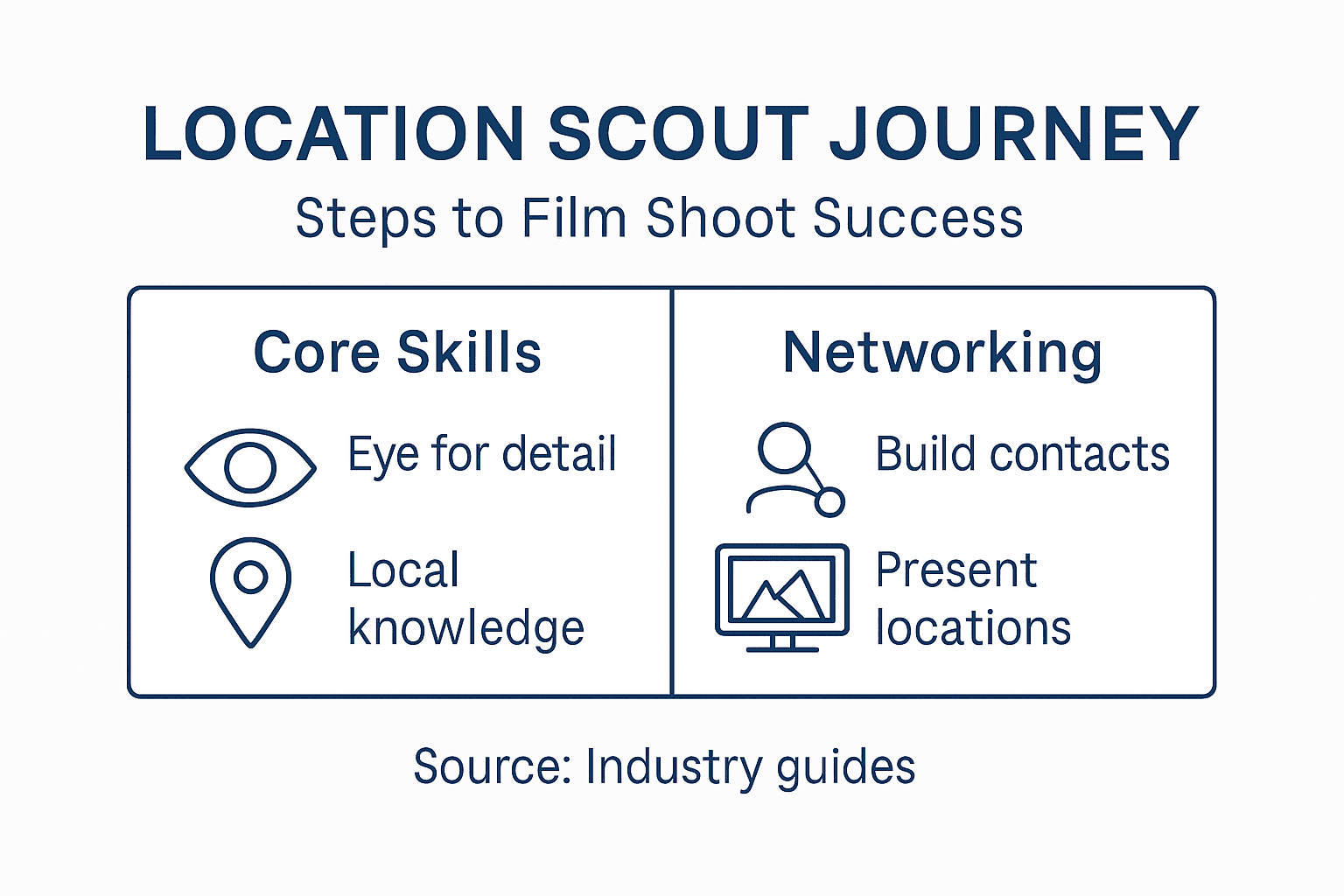
Organize your presentation strategically. Don’t just show pretty pictures. Prepare multiple location options for each scene requirement, giving producers real choices rather than one-size-fits-all suggestions.
Include critical details in every location presentation:
High-quality photographs from multiple angles and times of day
GPS coordinates and precise street addresses
Permit requirements and typical approval timeframes
Parking capacity and crew accessibility
Power availability and infrastructure details
Weather exposure and seasonal considerations
Contact information for property owners or managers
Estimated production costs for each location
Write brief descriptions that connect each location to the script’s needs. Don’t just describe what’s there. Explain how the location serves the director’s vision and story requirements. Show that you understand the project’s aesthetic.
Create visual presentations that tell a story. Use thoughtful location presentations with visual aids to help directors and producers visualize how each space supports their creative vision. Digital slide decks work better than printed materials because they allow producers to zoom, compare, and share easily.
A great location presented poorly loses to a mediocre location presented brilliantly.
Be honest about location limitations. If a space is gorgeous but parking is terrible, say so upfront. Producers respect scouts who anticipate problems rather than discovering them mid-shoot. This honesty builds trust and prevents location disasters.
Offer to do site visits with directors and cinematographers. Walking through locations together lets creative teams experience spatial relationships that photos can’t capture. Your presence allows you to answer questions immediately and demonstrate your local expertise.
Pro tip: Create a simple one-page summary for each location with contact info, key logistics, and a single stunning photograph—producers often forward these internally before requesting full presentations, so make them shareable and professional.
Compare approaches for presenting scouted locations to producers:
Approach | Benefit | Drawback |
Digital Slide Deck | Easy to share and update | Requires technical setup |
One-Page Summary | Quick reference for teams | Limited visual details |
Site Walkthroughs | Reveals spatial realities | Time-intensive for everyone |
Full Presentation Book | Comprehensive documentation | Risk of information overload |
Step 5: Verify readiness and ensure seamless shoot logistics
The shoot date is two weeks away. Everything looks perfect on paper. But you need to verify that reality matches the plan, or production disasters will unfold on set.
Start a final readiness checklist that confirms every operational detail. Logistics management involves planning and coordinating movement, equipment, crew, and materials to ensure smooth production operations. For film shoots, this means verifying permits are approved, facilities are secured, security is arranged, and transportation is confirmed.
Contact every location owner or manager one final time. Confirm shoot dates, crew arrival times, parking arrangements, and any last-minute restrictions. Don’t assume what was approved months ago is still valid. Circumstances change.
Verify critical logistics by checking off each element:
Permits are officially approved and in hand
Parking is genuinely available for crew vehicles and equipment trucks
Power access has been tested and confirmed working
Restroom facilities are accessible and prepared
Security arrangements are in place if required
Weather contingencies are identified and alternative dates discussed
Crew contact information is current and shared with all departments
Insurance documentation is submitted to property owners
Assess risks by walking through potential problems. What happens if a key crew member gets sick? Where’s the backup power if the site’s electricity fails? Is there weather coverage? Do alternate indoor locations exist if outdoor shoots become impossible?
Coordinate with management practices that ensure production readiness and minimize disruptions by confirming that crew leads understand location specifics. Brief the assistant director, camera operator, and gaffer on parking locations, power sources, and any site-specific challenges before they arrive.
Readiness verification catches problems during planning, not during filming when solutions cost thousands of dollars.
Create a location day-of reference sheet for crew. Include precise addresses, GPS coordinates, parking instructions, contact names, and emergency procedures. This document prevents confusion and delays on shoot day.
Stay in touch with producers and location scouts as the shoot approaches. If conditions change or issues emerge, communicate immediately. Transparency prevents last-minute surprises.
Pro tip: Visit each location 48 hours before the shoot to verify nothing has changed—check for construction, weather damage, or access issues that could derail filming and catch problems before they become crisis management on set.
Take Your Location Scouting Skills to the Next Level with Expert Support
Becoming a successful location scout means mastering complex challenges like permit requirements, local regulations, and seamless logistical coordination. You know that detailed local knowledge and strong relationships make or break a shoot. If you want to move beyond scouting to ensure smooth production execution in Switzerland, you need more than just great locations. You need a trusted partner who understands the intricacies of Swiss film production from permits to crew sourcing.
[
Discover how VideoProductionSwitzerland.com empowers location scouts and filmmakers with over 20 years of experience in permit handling, professional crew coordination, equipment sourcing, and logistics management. Avoid last-minute setbacks and ensure your scouting efforts translate into successful shoots. Whether you are scouting independently or supporting an international team, our client-centric approach guarantees expert local support. Start with a free consultation to align your location scouting expertise with reliable production services by visiting Video Production Switzerland. Explore how we take your scouting research from ideas to reality seamlessly.
Frequently Asked Questions
What skills do I need to become a successful location scout for film shoots?
To be a successful location scout, you need a good eye for visual storytelling combined with practical knowledge of production logistics. Focus on developing your visual vocabulary through film analysis and gain local knowledge by exploring your community systematically.
How do I start networking with producers and filmmakers as a location scout?
Begin networking by joining professional organizations and attending industry events. Attend local film festivals, mixers, and workshops to meet producers, share your interests, and discuss their location needs.
What should I include in my location presentation to producers?
Your location presentation should include high-quality photographs, GPS coordinates, permit requirements, and details about parking and power access. Organize your materials in a way that connects each location to the script’s needs and serves the director’s vision.
How can I ensure that a location is legally viable for filming?
You can ensure a location is legally viable by thoroughly researching permit requirements and confirming access with property owners. Keep detailed documentation of permits, application processes, and any limitations that might affect production.
What steps should I take to verify a location is ready for a shoot?
To verify a location is ready for a shoot, conduct a final checklist to confirm all logistics like approved permits, parking availability, and power access. Visit the location 48 hours before shooting to check for any last-minute changes or issues that could disrupt production.
How do I build and maintain relationships with property owners for scouting?
Building relationships with property owners involves regular communication and offering insights about the film industry. Offer to show examples of previous work and explain how their property could be featured, fostering trust and collaboration.
Recommended
