
What Is Location Scouting in Film? A Practical Guide

Updated: Sep 19
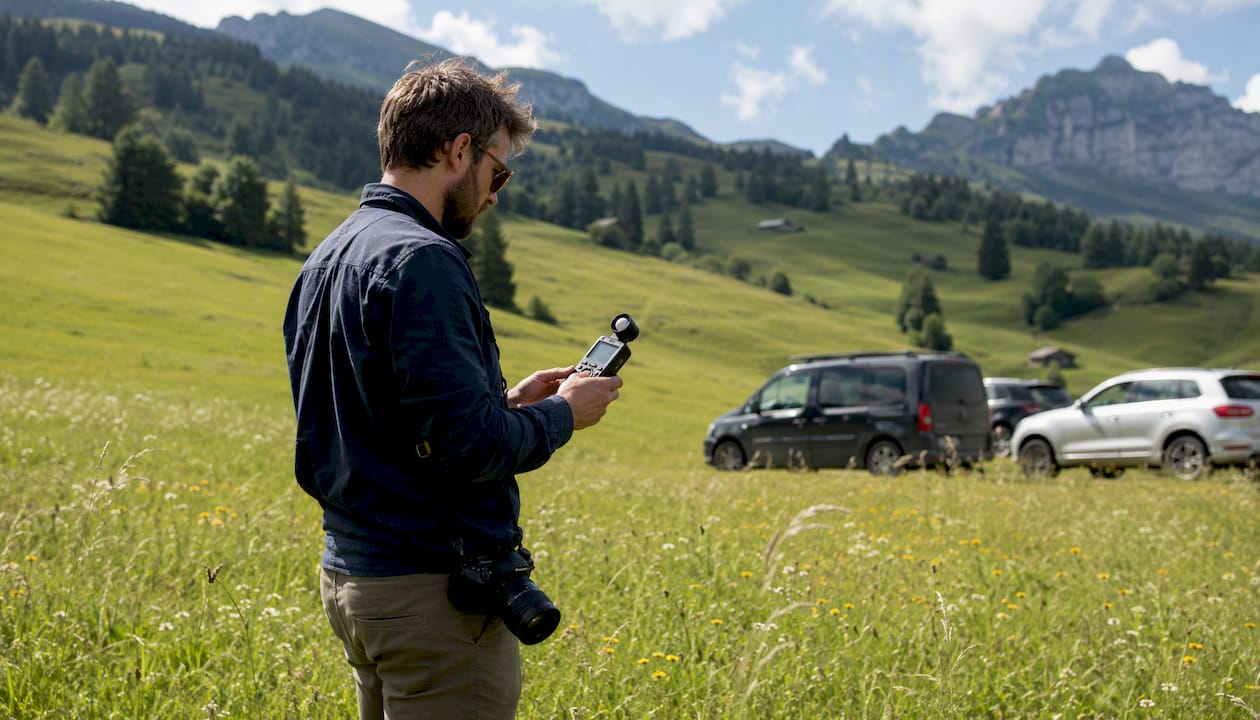
Location scouting is the pre-production process of finding, evaluating, and securing real-world places to shoot a film so they match both the director’s creative vision and the production’s practical needs. It’s the job that turns a script’s “INT. DINER, NIGHT” into an actual diner with enough electrical capacity for lighting rigs, parking for a grip truck, and an owner willing to sign a release. Done right, location scouting connects storytelling to logistics: power, sound, parking, and access all have to work before a single frame gets shot. Videoproductionswitzerland handles this exact process for international crews, and the film office permits, insurance paperwork, and site vetting involved are why a scouting misstep can quietly wreck a shooting schedule before day one.
Key Takeaways
Location scouting works because it converts a script’s creative demands into a physically shootable plan, covering power, sound, parking, and permits before cameras roll.
Point | Details |
Definition matters | Location scouting finds and secures real places that satisfy both story needs and shoot logistics. |
Timing is critical | Lock hero locations 8 to 12 weeks out, before major crew or equipment commitments. |
Evaluate beyond looks | Weigh permits, power, sound, and access alongside how well a site serves the story. |
Document relentlessly | Photos, measurements, and contact details prevent costly surprises on shoot day. |
Professional help scales with complexity | Videoproductionswitzerland handles scouting, permits, and on-day management for international Swiss shoots. |
Table of Contents
What Does Location Scouting Do for a Film?
A location isn’t just a backdrop. It’s a storytelling tool that shapes tone, mood, and even character before an actor says a line. A cramped, fluorescent-lit office says something different than a sun-drenched loft, and directors lean on scouts to find the version of a setting that does that work visually.

The logistical side is less glamorous but arguably more consequential. A gorgeous rooftop with no freight elevator means hours lost hauling gear up stairwells. A quiet-looking street that turns into a construction zone at 9 a.m. means blown audio and reshoots. MovieMaker points out that scouting done well before budgets lock is one of the cheapest forms of insurance a production can buy, and poor location choices tend to surface their true cost only after the crew has already arrived.
Two quick examples illustrate the split:
Creative: A abandoned factory chosen for a thriller’s climax does more narrative work than any line of dialogue, its rust and shadows telling the audience the character is trapped before the scene even starts.
Logistical: A charming café location looked perfect on paper, but the scout discovered too late that its single electrical circuit couldn’t support even basic lighting, forcing an expensive last-minute generator rental.
Scouting early also drives budgeting accuracy. Once a location is confirmed, a production can price out crew size, equipment needs, and travel days with real numbers instead of guesses.
Who Handles Location Scouting, and What Do They Actually Do?
The location scout finds and vets sites; the location manager runs them on shoot days. On larger productions those are two distinct jobs, sometimes with an assistant location manager supporting both. On a five-person indie crew, the director or producer often does all of it themselves, which is one reason learning to scout locations is a genuinely useful skill even for filmmakers who never intend to specialize in it.
A working scout’s core duties include:
Breaking down the script to build a list of every location needed
Researching and visiting candidate sites, then photographing and measuring them
Assessing power capacity, sound conditions, and access points
Negotiating with property owners on fees and shoot dates
Advising the production on permit requirements before locations get locked
Producing a lookbook or portfolio for the director and department heads to review
According to GetCameraCrew’s breakdown of the role, experienced scouts typically hand off a finalized location to the location manager, who then owns everything that happens there once the crew arrives. That handoff matters. A scout who vanishes after signing a contract leaves the manager guessing about details only the scout actually observed. On bigger union productions, this split comes with formal day rates and contracts; on a weekend short film, it’s often one overworked person wearing both hats.
When Should You Scout, and What Does “Locked” Mean?
Timing separates productions that run smoothly from ones that scramble. A general sequence looks like this:
8 to 12 weeks out (feature/commercial scale): Start scouting primary, hero locations that anchor major story beats.
4 to 8 weeks out: Scout secondary locations and identify backups in case negotiations fall through.
2 to 4 weeks out: Run tech scouts at confirmed locations with department heads present.
1 to 2 weeks out: Lock final agreements, permits, and insurance certificates.
Days before shoot: Confirm pickup locations and any last-minute logistical details, like parking permits or base camp placement.
A “locked” location means more than a verbal yes from a property owner. Per Wikipedia’s overview of the scouting process, locking involves a signed agreement, a deposit, confirmed insurance coverage, and a permit if one applies, along with a plan for base camp, crew parking, and equipment staging. Key locations need to be locked before a production commits to hiring crew or booking major equipment rentals. Building a shoot schedule around a location that isn’t actually secured is one of the fastest ways to torch a budget.
How Do You Scout a Location, Step by Step?
The process follows a fairly consistent order across productions of every size, though the formality scales with budget.
Break down the script and list every distinct location, noting story requirements for each (time of day, mood, specific architectural details).
Do desktop research using maps, satellite imagery, and reference photos to shortlist candidates before setting foot anywhere.
Conduct initial scouting visits to the strongest candidates, taking photos and notes on general suitability.
Bring the director and cinematographer for go-sees at the top two or three options so creative leads can weigh in before commitment.
Run a tech scout (recce) with key department heads to test technical assumptions on-site.
Secure permissions, negotiating fees, signing releases, and confirming the location is legally “clear” for filming.
Lock the location with a signed contract, deposit, and permit paperwork finalized.
On a site visit, capture more than pretty photos. Take wide shots for spatial context, detail shots of anything that might affect blocking or lighting, and reference images along likely shot lines. Note power outlet locations and amperage, run a basic sound assessment (traffic, HVAC hum, nearby construction), measure doorways and ceiling heights for gear clearance, and confirm parking, load-in routes, and the nearest restroom. Weather exposure and any physical risk factors belong in the notes too.
Pro Tip: Always scout at the same time of day you plan to shoot. A location that looks calm and evenly lit at 10 a.m. can turn into harsh shadows and honking traffic by 4 p.m., and you won’t know until you’ve stood there at that hour.
Hand off a finished lookbook, annotated photos, and every contact and contract detail to the rest of the production team. Good documentation here saves hours of confused phone calls later, a point indie-focused scouting guides emphasize as one of the simplest ways to avoid costly surprises.
What Should You Look for When Evaluating a Location?
Every candidate site should get judged against the same core questions before it makes the shortlist:
Does the location actually serve the story, or is it a compromise dressed up as a creative choice?
Can the production realistically obtain the necessary permits in time?
What are the power and rigging limits, and will they support the planned lighting setup?
How does sound behave here, and what ambient noise is unavoidable?
Is parking and load-in genuinely feasible for trucks and crew?
Are there neighborhood restrictions, curfews, or time-of-day limits on filming?
For the legal side, a solid permit checklist covers owner permission in writing, a certificate of insurance, film office permits where required, resident notification letters for busy neighborhoods, and any local noise restrictions. Studiovity’s guide to location scouting makes the point plainly: a beautiful location still has to be functional, meaning crew access and electricity matter as much as how it photographs.
Cost considerations run deeper than the base location fee. Overtime penalties, curfew violations, local authority fees, and mitigation costs (sound blankets, traffic control, extra security) can quietly double a location’s real price. When aesthetics and logistics conflict, the right call depends on the scene’s importance. A five-second establishing shot rarely justifies fighting a difficult permit process, while a location that anchors the film’s climax might be worth the extra cost and headache.
What Tools and Techniques Do Location Scouts Use?
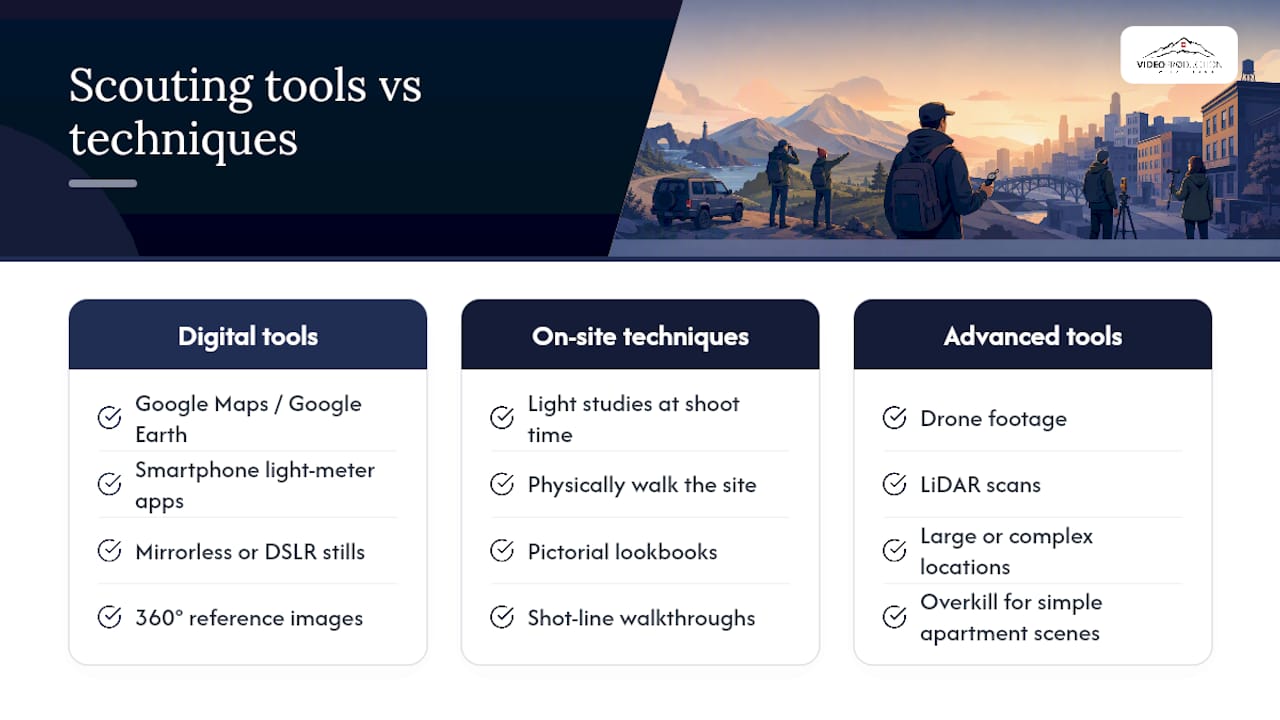
Modern scouting mixes old-fashioned legwork with a handful of digital shortcuts. Google Maps and Google Earth remain the starting point for narrowing candidates before anyone drives anywhere. Smartphone light-meter apps help gauge sun angles at different hours, while a decent mirrorless camera or DSLR produces the still photography that fills out a lookbook. Some scouts now shoot 360-degree reference images to give directors a fuller sense of a space remotely. Floor-measurement apps speed up capturing room dimensions, and shared tools like Evernote, Notion, or a Google Drive folder keep notes and photos organized for the whole team.
Beyond gear, technique matters just as much. Light studies at the actual planned shoot time catch problems that daytime desktop research misses entirely. MovieMaker’s primer on scouting notes that digital tools speed up discovery, but nothing replaces physically walking a site at the hour you intend to film. Pictorial lookbooks give cast and crew a shared visual reference before arrival, shot-line walkthroughs help the DP plan camera placement in advance, and basic noise tests during a scout visit can flag problems before they become costly reshoots.
A tech scout should include the director of photography, production designer, gaffer, and location manager at minimum. Each brings a different lens: the gaffer checks power and rigging points, the production designer assesses what needs dressing or removing, and the DP walks likely camera positions.
Drone footage and LiDAR scans add real value for large or architecturally complex locations, particularly on bigger commercial and feature productions. For a simple two-person dialogue scene in an apartment, that level of tooling is usually overkill. Anyone weighing lighting choices at a scouted location further along in prep might find WonderLens’s guide to lighting and video realism a useful reference for translating scout notes into actual camera setups.
What Are the Most Common Location Scouting Problems?
Certain issues show up on set after set, and recognizing them early saves real money.
Insufficient electrical supply. Older buildings often can’t handle modern lighting loads. Bring a generator or budget for a power upgrade before committing.
Persistent ambient noise. HVAC systems, traffic, and nearby construction ruin dialogue tracks. Plan boom-friendly shoot windows or budget for ADR.
Inaccessible load-in. Narrow hallways, no freight elevator, or steep stairs slow everything down. Confirm load-in routes during the initial scout, not the tech scout.
Neighbor resistance. Residents unhappy about noise, parking, or crowds can shut a shoot down mid-day. Negotiate resident letters and notify neighbors well ahead of time.
Hidden costs from property managers. Some owners add fees after a deal feels settled. Get everything in writing before locking.
Unreasonable insurance or permit requirements. Some venues demand coverage limits far beyond what’s typical. Budget contingency for this or negotiate the terms early.
Major production centers add another layer: heavy bureaucracy, competitive permit slots, and stricter enforcement of noise ordinances. In those markets, bringing in an experienced location manager early, rather than scrambling once problems appear, tends to be the difference between a smooth shoot and a stalled one. For productions juggling several sites across a shoot, managing multiple locations well ahead of time avoids a lot of this scramble entirely.
What Belongs on a Tech Scout Checklist?
A tech scout works best as a short, exportable list rather than a wall of notes scattered across different apps. Items worth checking off on-site include contact information for the owner or manager, exact access times, power capacity and outlet locations, available parking spaces, restroom locations, the nearest hospital, identified noise sources, and measurement references for doorways and ceiling heights.
A simple table format works well for turning this into a spreadsheet:
Item | Notes to Capture |
Contact info | Owner/manager name, phone, backup contact |
Access times | Building hours, load-in window, curfew |
Power capacity | Amperage, outlet count and location |
Parking | Number of spaces, truck access, street restrictions |
Restrooms | Location, availability for full crew size |
Nearest hospital | Address and drive time |
Noise sources | HVAC, traffic, construction schedules |
Permit status | Confirmed, pending, or not required |
Keep photo filenames consistent across the whole lookbook, something like location name, room, and angle, so anyone on the team can find the right reference image without hunting. For terminology on what a tech scout actually involves and who typically runs it, this explainer on the recce process covers the distinctions in more detail.
When Does It Make Sense to Hire a Professional Location Service?
Doing your own scouting works fine for a short film shot in your hometown. It stops working the moment a production adds complexity: international shoots in unfamiliar permit systems, large cast and extras counts, sensitive or historic locations with strict access rules, or tight timelines that leave no room for a failed negotiation.
A professional location service typically delivers:
Full scouting and shortlisting based on script needs
Permit and insurance coordination with local authorities
Owner and property manager negotiations
Tech-scout coordination with department heads
On-day location management during the shoot
Neighbor and resident outreach to prevent mid-shoot complaints
A typical engagement flow looks like a free consultation, followed by a needs assessment, then a scouting phase, locking locations, and on-day support once cameras roll. GetCameraCrew’s overview of scout deliverables confirms this bundling of scouting with administrative and operational support is standard for complex productions, not an upsell.
Approach | Best fit | Tradeoff |
DIY scouting (producer/director) | Small local shoots, tight budgets | Time-intensive, higher risk of permit or logistics gaps |
In-house location manager | Mid-size productions with local crew | Requires hiring and managing a specialist |
Professional location service | International shoots, complex permits, sensitive sites | Higher cost, but removes logistical risk entirely |
For crews unfamiliar with a country’s specific permit process, working with a local partner rather than learning the system from scratch on a compressed timeline is usually the more sensible route, and Videoproductionswitzerland exists precisely to fill that gap for international shoots.
A Scout’s Take: Story First, Document Everything
Every location decision should start with one question: does this serve the story? It sounds obvious, but I’ve watched productions fall in love with a visually striking site that had no business being on the shortlist once you factored in power, access, and permit realities. The best scouts I’ve studied treat aesthetics as the second filter, not the first. Story determines what a location needs to accomplish; logistics determine whether it can.
The other habit that separates a smooth shoot from a chaotic one is documentation. Photos, measurements, contact details, permit status, all of it written down consistently, not scattered across three different apps and someone’s memory. A scout who scouts early and writes everything down gives the rest of the production room to actually solve problems instead of discovering them on shoot day.
How Videoproductionswitzerland Handles Location Logistics for You
Scouting a country you’ve never filmed in before means learning an unfamiliar permit system, finding trustworthy local contacts, and hoping the location that looked great in photos actually has the power and access your crew needs. Videoproductionswitzerland removes that guesswork for international crews shooting in Switzerland by handling scouting, permits, crew sourcing, and on-day location management as one coordinated service, rather than leaving a visiting production to piece it together alone.
[
That means a director or producer flying in for a shoot doesn’t have to learn Swiss film office procedures or negotiate directly with property owners in a language they don’t speak. Videoproductionswitzerland manages the scouting, the permit applications, the insurance coordination, and the logistics around parking, power, and access, so the crew’s time on the ground goes toward shooting rather than solving location problems. Anyone budgeting for a Swiss shoot can also check current video production costs to see how location support fits into overall project pricing. The next step is straightforward: request a free consultation and a location scouting quote before locking your shoot dates.
Sources
Readers who want to go deeper into specific aspects of the process can check these sources for job descriptions, checklists, and additional practical examples:
Recommended
