
Location Scouting Services for Film and Commercial Shoots


TL;DR:
Professional location scouting services identify suitable sites that meet a director’s vision and production requirements. They provide detailed reports with photos, measurements, GPS data, ownership, and permit notes to prevent costly issues during filming. Skipping expert scouting often leads to unanticipated delays, safety hazards, or permit problems that can harm the production budget and schedule.
Professional location scouting services identify, evaluate, and secure real-world sites that satisfy a director’s visual brief alongside a production’s technical and legal requirements. Hire a scout when you’re dealing with complex shoots, tight schedules, unfamiliar jurisdictions, scenes that demand specific lighting or access conditions, or any situation where permits and logistics are likely to drive risk or cost. The core deliverables you should expect: high-resolution photos from multiple angles, a scout report with GPS coordinates and measurements, contact and ownership information, preliminary permit notes, and a viability score for each candidate site. Skip professional scouting on a simple single-location shoot with a familiar space and no permit exposure. On anything more complex, the cost of a scout is almost always less than the cost of discovering a problem on shoot day.
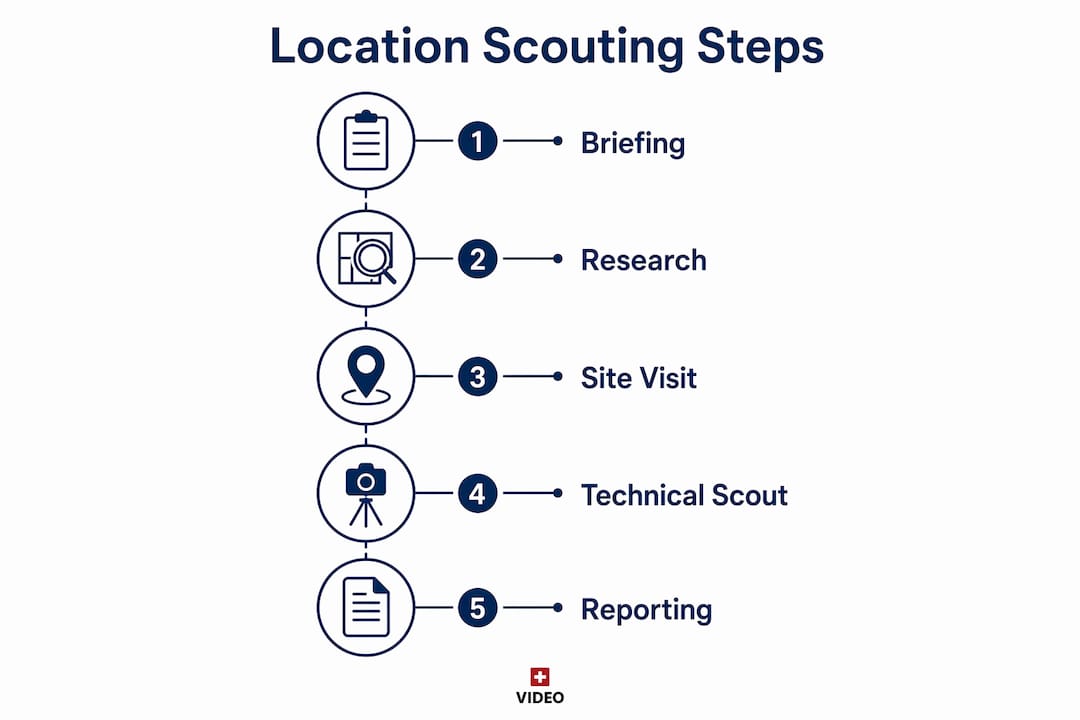
Table of Contents
Location scout vs. location manager vs. tech scout: who does what?
How does the location scouting process work from brief to tech recce?
What permits and rights do U.S. shoots need, and who handles them?
Why is the tech scout so critical before you lock a location?
What mistakes do productions make with locations, and how do scouts prevent them?
What does a best-practice scouting workflow look like in operation?
The case for treating location scouting as a technical discipline, not a creative errand
What Videoproductionswitzerland offers productions that need full-service location support
Useful sources and next steps for your location scouting process
What does a location scout actually do on your production?
Location scouting is a critical pre-production discipline that balances a director’s visual requirements with logistical realities such as permits, power access, and parking. Understanding what a scout does day-to-day helps you compare their output against in-house capabilities and build accurate budget line items.
Research phase
Before anyone visits a site, a scout pulls existing files, runs online mapping and satellite imagery, searches permit databases, and identifies property ownership contacts. This remote work narrows a long list of candidates down to a viable shortlist worth visiting in person.
Field work
On site, a scout covers far more than aesthetics. Standard field tasks include:
Photo coverage: Multiple angles, wide establishing shots, and detail shots of power panels, load-in routes, and ceiling heights
Measurements: Room dimensions, ceiling clearance, doorway widths, and distance from parking to set
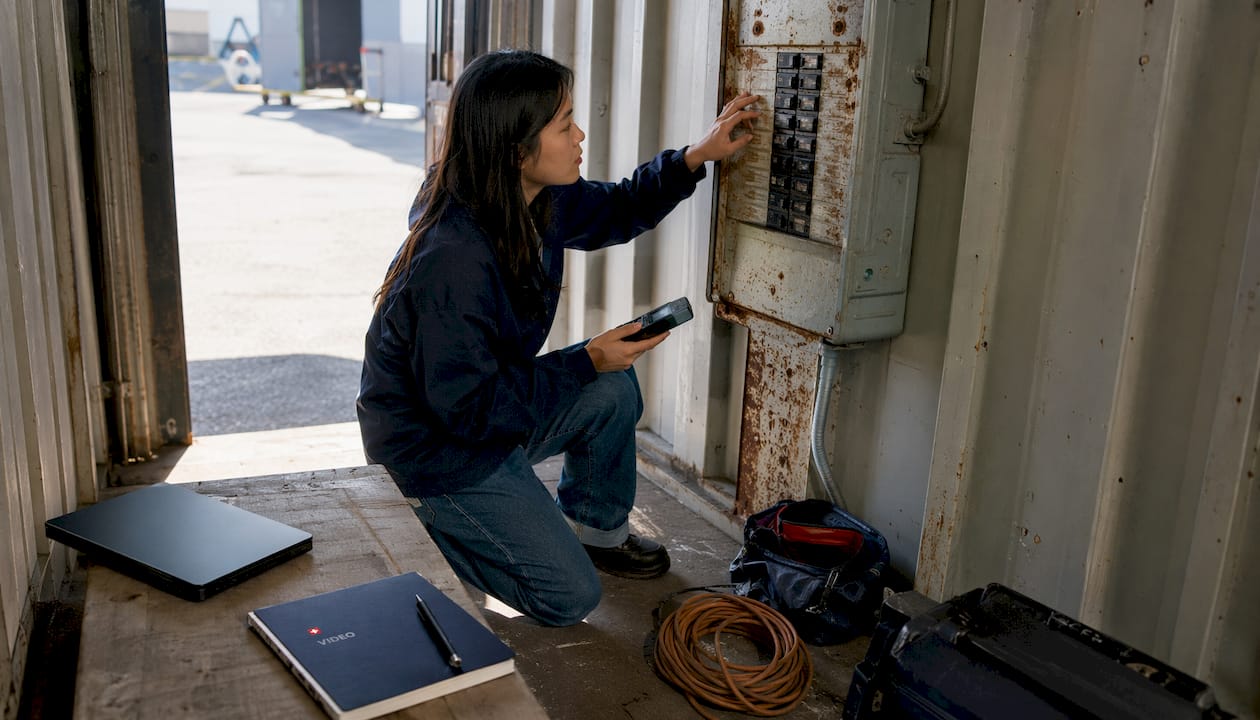
Power checks: Breaker panel location, available amperage, and feasible generator placement
Access and parking: Load-in routes, truck access, nearby parking capacity, and any weight restrictions
Ambient audio memo: A 10-minute recording at the location to capture low-level noise that ears filter out but microphones will catch
Owner/manager conversations: Initial contact to gauge willingness, ballpark fees, and any access restrictions
Deliverables
A complete scout report should include an image slate, annotated floor plans or measurements, GPS coordinates, permission and contact details, initial permit notes, flagged risk items, and a viability score or recommendation for each site. These outputs enable fast, data-driven decisions between options rather than relying on memory or verbal agreements.
Who to involve
For straightforward shoots, the scout works alone. On complex productions, loop in the director of photography for lighting assessments, the production designer for set-dress constraints, and the production manager for budget and permit decisions. Getting those voices in early prevents costly re-scouts.
Pro Tip: Ask your scout to photograph the breaker panel and likely generator placement at every site, even when power looks adequate. That single habit has saved more shoot days than any other field practice.
For productions that need full-service location support alongside crew sourcing and logistics, Videoproductionswitzerland handles the entire pre-production chain, from location research through permit filing and day-of coordination.
Location scout vs. location manager vs. tech scout: who does what?
These three roles are often confused, and conflating them creates gaps in coverage on shoot day. A location scout handles research, footwork, and photographic documentation, while a location manager leads logistics, legal clearance, and permitting on selected sites.
Responsibility | Location Scout | Location Manager | Tech Scout / Recce |
Creative fit assessment | Primary | Secondary | Confirms |
Technical checks (power, sound, access) | Initial pass | Reviews and escalates | Detailed, department-specific |
Permit ownership | Flags requirements | Files and secures | N/A |
Location agreements / contracts | Gathers contact info | Negotiates and executes | N/A |
Day-of logistics | Minimal | Primary | N/A |
Department head coordination | Minimal | Supports | Leads walk-through |
Where responsibilities overlap: On lower-budget or single-unit shoots, one person often covers both the scout and manager roles. That works when the location is straightforward and permits are minimal. On multi-day shoots, complex permit environments, or international productions, separating the roles protects the production. The scout finds the options; the manager owns the deal and the paperwork.
The tech scout (or recce) is a separate event entirely. It happens after a location is selected, not during the search phase. Its purpose is to surface issues that photos cannot reveal: light shifts across the day, traffic patterns at planned shoot times, and sound hazards that only appear at certain hours. Production consultants consistently flag skipping the tech scout as one of the highest-risk decisions a production can make.
How does the location scouting process work from brief to tech recce?
A well-run scouting process moves through seven phases. Knowing the sequence and the time each phase requires lets you build scouting into your pre-production schedule before it becomes a crisis.
Brief and script breakdown (Day 1–2). The scout receives the script or shot list, identifies every location type needed, and flags scenes with unusual technical demands (night exteriors, water, industrial spaces, etc.).
Remote research (Days 2–10). File pulls from existing databases, satellite and street-view mapping, ownership lookups, and initial visual matching against the brief. A professional scout with a strong database can deliver a shortlist within days.
Shortlist presentation (End of week 1–2). The scout presents candidate sites with preliminary photos, notes, and a rough viability assessment. The director, DP, and producer review and select sites for in-person visits.
Site visits (1–3 weeks before location lock). Full field scouting with photos, measurements, audio memos, and owner conversations. For multi-location projects, run parallel scouting teams to compress this window.
Tech scout / recce (1–2 weeks before shoot). Department heads walk each confirmed location. This is where camera positions are blocked, lighting placements are planned, and power and load-in logistics are finalized. Budget a full day per location for complex shoots.
Contract, permits, and insurance (3–6 weeks before shoot, depending on jurisdiction). Location agreements are executed, permit applications are filed, and certificates of insurance are secured. Federal locations (National Park Service, Bureau of Land Management) often require longer lead times.
Final prep (1 week before shoot). Confirm all access arrangements, distribute location packages to department heads, and verify that backup locations are still available if the primary falls through.
Practical sequencing tip: Always lock at least one backup location before you commit to the primary. If the primary falls through at the last minute, a documented backup with a warm owner relationship can save the shoot day.
For guidance on managing multiple locations across a single production, the multi-location planning guide covers scheduling and logistics in detail.
What do scouts actually check when they walk a site?
The systematic evaluation a scout runs through in person covers three pillars: creative fit, production viability, and practical cost. Here is how each plays out on the ground.
Lighting and sun path
A scout notes the direction of windows, the quality of natural light at planned shoot times, and whether the sun path creates problems (hard backlight at noon, loss of light by 3 PM in winter). This observation is time-specific, which is why visiting at the planned shoot time matters.
Sound and ambient noise
Recording a 10-minute ambient audio memo during the site visit is one of the highest-value, lowest-cost practices in scouting. Ears adapt to background noise; microphones do not. HVAC hum, nearby traffic, flight paths, and construction all show up on that recording in ways they never would during a walk-through conversation.
Power access
The scout photographs the breaker panel, notes available amperage, and identifies the most practical generator placement and cable routes. Standard residential panels often cannot support a full lighting package without supplemental power.
Ceiling height and rigging clearance
Standard residential ceilings run around 8 feet, which limits lighting placement and rules out high-angle shots entirely. Always measure clearance rather than estimate it. A ceiling that looks workable in a photo can eliminate half your lighting options on set.
Load-in, parking, and access routes
The scout documents the path from the nearest truck parking to the set, noting any stairs, narrow doorways, or weight-restricted surfaces. Parking capacity for crew vehicles is assessed separately from equipment load-in.
Health, safety, and accessibility
Hazards (uneven surfaces, low clearances, chemical storage, structural concerns) are flagged in the report. Accessibility for crew with mobility limitations is noted, particularly for shoots with extended setups.
Ownership and insurance requirements
The scout records the property owner’s contact details, any stated restrictions, and preliminary insurance requirements. This information goes directly to the location manager or production manager for contract and COI purposes.
Pro Tip: Use a structured scoring system: rate each site on creative fit, production viability, and practical cost on a simple 1–5 scale. A scored scout report makes the final decision defensible and gives the director and producer a shared framework for comparing options.
How much do location scouting services cost?
Pricing models vary by project complexity, and understanding the structure helps you build an accurate budget line item and compare bids on equal terms.
Common pricing models:
Day rate: The most common structure for individual scouts. Rates vary significantly by market, production type, and the scout’s experience level.
Half-day rate: Used for shorter site visits or file-pull-only engagements.
Project flat fee: Common for defined-scope projects with a fixed number of locations and deliverables. Easier to budget but requires a clear scope agreement upfront.
Retainer or multi-site pull: Used when a production needs ongoing location research across a long pre-production period or multiple episodes.
Major cost drivers:
Production complexity and number of locations required
Travel and accommodation when sites are outside the scout’s home market
Access to specialty locations (private estates, active industrial facilities, federal land)
Time required for permit research and paperwork
Tech scout attendance by multiple department heads (their time is billed separately)
Local agency or film office fees
Additional billable items to watch for:
Parking negotiations and location fee deposits
Drone scouting and FAA waiver assistance
Location agreement drafting or legal review
Location manager handover documentation
When comparing bids, ask each vendor to itemize travel, permit research, and tech scout attendance separately. A lower day rate that excludes permit research can end up costing more than a higher rate that includes it. Insist on a written scope that specifies the number of sites, photo resolution, measurement format, and who owns the scout images after delivery.
How do you hire a location scout without getting burned?
The wrong scout costs you more than their fee. A missed permit requirement, an undocumented sound issue, or a location agreement that falls apart two days before the shoot can derail an entire production. Here is a practical hiring process.
Request a sample scout report. A professional scout should be able to show you a redacted report from a previous project. If they cannot, that is a clear signal.
Review the portfolio for similar scenes. A scout with strong residential interiors may not have the permit relationships needed for a shoot on federal land or a transit authority location.
Ask about local permitting experience. Which film offices have they worked with? Do they have established relationships with city permit coordinators? Have they filed NPS or BLM permits before?
Confirm tech scout availability. Some scouts hand off after the shortlist phase. If you need them present for the tech recce, confirm that upfront and include it in the contract.
Check references. Ask specifically about how the scout handled a location that did not work out. Problem-solving under pressure is as important as finding the right site.
Credentials to verify:
Portfolio with dates and production credits
References from producers or production managers (not just directors)
Stated familiarity with local permitting authorities
Proof of their own liability insurance or confirmation they work under the production’s policy
Red flags that should stop a conversation:
Vague deliverables with no sample report or photo examples
Reluctance to discuss permits, insurance, or access restrictions
Pricing with no itemized scope
No references from productions of comparable scale
Specify deliverables in the contract: number of sites, photo resolution, measurement format, turnaround time, and ownership terms for scout images. Scout photos are production assets; make sure the agreement is clear on usage rights.
What permits and rights do U.S. shoots need, and who handles them?
The U.S. permitting landscape involves multiple jurisdictional layers, and knowing which agency holds authority over your location is the difference between a smooth shoot and a shutdown. Specialized location services have established processes to obtain permits from federal, state, and local authorities, but production must understand who owns each step.
Common permitting authorities by location type:
City or county film office: Most urban and suburban shoots. Lead times typically range from a few days to three weeks depending on the city and the complexity of the request.
State parks: Managed at the state level; requirements and fees vary by state. Most require a permit application, proof of insurance, and a site fee.
National Park Service: Federal jurisdiction; lead times of four to six weeks are common, and some parks require environmental assessments for larger productions.
Bureau of Land Management: Covers vast areas of public land in the western U.S. Permit requirements depend on the scope of the production and the sensitivity of the land.
FAA: Required for drone operations. A Part 107 waiver or authorization through the FAA’s LAANC system is needed for most commercial drone work near controlled airspace.
Special-use agencies: Bridges, transit authorities, port authorities, and military installations each have their own permitting processes and often require additional insurance riders.
What scouts typically deliver versus what production must secure:
Scouts gather ownership information, flag permit requirements, and may file basic city permits on smaller productions. Final permits, certificates of insurance, traffic and parking control plans, and location agreements are typically the responsibility of the location manager or production manager. Missing a resident-notification window on a city permit can delay or void the permit entirely, so lead times are not suggestions.
For a step-by-step breakdown of the U.S. permit filing process, the filming permits guide covers the sequence from application to approval across major jurisdictions.
Why is the tech scout so critical before you lock a location?
The tech scout is where a selected location either gets confirmed or gets cut. It surfaces issues that photos simply cannot reveal: light shifts across the day, traffic patterns at planned shoot times, and sound hazards that only appear at certain hours.
Who should attend:
Director and DP (camera positions, blocking, lighting approach)
Production designer (set-dress constraints, art department logistics)
Key grip and gaffer (rigging, power, lighting placement)
Sound mixer (ambient noise assessment at planned shoot times)
Location manager or scout (access, logistics, permit status)
Tech scout agenda:
Full walk-through of all planned shooting areas
Camera position and blocking notes for each scene
Lighting placement and rigging feasibility checks
Sound check at planned shoot times (not just during the walk-through)
Generator placement and cabling routes
Set-dressing constraints and art department access
Health, safety, and emergency egress review
Deliverables from a tech scout:
Annotated photos with department notes, a lighting diagram, a power and load-in plan, sound notes, and an action item list that assigns responsibility for resolving each identified risk before shoot day.
Skipping the tech scout to save half a day in pre-production is a trade that rarely pays off. A ceiling that looked workable in photos may rule out the lighting rig the gaffer planned. A street that seemed quiet during the scout may have a delivery truck route at 7 AM. These are the discoveries that cost shooting days when they surface on set rather than in pre-production.
What mistakes do productions make with locations, and how do scouts prevent them?
Most location-related production problems are predictable. They happen because someone committed to a site based on photos alone, or because technical checks were skipped to save time in pre-production.
Common mistakes and their consequences:
Committing based on photos only. A location that photographs beautifully may have a ceiling too low for the lighting package, a sound environment that makes dialogue unusable, or a load-in route that cannot accommodate a grip truck.
Underestimating sound issues. HVAC systems, nearby roads, flight paths, and neighboring businesses create ambient noise that kills dialogue tracks. This is the most common surprise on shoot day.
Ignoring power and ceiling constraints. Standard residential power and 8-foot ceilings eliminate a significant portion of lighting options. Finding this out during setup costs hours.
Not verifying parking and load-in. A location with no truck access or inadequate parking forces crew to carry gear long distances, slowing setup and adding fatigue.
Failing to secure written permission. A verbal agreement with a property owner is not a location agreement. Without a signed document, the owner can revoke access at any time, including the morning of the shoot.
How a professional scout prevents each of these:
A scout’s technical checks, ambient audio memo, breaker and power verification, documented owner conversations, and proactive permit identification address every item on that list before it becomes a shoot-day crisis. Finding a ceiling-height problem during the scout phase costs nothing to resolve (you move to the next candidate). Finding it during setup costs hours of shooting time and potentially the entire day.
What does a best-practice scouting workflow look like in operation?
Professional scouting firms follow a structured process that integrates directly into production planning and budgeting. Here is how that workflow operates from intake to handover.
Process flow:
Phase | Key Activities | Output |
Intake call | Script breakdown, location brief, budget parameters | Confirmed scope and deliverable list |
Visual research and file pulls | Database search, satellite mapping, ownership lookup | Candidate list with preliminary images |
Site visits | Field photography, measurements, audio memos, owner contact | Full scout report per location |
Tech scout | Department head walk-through, blocking and lighting notes | Annotated photos, power plan, action items |
Formal report and permit checklist | Compiled deliverables, permit requirements, risk flags | Scout package for production manager |
Contract and negotiation | Location agreements, COI requirements, fee confirmation | Executed agreements |
Handover | Full package to location manager or production manager | Clean handover documentation |
Sample deliverables in a complete scout package:
Scaled photo sheets, annotated maps with GPS coordinates, ambient sound memos, power and load-in diagrams, measurement sheets for each space, and a permit tracker that lists the required authority, application status, and lead time for each location.
Trust signals to request from any scouting vendor:
A sample scout report with redacted client information
Portfolio items with production dates and credits
References from producers or production managers on comparable projects
Stated familiarity with the specific local agencies relevant to your shoot
For productions that need full-service support beyond location scouting, including crew sourcing, gear, and logistics, the production support services offered by Videoproductionswitzerland cover the entire pre-production and shoot-day chain. If budget structure is a priority, the production cost breakdown gives a clear picture of how location scouting fits into overall production spend.
Key Takeaways
Professional location scouting services reduce schedule risk and hidden costs by identifying technical, legal, and logistical problems before they reach the shoot day.
Point | Details |
Hire a scout for complex shoots | Unfamiliar jurisdictions, tight schedules, or scenes with specific lighting and access needs justify professional scouting. |
Top three budget drivers | Travel and accommodation, permit research time, and tech scout attendance by multiple department heads drive most cost variation. |
Three non-negotiable report elements | Every scout report must include GPS coordinates with measurements, an ambient audio memo, and documented ownership and permit status. |
Tech scout is not optional | Skipping the tech recce risks discovering ceiling, sound, and power problems during setup rather than in pre-production. |
Videoproductionswitzerland | Offers full-service location scouting, permits, crew sourcing, and logistics for productions needing end-to-end pre-production support. |
The case for treating location scouting as a technical discipline, not a creative errand
Most productions underinvest in scouting because they frame it as a creative task: find a pretty place that matches the mood board. That framing is what causes the problems. The productions that run smoothly treat scouting as a technical discipline first. The creative brief is the input; the scout’s job is to find sites that satisfy it without creating production risk.
The best scouts I have seen work think like producers. They weigh power, parking, and permit exposure as heavily as aesthetics, because they know that a location that photographs beautifully but has no truck access or a ceiling too low for the lighting package will cost the production far more than it saves. The ambient audio memo is a perfect example of this mindset: it takes ten minutes, costs nothing, and has saved more dialogue tracks than any amount of post-production noise reduction.
The other underrated argument for early tech recces is budget accuracy. When department heads walk a location before the budget is locked, they surface the real costs: the generator needed because the panel is undersized, the additional grip days because the ceiling limits the lighting approach, the extra permit lead time because the location crosses a jurisdictional boundary. Finding those costs in pre-production means you can plan for them. Finding them on shoot day means you absorb them.
Productions that skip professional scouting on complex shoots are not saving money. They are deferring costs to the most expensive possible moment.
What Videoproductionswitzerland offers productions that need full-service location support
For productions that need more than a scout report, Videoproductionswitzerland delivers end-to-end pre-production support: location research, site visits, permit filing, crew sourcing, gear coordination, and day-of logistics management. With over 20 years of experience handling international shoots, the team takes the permit headaches, vendor coordination, and logistical complexity off your plate so your creative team stays focused on the work.
[
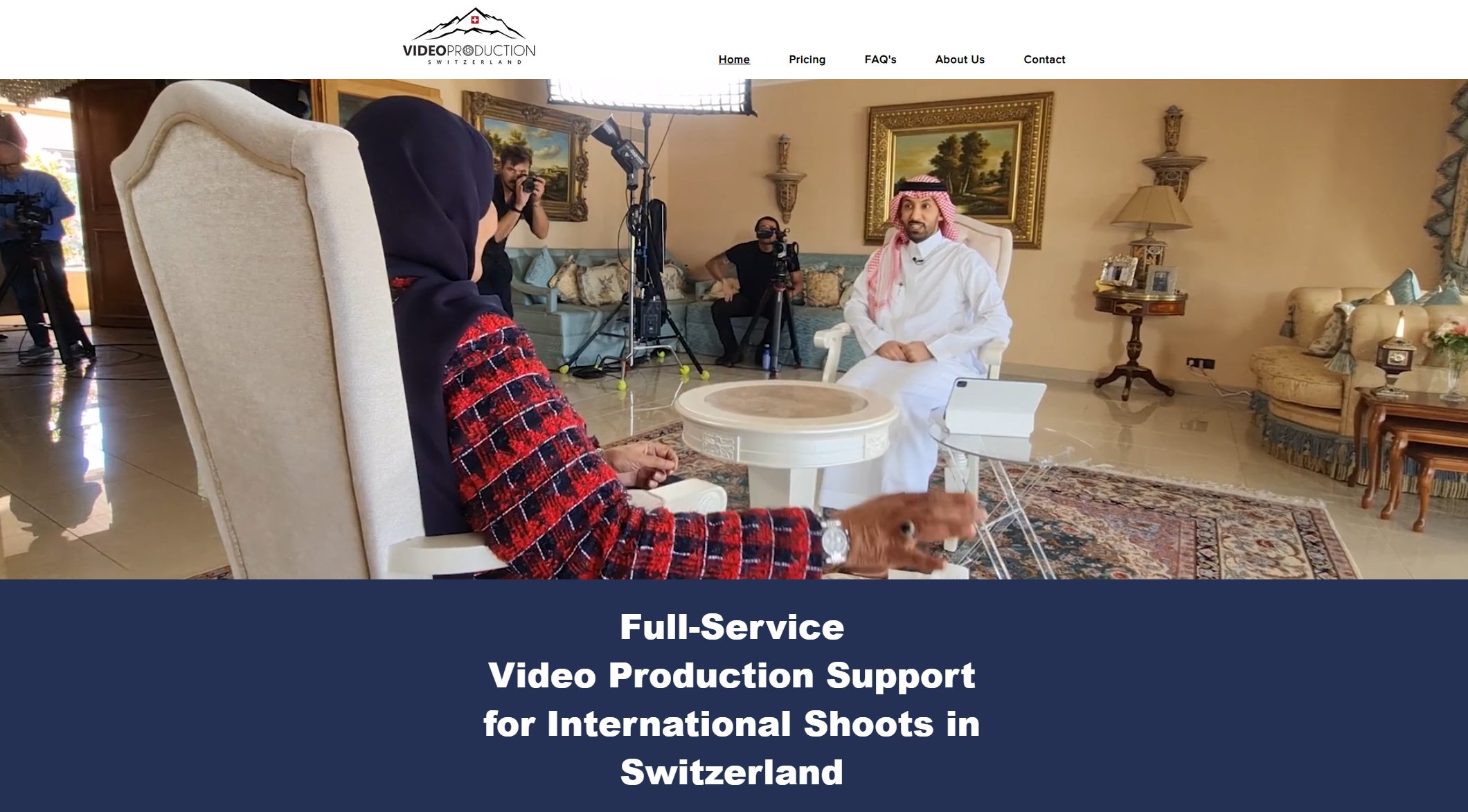
The practical advantage for productions coming from this article: you get location scouting integrated with the rest of your pre-production chain. No handover gaps between the scout who found the location and the team managing permits and crew. One point of contact, clear deliverables, and a process built around keeping your shoot on time and on budget.
If you are planning a shoot and need location scouting alongside full production support, get in touch with the team to discuss your project scope and timeline.
Useful sources and next steps for your location scouting process
Before you brief a scout or file a permit, these resources will save you time and prevent the most common mistakes.
Practical checklists and scouting guides:
StudioBinder’s location scouting checklist covers the full range of technical and creative evaluation criteria, with a downloadable PDF for producers and ADs.
Plotwell’s film location scouting checklist is particularly strong on the ambient audio memo and the structured scoring approach.
Wrapbook’s location scouting guide includes a free downloadable checklist and permitting guides for major U.S. production hubs including Los Angeles and New York City.
U.S. permit resources:
The Association of Film Commissioners International (AFCI) maintains a directory of U.S. film commissions by state and city, useful for identifying the correct permitting authority for any location.
The FAA’s LAANC system handles drone authorizations in controlled airspace; check authorization requirements before any aerial scouting or production work.
Your immediate action list:
Brief your scout with the script breakdown and a clear location brief before any research begins.
Request a sample scout report before signing any agreement.
Schedule the tech scout with all relevant department heads at least two weeks before your shoot date.
Confirm backup locations are documented and accessible before you lock the primary.
For productions that need full-service support from location research through shoot-day logistics, the Videoproductionswitzerland services page is the right starting point.
Recommended
