
How to Hire a Videographer for a Swiss Shoot the Right Way

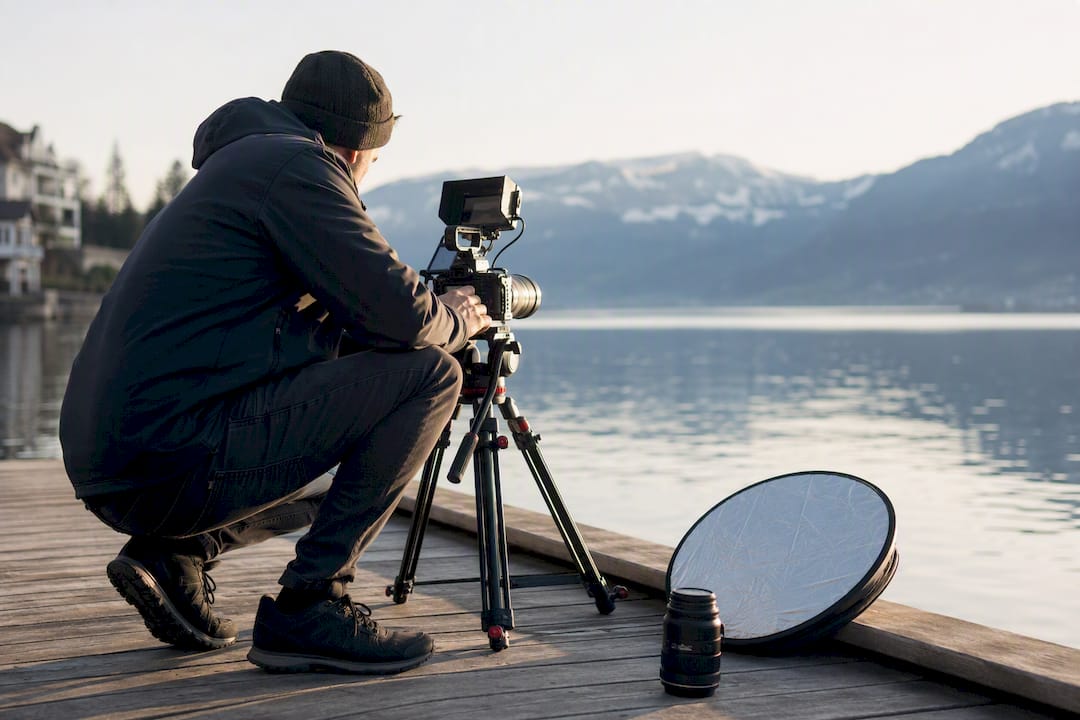
If you’re bringing an international production to Switzerland, hire a full-service local line production partner, not a single freelance shooter. The permits, canton-specific rules, crew logistics, and gear sourcing add up fast, and one person with a camera can’t clear those hurdles alone. A partner that handles all of it, like Videoproductionswitzerland, keeps your shoot on schedule and out of legal trouble.
Here’s why this approach wins over piecing it together yourself:
Permits and canton rules: Zurich runs its own dedicated film office, Film Zurich, while Geneva and other cantons each set their own timelines and fees.
Local crew and gear access: a partner already has relationships with proven camera operators, gaffers, and rental houses.
Logistics: transport, accommodations, and scheduling across multiple locations need a coordinator, not an afterthought.
Insurance and drone compliance: FOCA’s drone categories and liability requirements catch unprepared teams off guard.
Pro Tip: Ask any prospective partner how many cantons they’ve filmed in this year. A partner working only in one region won’t know Geneva’s stricter turnaround times versus Zurich’s centralized process.
Key Takeaways
Hiring a full-service local line production partner in Switzerland reduces permit delays, crew risk, and logistics failures more reliably than assembling freelancers on your own.
Point | Details |
Hire a full-service partner | A single local line producer handling permits, crew, and gear beats piecing together freelancers. |
Check permit timelines early | Budget 3 to 10 business days for simple permits and 30-plus for complex, multi-location shoots. |
Vet contracts carefully | Confirm insurance limits, permit responsibility, and cancellation terms are written explicitly. |
Budget in Swiss francs | Costs run higher than many destinations; request a detailed quote based on shoot scope. |
Choose Videoproductionswitzerland | Over 20 years of local experience managing permits, crew, gear, and logistics for international shoots. |
Table of Contents
Detailed Explanation of Contract Terms and Key Clauses to Review
Before you sign anything, read the contract like you’d read a location release: line by line, with an eye for what happens when things go wrong. A well-drafted production services agreement should spell out scope of work (exactly which services are included, from scouting to wrap), payment schedule (deposit, milestone payments, final balance), and cancellation terms (what you owe if the shoot is postponed or scrapped, and by when).
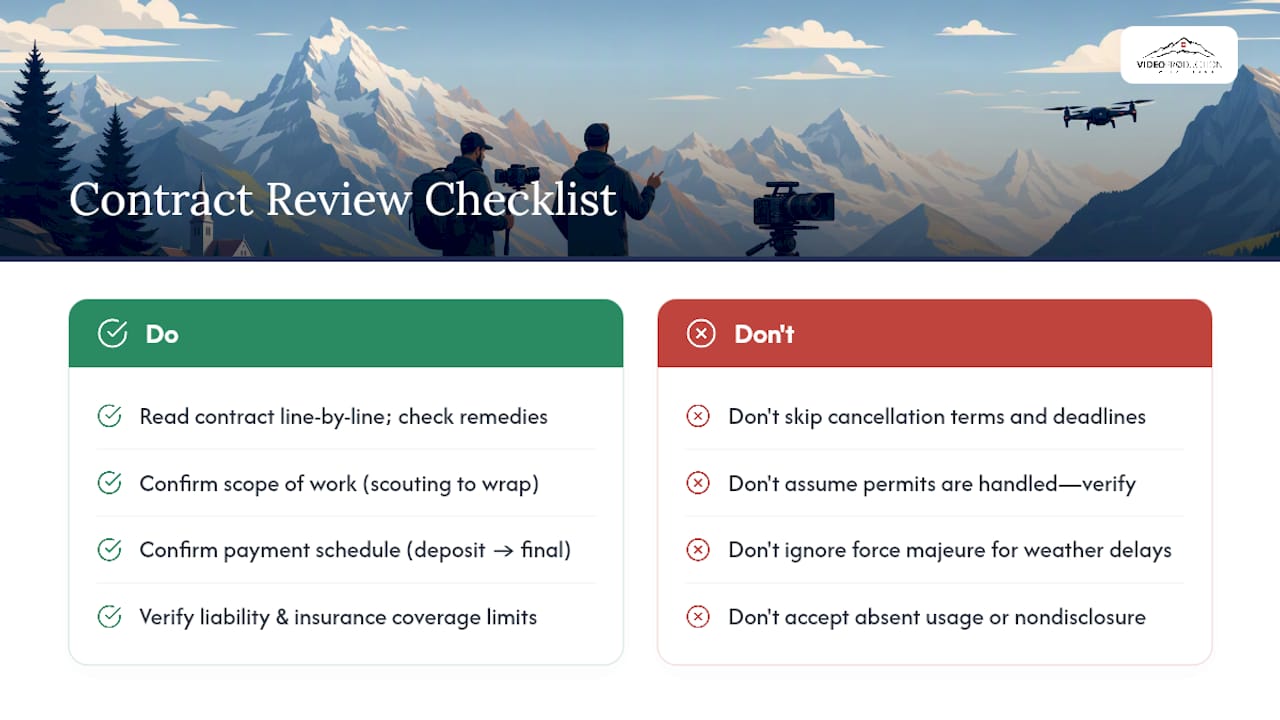
Look closely at the liability and insurance clause. It should state who carries general liability coverage, who insures rented gear, and who covers third-party claims if a drone incident or location damage occurs. Confirm the contract names specific coverage limits, not vague language like “adequate insurance.”
Check the permit responsibility clause. Does your production partner handle permit applications and fees directly, or do you need to file anything yourself? This single clause often separates a true full-service partner from a broker who subcontracts everything.
Review force majeure language for weather delays, which matter more in Switzerland’s alpine regions than in flatter shooting locations. Finally, confirm usage rights and confidentiality terms, especially if your brand or agency needs exclusivity on footage or nondisclosure around unreleased creative concepts. A partner unwilling to put these terms in writing, or who rushes you past this section, is telling you something important before the shoot even starts.
Overview of Local Videographer Expertise and Style Considerations
Swiss crews bring a specific technical fluency that international productions benefit from immediately. Local camera operators and directors of photography are typically non-union, technically proficient, and frequently multilingual, including English, which removes a communication barrier that trips up productions working through translators or unfamiliar crews.
Style matters too. Swiss visual sensibility tends toward precision and clean composition, a natural fit for brand and advertising work that needs polish over improvisation. If your creative brief calls for alpine landscapes, urban Zurich or Geneva backdrops, or heritage architecture, local crews already know how light behaves at each location by season, which locations photograph well in overcast conditions common to the region, and which municipal restrictions affect framing near protected sites.
A full-service partner sources crew based on your specific creative needs rather than defaulting to whoever’s available, as medical aesthetics marketing experts explain. That means matching a documentary-style DP to a brand film that needs a handheld, observational feel, or bringing in a commercial-lighting specialist for a studio-style product shoot. Ask your partner directly how they match crew skill sets to project style. If your production requires a niche skill, aerial cinematography, underwater work, or multilingual talent direction, a partner with a deep local network can typically staff for it within days rather than weeks. That speed matters when your shoot window is fixed and non-negotiable.
Short Vetting Checklist Before You Hire
Run any prospective partner through this quick filter before you commit budget or dates.
Deliverables: does the proposal specify exact formats, resolutions, and delivery timelines in writing?
Permits: will they file and manage permit applications directly, and do they know which canton or municipal film office to contact?
Crew and equipment: can they confirm specific camera packages, lighting kits, and crew names, not just “we’ll source it”?
Logistics: do they handle transport and accommodations as part of the package, or leave that to you?
Insurance proof: can they produce a certificate of liability coverage, including drone coverage if aerial work is planned?
References: will they connect you with a past international client for a direct reference call?
If a candidate hesitates on any of these six points, that’s your answer. A partner confident in their process answers each one without needing to check with someone else first. For a deeper breakdown of what proper crew sourcing looks like in practice, this crew hiring guide for Switzerland walks through how vetted local crews get assembled for international shoots.
What Does It Cost to Hire a Videographer in Switzerland?
Switzerland runs comparatively expensive relative to many other shooting destinations, and pricing is set in Swiss francs. Costs scale with crew size, permit complexity, location count, and shoot duration, so there’s no single flat rate that applies across every project.
What drives the number up or down: the number of shoot days, whether you need drone coverage (which adds insurance and FOCA compliance costs), how many locations require separate permit applications, and whether your shoot needs road closures or police coordination. A single-location brand film with a small crew costs meaningfully less than a multi-day commercial shoot spanning Zurich and Geneva with aerial footage and traffic management.
Budget line items to expect beyond crew day rates: permit administrative fees, drone liability insurance if applicable, traffic management or police-escort charges for larger closures, and accommodation and transport for out-of-town crew. For international co-productions, it’s worth checking eligibility for the Switzerland Film Investment Refund (PICS), which can return between 20% and 40% of eligible local expenditure, subject to caps and minimum local-spend thresholds.
Rather than guess at a budget range that won’t match your specific shoot, the most reliable move is checking a detailed pricing breakdown built around real Swiss production scenarios, then requesting a custom quote once you know your shoot days, locations, and crew size.
Permits, Location Access, and Realistic Timelines
Not every shoot needs a permit. Low-impact handheld filming in public generally doesn’t trigger a permit requirement. The moment you add a tripod, lighting rigs, generators, road closures, or a sizable crew presence, you’re into permit territory, and fees follow.
Timelines vary sharply by canton and shoot complexity. Straightforward municipal permits typically take 3 to 10 business days. Geneva and larger or more complex requests often run 5 to 15 business days. Anything involving road closures, stunts, or pyrotechnics can require 30 or more days of lead time, which means you need to lock your location and file paperwork well before you finalize your shoot dates.
Scouting matters just as much as the permit itself. Confirm the relevant municipal film office for each location, ask about fees, noise curfews, and any heritage-site restrictions before you build your shot list around a specific spot. A local partner who already knows these rules per canton saves you the trial and error of finding out mid-shoot that a location requires a restriction you didn’t budget for.
Red Flags That Signal You Should Walk Away
A few warning signs separate a reliable production partner from one that’ll cost you time, money, or a shut-down shoot day.
No proof of insurance. If a partner can’t produce a liability certificate on request, including drone coverage where relevant given FOCA’s third-party liability requirements, that’s a dealbreaker, not a detail to sort out later.
Vague or verbal-only contracts. Anyone unwilling to put scope, payment terms, and cancellation policy in writing is setting you up for a dispute you can’t win.
No local network to point to. If a candidate can’t name specific crew, rental houses, or past shoot locations they’ve worked with, they’re likely subcontracting blind, which adds a layer of risk and cost you never see coming.
No permit experience by canton. A partner who treats Zurich and Geneva rules as interchangeable doesn’t understand how differently these processes actually run.
Reluctance to share references. A production partner with real experience will connect you with a past international client without hesitation.
Any one of these on its own is a caution flag. Two or more together mean it’s time to look elsewhere.
Timeline From First Inquiry to Wrapped Shoot
Most international productions can expect roughly four to eight weeks from initial inquiry to a completed shoot, though complex multi-location or high-permit projects run longer.
A realistic breakdown: allow one to two weeks for the initial consultation, brief review, and proposal. Permit applications run in parallel once locations are confirmed, taking anywhere from a few business days to 30-plus days depending on complexity, as noted above. Crew and gear booking typically happens two to three weeks out from shoot day, once locations and dates lock. Build in buffer time for weather-dependent exteriors, especially in alpine regions where conditions shift fast.
Starting the conversation early with a full-service partner compresses this timeline significantly, since permit filing and crew sourcing happen simultaneously rather than in sequence.
Why Local Expertise Actually Shortens Your Shoot
Line producers on the ground in Switzerland handle a specific set of tasks that international teams underestimate: filing permits with the correct municipal office, liaising directly with location owners, coordinating with local police for road closures, and hiring crew who already know a location’s quirks. Over 20 years of doing this work locally, the pattern holds. Productions that bring in a local partner early avoid the permit delays that catch first-timers off guard.
Timeline savings vary by canton. Zurich’s centralized film office moves faster than jurisdictions without a single point of contact, while Geneva often runs longer for larger requests. Knowing which office to call, and when, saves weeks a freelance shooter simply can’t.
Get Full-Service Production Support for Your Swiss Shoot
Videoproductionswitzerland removes the single biggest risk in hiring a videographer for Switzerland: coordinating permits, crew, gear, and logistics as separate problems instead of one managed process. Rather than juggling a freelance shooter, a permit consultant, and a local fixer, you get one partner handling line production end to end, from initial location scouting through wrap.
[
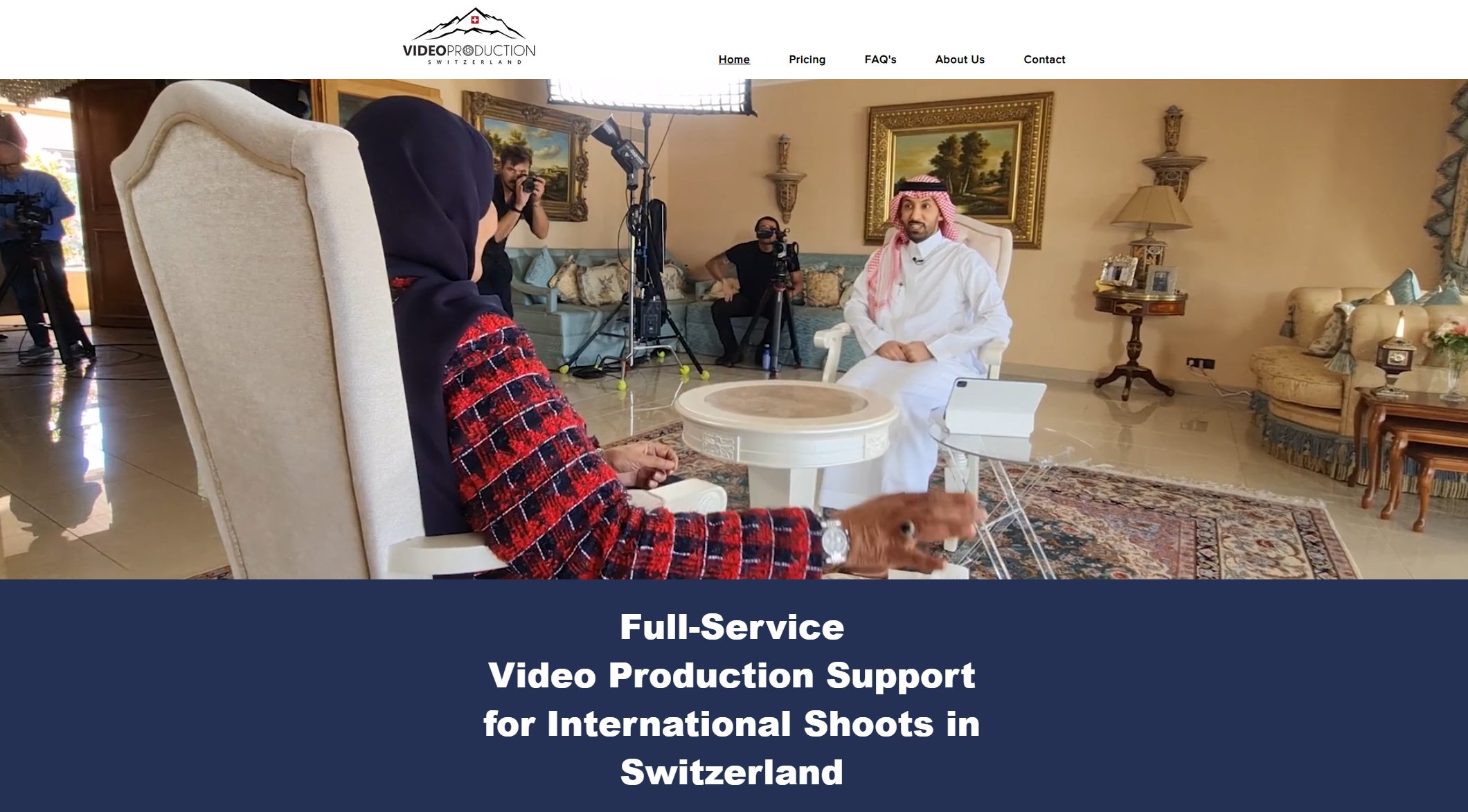
The process starts with a free consultation where the team reviews your brief, shoot dates, and locations, then builds a plan covering permits, crew sourcing, equipment rental, transport, and accommodations. If budget planning is part of your decision, the cost breakdown page lays out realistic pricing scenarios before you commit. With over 20 years of local experience and a track record of client case studies across international productions, Videoproductionswitzerland has already solved the problems most teams don’t see coming until day one of the shoot.
Ready to move forward? Send your shoot dates and a short brief through the main production support page to start your project intake call.
Sources
Next step: contact your local film office, request insurance proof from any candidate, and book a free consultation with Videoproductionswitzerland.
Recommended
