
Finite scheduling software cuts Swiss film shoot delays 30%


Most international filmmakers assume scheduling software is scheduling software. That’s a costly mistake. Generic scheduling software fails to prevent 30% of resource conflicts in film shoots, leaving crews idle and budgets bloated. Finite scheduling software addresses this gap by respecting real resource limits and integrating Swiss-specific regulatory constraints. This article shows you how finite scheduling solutions transform Swiss film production efficiency, ensuring compliance and cost control.
Table of Contents
Key takeaways
Point | Details |
Finite scheduling prevents conflicts | Respects actual resource limits, cutting scheduling errors by 30% compared to generic tools. |
Swiss compliance integration | Embeds permit deadlines and regulatory timings directly into production schedules. |
Real-time adaptability | Enables immediate schedule updates for weather changes, permit delays, or crew availability shifts. |
Cost savings demonstrated | Reduces idle on-set time by 20%, saving approximately CHF 10,000 per 10-day shoot. |
Collaboration centralized | Cloud-based platforms unify multilingual, multi-location teams around one schedule source. |
Understanding finite scheduling in film production
Finite scheduling software schedules tasks within defined resource limits. Each crew member, equipment piece, and location has limited availability. The software allocates them only when actually available. This differs fundamentally from infinite scheduling, which assumes unlimited resources and creates fantasy timelines.
Film shoots operate under tight constraints. You have three camera operators, not ten. Your sound mixer works specific hours. Permits restrict shoot windows at historic sites. Manual scheduling neglects integration with permits, locations, and dynamic resource changes causing significant delays. Spreadsheets cannot flag conflicts when your key grip is double-booked or your crane arrives after your permit expires.
Infinite scheduling produces beautiful Gantt charts that collapse on day one. Tasks stack without checking if resources exist to execute them simultaneously. Your schedule shows three scenes shooting concurrently, but you only have one director of photography. Reality hits hard.
Manual spreadsheet scheduling compounds these problems for international shoots. Time zone confusion, currency conversions, and permit deadline tracking overwhelm basic tools. You’re juggling Swiss permit offices, equipment rentals across cantons, and crew flying from multiple countries. Excel wasn’t built for this complexity.
Pro Tip: Define all resource constraints upfront. List every crew role’s availability, equipment rental periods, location access windows, and permit restrictions before scheduling a single scene. This data foundation makes finite scheduling accurate.
Incorporating Swiss regulatory compliance
Switzerland requires specific filming permits depending on location type and shoot scale. Public spaces, national parks, and urban centers each have distinct approval processes. Swiss filming permit applications typically require 15 business days for approval, though complex locations extend this to 30 days. Missing these deadlines stops your shoot cold.
Finite scheduling software integrates permit timing as hard constraints. The system prevents scheduling scenes at locations before permit approval dates. It flags permit expiration deadlines, ensuring you complete shoots within approved windows. This automation eliminates guesswork and manual tracking.
Key regulatory features include:
Permit deadline alerts that notify producers 7 days before expiration
Compliance checklists ensuring insurance certificates and safety plans attach to relevant shoot days
Location-specific restriction overlays showing noise ordinance hours or seasonal access limits
Multi-jurisdiction tracking when shoots span different Swiss cantons with varying rules
Ignoring local regulations triggers immediate consequences. Zurich fines unauthorized commercial filming CHF 5,000 minimum. Canton authorities can halt productions, seize equipment, and deny future permits. Your reputation suffers permanent damage in a small, interconnected Swiss production community.
Software synchronizes permit approvals with production schedules by creating dependencies. Scene 12 at Bahnhofstrasse cannot schedule until Zurich city permit status changes to approved. Once approved, the software auto-releases that location for scheduling within permitted dates and hours. This dependency management prevents premature commitments.
Addressing Swiss-specific logistical challenges
Switzerland’s mountainous geography creates unique scheduling obstacles. A location in Zermatt sits 90 minutes from Brig by train, but weather can close mountain passes unpredictably. Equipment trucks face road restrictions and tunnel closures. These variables demand sophisticated scheduling that accounts for real travel conditions.
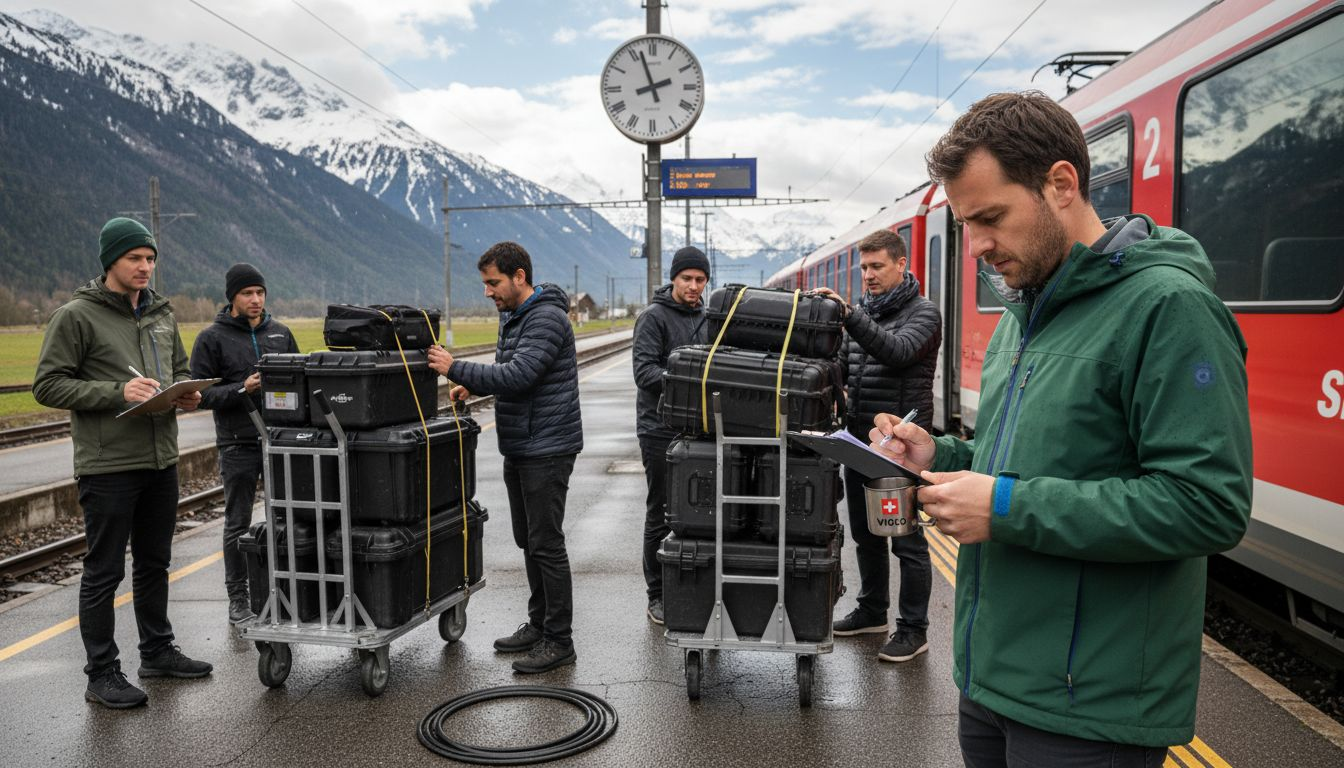
Transport infrastructure constraints affect crew and equipment movement significantly. Swiss rail schedules are punctual but inflexible. Missing a connection adds 60-minute delays minimum. Road freight faces weekend driving bans in tourist regions. Finite scheduling software integrates location-specific travel time data, calculating realistic transition periods between shooting sites.
Route | Distance | Typical Travel Time | Permit Processing |
Zurich to Lucerne | 54 km | 50 min by train, 70 min by truck | 10 business days |
Geneva to Zermatt | 242 km | 3.5 hours by train, 4+ hours by vehicle | 15 business days |
Basel to St. Moritz | 236 km | 4 hours by train, 5+ hours by truck | 20 business days |
Bern to Lugano | 205 km | 2.5 hours by train, 3.5 hours by vehicle | 12 business days |
The software optimizes shoot sequences to minimize idle time and delays. It groups scenes by location clusters, reducing daily travel. Scene order adjusts to match equipment delivery schedules and crew availability windows. Weather-dependent exterior shots schedule with backup interior alternatives automatically shifting if forecasts worsen.
Advanced systems incorporate real-time traffic and transit data. A delayed equipment shipment triggers automatic rescheduling of dependent scenes. The software proposes alternative sequences using available resources at accessible locations. This dynamic optimization keeps productions moving despite inevitable disruptions.
Production efficiency gains compound when scheduling respects Swiss logistical realities. Unrealistic travel assumptions create cascading delays. Your crew arrives late, light fades early, permits expire unused. Production planning insights demonstrate that location-aware scheduling cuts wasted production days by 40%. Scheduling production control systems prevent these costly mistakes through constraint-based planning. Modern production planning software makes this optimization accessible to productions of any scale.
Software tools and features for film scheduling
Movie Magic Scheduling remains the film industry standard for detailed production breakdowns. Its drag-and-drop interface balances resources visually, showing conflicts instantly. Budget integration links schedule changes to cost implications automatically. Producers see financial impact before committing to schedule adjustments.
Scenechronize offers cloud-based collaboration designed for international productions. Real-time updates sync across team members in different time zones. The platform detects scheduling conflicts automatically, alerting relevant department heads immediately. Version control prevents team members from working on outdated schedules.
Feature | Movie Magic Scheduling | Scenechronize | Key Benefit for Swiss Shoots |
Resource conflict detection | Manual review required | Automatic alerts | Prevents double-booking crew across multiple Swiss locations |
Permit deadline tracking | Custom fields needed | Built-in compliance module | Integrates 15-day Swiss permit timelines automatically |
Weather integration | No native support | API-connected forecasts | Reschedules weather-dependent Alpine shoots proactively |
Multi-language support | English only | 12 languages including German, French, Italian | Accommodates Swiss multilingual crew communication |
Real-time collaboration | Local file sync | Cloud-native updates | Enables coordination between international producers and local Swiss teams |
Budget impact analysis | Full integration | Limited financial tools | Movie Magic shows cost changes from schedule adjustments instantly |
Pro Tip: Choose software aligned with your production size and collaboration needs. Small crews benefit from Scenechronize’s simplicity and cloud access. Large productions with complex budgets require Movie Magic’s deep financial integration.
Scenario analysis features prove essential for dynamic Swiss shoots. Software creates alternative schedules based on different assumptions. What if the Jungfraujoch permit delays two weeks? What if your lead actor becomes unavailable? The system generates viable alternatives instantly, showing resource implications and budget impacts for each scenario.
Real-time update capabilities handle production chaos gracefully. Weather closes your mountain location. The software identifies interior alternatives using available sets and crew. Permit approval arrives early. The system proposes advancing that location’s scenes to capture optimal light conditions. These adaptive features transform reactive firefighting into proactive optimization.
Benefits of finite scheduling software in Swiss productions
Finite scheduling software reduces idle on-set time by up to 20%, translating to approximately CHF 10,000 savings per 10-day shoot. Swiss crew day rates average CHF 800 to CHF 1,200. Every hour of prevented idle time multiplies across your entire crew. Efficient scheduling eliminates gaps where crew waits for equipment, permits, or preceding scenes.
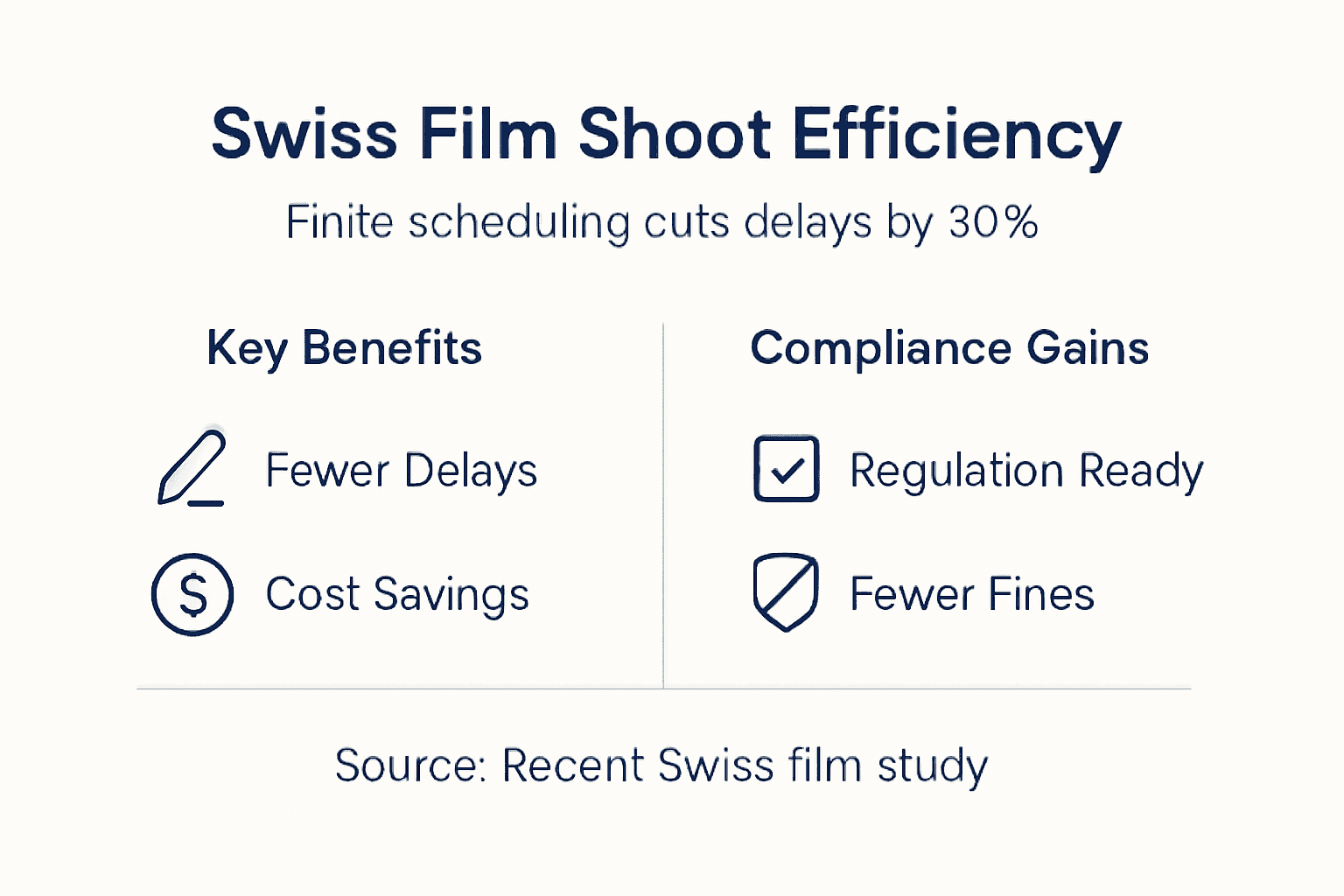
Scheduling conflicts and permit delays trigger costly shoot rescheduling. Moving a shoot day incurs location rebooking fees, crew overtime charges, and equipment rental extensions. Software-driven conflict detection prevents these expenses by identifying issues during planning, not on-site. Productions report 60% fewer emergency rescheduling events when using finite scheduling tools.
Key operational improvements include:
Centralized schedule access eliminates version confusion across international teams
Automated notifications keep department heads informed of changes affecting their resources
Dependency tracking shows ripple effects before committing to schedule modifications
Resource utilization reports identify underused crew or equipment, enabling cost optimization
Historical data analysis improves future shoot planning accuracy
Compliance adherence improves dramatically with integrated regulatory tracking. Software prevents accidental permit violations by blocking schedule changes that exceed approved parameters. Automated documentation ensures insurance certificates, safety plans, and permissions attach to relevant shoot days. This systematic approach avoids fines and production stoppages.
Efficient scheduling boosts overall shoot morale and stakeholder satisfaction. Crew members appreciate predictable schedules that respect their availability constraints. Clients see professional organization and on-time delivery. Location partners experience smooth, well-coordinated shoots that respect their property and regulations. These relationship benefits compound across your production career in Switzerland’s tight-knit film community. The time management benefits extend beyond immediate cost savings to long-term industry reputation.
Streamline your Swiss film productions with expert scheduling support
Complex scheduling demands both sophisticated software and local Swiss expertise. Our team at Video Production Switzerland combines proven finite scheduling tools with 20 years of Swiss production experience. We integrate regulatory compliance, location logistics, and resource optimization into schedules that actually work.
[
International productions face unique coordination challenges in Switzerland. We handle permit applications, equipment sourcing, crew booking, and location access within scheduling constraints. Your production runs smoothly because our scheduling solutions account for every Swiss-specific variable. We deliver transparent video production costs that match realistic schedules, eliminating budget surprises. Let us transform your Swiss shoot from logistical challenge to seamless execution.
Frequently asked questions about finite scheduling software for Swiss film shoots
What distinguishes finite scheduling software from other project management tools?
Finite scheduling software respects actual resource availability limits, preventing impossible task assignments. Standard project management tools allow unlimited parallel tasks regardless of resource constraints. For film productions, this difference means preventing crew double-booking and equipment conflicts that generic tools miss.
Can finite scheduling software adapt to last-minute changes during Swiss shoots?
Modern finite scheduling platforms enable real-time updates visible to all team members instantly. When weather closes a location or permits arrive early, the software recalculates dependent tasks and proposes viable alternatives. Cloud-based systems like Scenechronize excel at this dynamic rescheduling, essential for unpredictable Alpine conditions.
How does finite scheduling software handle multilingual and multi-location international teams?
Leading platforms support multiple interface languages and time zone coordination automatically. Scenechronize offers 12 languages including German, French, and Italian for Swiss crews. The software converts all scheduling data to each user’s local time zone, preventing confusion between international producers and local teams.
Is local Swiss regulatory expertise still necessary when using scheduling software?
Absolutely. Software automates permit deadline tracking and compliance checks, but human expertise interprets canton-specific regulations and builds relationships with approval authorities. Effective productions combine software efficiency with experienced local coordinators who understand Swiss regulatory nuances and cultural expectations.
What initial data is required to effectively implement finite scheduling for my production?
Comprehensive resource inventories form the foundation. List all crew members with availability dates, equipment rental periods, location access windows, and permit application timelines. Include travel time data between locations and regulatory constraints for each shooting site. This upfront data investment enables accurate finite scheduling that respects real-world constraints.
How long does it take to implement finite scheduling software for a Swiss production?
Small productions with straightforward requirements implement cloud platforms like Scenechronize within 2-3 days. Larger shoots using Movie Magic Scheduling require 1-2 weeks for full crew training and data migration. The implementation investment pays back immediately through prevented conflicts and optimized resource utilization.
Recommended
