
Filming in the Swiss Alps: Essential Guide for International Crews

TL;DR:
Permits vary by canton and require early, detailed applications for successful filming.
Local scouts and film commissions provide critical support for location access and logistics.
Combining official support with private fixers ensures efficient, reliable production experiences.
Switzerland draws international film crews like few other destinations on earth. The Alps deliver jaw-dropping scenery, but the logistics behind a successful shoot here are anything but simple. Permits vary by canton, drone rules are strict, and mountain access can shut down without warning. Zurich alone hosts 600+ productions annually, which tells you everything about Switzerland’s global appeal and nothing about how hard it is to navigate the paperwork. This guide covers permit requirements, location scouting, film commission support, and cost management so you can walk onto set with total peace of mind.
Table of Contents
Understanding permit requirements for filming in the Swiss Alps
Scouting the best Swiss Alps locations: What filmmakers need to know
Navigating Swiss film commissions: Free support vs. private fixers
Costs, incentives, and practical filming tips for the Swiss Alps
Behind the scenes: What most guides overlook about filming in the Swiss Alps
Key Takeaways
Point | Details |
Permit complexity | Swiss Alps film permits have strict rules; apply early and check for additional requirements like drone approval. |
Local expertise | Hiring local scouts and fixers saves time by navigating seasonal closures and logistical hurdles. |
Official vs. private support | Official commissions offer free assistance but require advance notice; private fixers are faster for urgent needs. |
Green filming incentives | Eco-friendly productions may qualify for incentives worth up to CHF 6000 in Zurich. |
Premium costs | Budget for ‘Alps premium’ costs, which reflect both logistical complexity and production quality guarantees. |
Understanding permit requirements for filming in the Swiss Alps
Permit rules are the first major hurdle for any international crew, and they are more layered than most guides let on. Switzerland is a federal country, which means each canton sets its own rules. What works in Valais will not automatically work in Zurich or Ticino. Getting this wrong can halt your shoot on day one.
In Zurich, the rules are especially specific. A permit is required if your shoot runs longer than one hour, involves more than five people, or uses any public infrastructure. Shooting on public holidays triggers additional restrictions. And if you plan to fly a drone, that requires a completely separate approval process through Swiss aviation authorities, independent of your standard filming permit. You can review the full Swiss drone laws before submitting any applications.
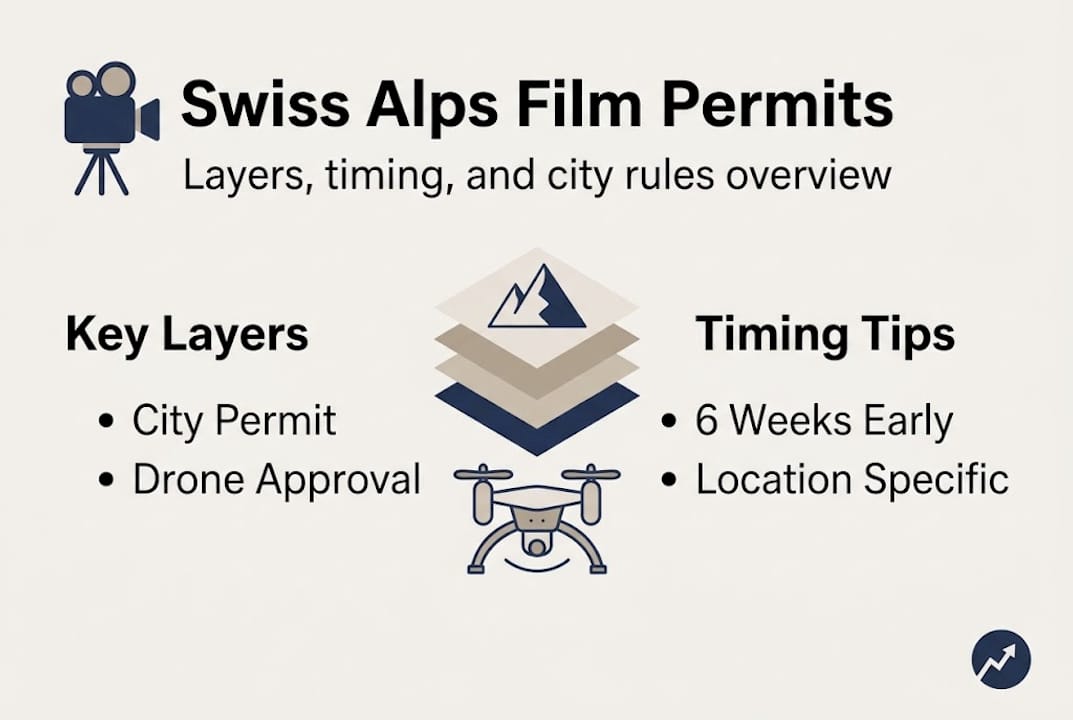
Here is how the main Alpine regions compare:
Region | Permit Authority | Typical Lead Time | Drone Rules |
Zurich | City of Zurich Film Office | 4 to 6 weeks | Separate aviation approval required |
Valais | Valais Film Commission | 6 to 8 weeks | Canton-specific restrictions apply |
Ticino | Ticino Film Commission | 4 to 6 weeks | Aviation authority approval needed |
Lucerne | Film Commission Central Switzerland | 6 weeks minimum | Restricted near populated areas |
Key factors that affect your permit needs across all regions:
Group size: Most cantons trigger permit requirements above five crew members
Duration: Shoots exceeding one hour almost always require formal approval
Infrastructure use: Roads, bridges, cable car stations, and public squares require separate clearance
Public holidays: Restrictions tighten significantly on national and cantonal holidays
Aerial filming: All drone operations need aviation authority sign-off, regardless of location
For a detailed walkthrough of the process, the permit application steps resource covers each stage clearly. If you are planning aerial shots, the drone regulation guide is essential reading before you even pack your equipment.
Pro Tip: Submit permit requests at least six weeks before your shoot date. Complex locations or larger crews may need eight weeks or more, especially in peak summer season when applications pile up.
“The permit process in Switzerland is not bureaucracy for its own sake. It protects locations, local communities, and your production from costly surprises. Treat it as a quality filter, not a barrier.”
Scouting the best Swiss Alps locations: What filmmakers need to know
Once permits are underway, location scouting becomes your next critical focus. The Alps look effortlessly cinematic on screen, but reaching the right spot at the right time requires serious local knowledge.
Roads in alpine areas close seasonally, sometimes with little advance notice. Cable cars operate on fixed schedules and fill up fast during summer, which is the peak period for exterior shoots. Hiring local scouts for Alps access is not a luxury. It is the difference between a smooth recce and a wasted day on a closed mountain road.
Here is what experienced scouts bring to your production:
Seasonal access knowledge: They know which roads open in May versus July and which cable cars require advance booking
Weather pattern insight: Local scouts track microclimates that national forecasts miss entirely
Landowner relationships: Private land access in the Alps often depends on personal connections built over years
Backup location options: When your primary location is unavailable, a local scout has alternatives ready immediately
Safety awareness: Alpine terrain carries real risks; local experts know which areas are safe for large crews and equipment
Summer is the preferred season for exterior shoots, and for good reason. Weather risk drops significantly, daylight hours are long, and most locations are fully accessible. That said, summer also brings the most competition for permits and cable car bookings, so plan accordingly.
One incentive worth knowing: Zurich offers green filming incentives of up to CHF 6000 for eco-friendly productions. If your crew is already committed to sustainable practices, this is money you should not leave on the table.
For visual inspiration and practical access notes, the guide to top filming spots in Switzerland is a strong starting point. You can also review outdoor scouting advice specific to alpine environments.
Pro Tip: Book cable cars and mountain transport at least four to six weeks ahead during summer. Last-minute bookings are rarely available, and missing your transport window can cost you an entire shoot day.
Navigating Swiss film commissions: Free support vs. private fixers
After scouting locations, you need to decide who will support your production logistics on the ground. Switzerland offers two main options: official film commissions and private fixers. Each has real strengths, and the right choice depends on your timeline and complexity.
Official film commissions provide free support for international productions. They assist with permit coordination, location access, local contacts, and sometimes crew referrals. The Valais Film Commission, Ticino Film Commission, and Film Commission Central Switzerland are the primary contacts for Alpine shoots. The catch is lead time. These commissions work best when you contact them at least six weeks in advance, and ideally earlier for complex multi-location shoots.
Private fixers charge fees but offer speed and flexibility that official channels cannot always match. For urgent requests, last-minute changes, or highly specific logistical needs, a trusted private fixer can resolve issues in hours rather than weeks.
Support Type | Cost | Speed | Best For |
Film Commission | Free | 6 to 8 weeks lead time | Planned shoots with clear timelines |
Private Fixer | Paid (varies) | Days to weeks | Complex, urgent, or multi-location needs |
Combined Approach | Mixed | Optimized | Large international productions |
Key considerations when choosing your support model:
Budget: Commissions are free but require advance planning; fixers add cost but save time
Complexity: Multi-canton shoots with tight schedules benefit from private fixer involvement
Relationships: Fixers with existing local relationships can unlock access that commissions cannot
Flexibility: Private fixers adapt faster to last-minute changes on location
You can explore the commission support benefits in more detail to decide which approach fits your production model.
“The ‘Alps premium’ debate misses the point. Yes, Switzerland costs more. But that cost buys you access to locations, safety infrastructure, and logistical reliability that simply does not exist at the same level anywhere else.”
Costs, incentives, and practical filming tips for the Swiss Alps
With your support options clear, the next focus is budgeting realistically and squeezing maximum value from every franc you spend. Switzerland is not cheap, and Alpine shoots add layers of cost that flat-terrain productions never face.
The 600+ productions per year in Zurich alone reflect strong demand, and demand keeps prices firm. Alpine logistics, seasonal access windows, and specialized crew requirements all contribute to what the industry calls the “Alps premium.” Budget for it from day one rather than discovering it mid-production.
Cost factors specific to Alpine shoots:
Cost Category | Typical Driver | Mitigation Strategy |
Transport | Mountain access, cable cars, specialized vehicles | Book early, consolidate trips |
Permits | Multi-canton shoots, drone use, infrastructure | Apply early, use commission support |
Crew | Specialized alpine experience, local rates | Hire through trusted local networks |
Weather contingency | Unpredictable alpine conditions | Build buffer days into schedule |
Steps international crews can take to optimize costs and workflow:
Plan your permit timeline first. Everything else in your schedule depends on permit approvals, so start there.
Consolidate locations by canton. Minimizing cross-canton shoots reduces permit complexity and travel costs.
Apply for green filming incentives early. Eligibility is limited and competitive, especially in Zurich where the CHF 6000 incentive attracts significant interest.
Hire local crew for alpine-specific roles. Local experts reduce costly mistakes and speed up on-location problem solving.
Build weather buffer days into your schedule. Alpine weather changes fast; a one-day buffer can save an entire production.
For location-specific cost planning, the guide to filming in Zermatt covers one of the most sought-after and logistically demanding Alpine destinations. The Alps media service overview also provides useful benchmarks for regional service costs.
Pro Tip: Tap green filming incentives as early as possible in your pre-production phase. Eligibility windows close, and late applications are rarely approved regardless of how strong your project is.
Behind the scenes: What most guides overlook about filming in the Swiss Alps
Most practical guides stop at permit checklists and location lists. What they miss is the deeper logic behind Switzerland’s strict and sometimes costly production environment, and why that logic actually works in your favor.
Switzerland’s 600 productions annually are not a coincidence. They are the result of a system that prioritizes reliability, safety, and access quality above all else. The rules feel rigid until you realize they are what keep locations pristine and accessible year after year. A production that cuts corners on permits does not just risk fines. It risks losing access for every crew that comes after.
The most effective international productions we have seen combine official commission support with private local expertise. Commissions provide institutional knowledge, contacts, and free logistical groundwork. Local fixers and scouts provide speed, flexibility, and the kind of on-the-ground judgment that no official handbook can replicate. Using both is not redundant. It is the smartest workflow available.
You can explore film license insights to understand how the licensing layer fits into this broader picture. The cost is not just a price. It is a guarantee of scenic access, safety infrastructure, and a production environment that delivers what it promises.
Pro Tip: Blend commission knowledge with local fixer expertise from the very start of pre-production. The crews that do this consistently finish on time, on budget, and with footage that justifies every franc spent.
Get expert support for your Swiss Alps film shoot
Planning a shoot in the Swiss Alps involves more moving parts than almost any other international production environment. You deserve support that takes the guesswork out of every step.
[
We offer full-service production support built specifically for international crews filming in Switzerland. From transparent Switzerland production costs and permit management to location scouting and local crew coordination, we handle the logistics so you can stay focused on your creative vision. Our full-service production support covers everything from your first location recce to your final wrap day. Book a free consultation and let us show you exactly what a stress-free Swiss Alps shoot looks like.
Frequently asked questions
How early should I apply for Swiss Alps filming permits?
Apply at least six weeks in advance to secure approvals and manage local logistics without last-minute pressure. Complex or multi-location shoots may need eight weeks or more.
Do I need a separate permit for drone filming in the Swiss Alps?
Yes, drone use requires separate aviation authority approval alongside your standard filming permit, regardless of which canton you are shooting in.
What are the best times of year for filming exteriors in the Alps?
Summer reduces weather risk significantly and provides the widest access to Alpine locations, making it the preferred season for exterior film shoots.
How can I access green filming incentives in Switzerland?
Apply early through the relevant Zurich program, which offers up to CHF 6000 in support for qualifying eco-friendly productions. Eligibility is competitive, so early applications have the best chance of approval.
Recommended
