
Filming Etiquette in Switzerland: What You Need to Know

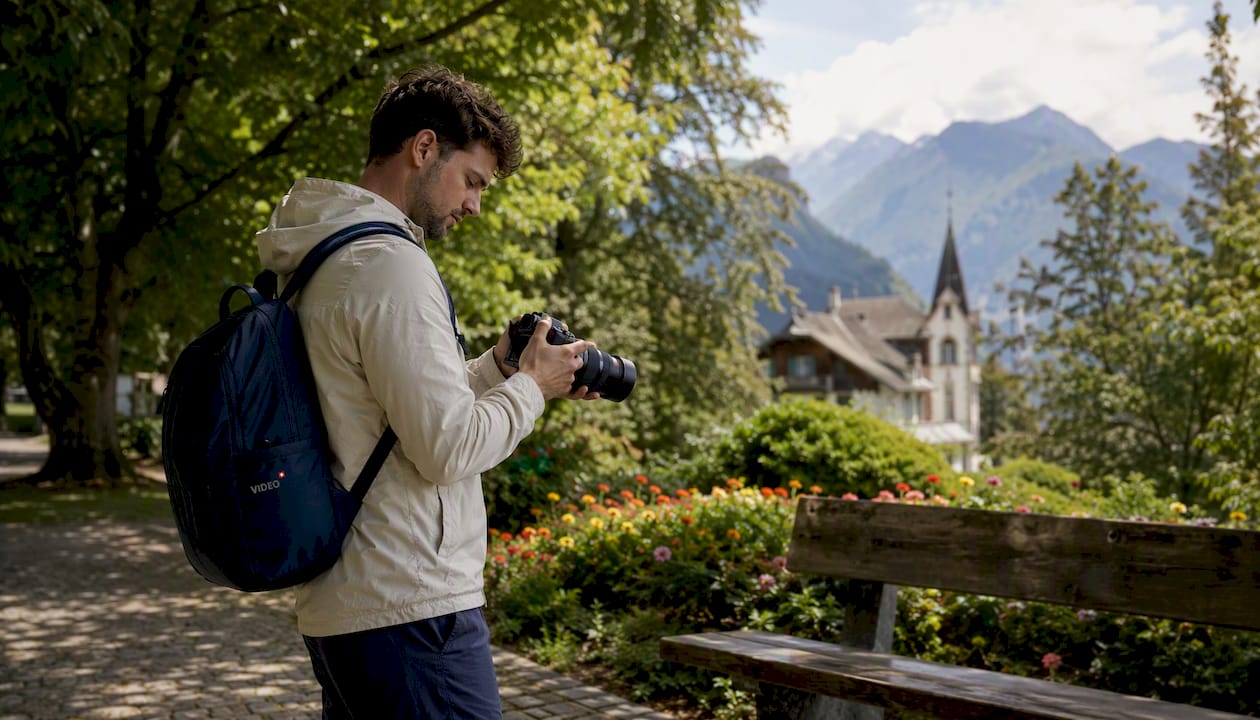
Filming in Switzerland is generally allowed in public spaces, but the moment a recognizable person appears in your footage and you publish or use it commercially, you have a legal obligation to secure consent. Keep your shoot low-impact, ask before you point a camera at anyone, and confirm cantonal permit requirements before you set up.
Do:
Ask for written consent from anyone who is identifiably filmed and whose image will be published or used commercially
Keep noise, equipment footprint, and crew size minimal to avoid triggering permit requirements
Check municipal rules early — cantonal requirements vary significantly between Zurich, Basel, Geneva, and other regions
Don’t:
Publish recognizable people in advertising or promotional material without a signed release
Film in semi-private locations (hospital grounds, school yards, restaurant terraces) without explicit permission from the venue
Fly a drone without first checking Federal Office of Civil Aviation (FOCA) regulations and any local municipal restrictions
Table of Contents
What are the filming etiquette rules in Switzerland?
Swiss law protects every person’s image through personality rights codified in the Swiss Civil Code. The core trigger is recognizability: once a person can be identified from your footage, their image becomes personal data, and publishing it commercially generally requires their consent. The revised Swiss Data Protection Act (revDSG), which came into force in September 2023, reinforced this by treating biometric and visual data as personal information subject to data-protection principles.
The system operates on two levels. Federal law sets the privacy floor through the Civil Code and the revDSG. Below that, cantonal and municipal authorities layer on permit requirements tied to the physical impact of a shoot on public space. A solo traveler filming a mountain vista faces almost no obligations. A commercial crew with lights, rails, and ten people on a Zurich sidewalk faces a formal permit process.
Practical rule of thumb: If a viewer watching your finished footage could name or identify a person without any additional information, that person is recognizable under Swiss law. Consent is required before commercial publication, and the burden of proof is on the filmmaker.
Press and public-interest journalism carry narrower exceptions. A news crew covering a public demonstration can capture bystanders without individual releases because the public-interest defense applies. For commercial shoots, advertising, branded content, or stock footage, that defense is essentially unavailable. The Basel-Stadt filming guidance is one of the clearest canton-level illustrations of how these federal principles translate into local rules, and it is worth reading even if you are not shooting in Basel.
When do you need written releases and how do you handle crowd shots?
Written consent is required the moment a person is identifiable in your footage and that footage will be published or used commercially. This is not a gray area in Switzerland.
Situations that always require a signed release:
Individual portraits or close-up shots used in advertising, promotional videos, or branded content
Footage submitted to stock libraries (Getty Images, Shutterstock, and similar platforms)
Social media posts or YouTube content where the person is the subject of the shot, not incidental background
Any footage featuring minors, regardless of the intended use
Footage of vulnerable adults (patients, people in care settings)
Event coverage sold or licensed to third parties
A solid release form should include the subject’s full name, the scope of permitted use (commercial vs. editorial, specific platforms or media), the territory, the duration of the license, any compensation agreed, and the language of the document. For Swiss shoots, prepare the form in the dominant local language of the canton where you are filming — German, French, or Italian — plus English. Explicit scope-of-use language distinguishing commercial from editorial use prevents downstream disputes that are expensive to resolve.
Pro Tip: For planned crowd scenes, use a combination of PA announcements in the local language, visible signage at entry points, and a brief multilingual leaflet (German/French/Italian/English) explaining the shoot. Anyone who does not want to appear on camera should be given a clear, easy way to step out of frame. Document the announcement time and the signage locations.
For minors, parental or guardian consent is mandatory. Where the child is old enough to understand, obtain their assent separately and document it alongside the parental signature. Keep both documents on set in digital and paper form throughout the shoot.
When does your shoot require a municipal or cantonal permit?
The trigger for a permit is the impact your shoot has on public space, not the fact that you are filming. In Zurich, a shoot requires a permit when it lasts longer than one hour, involves technical infrastructure such as spotlights or camera rails, or brings more than five people to a location. Smaller handheld shoots that stay under all three thresholds generally do not need a permit, provided they do not obstruct traffic.
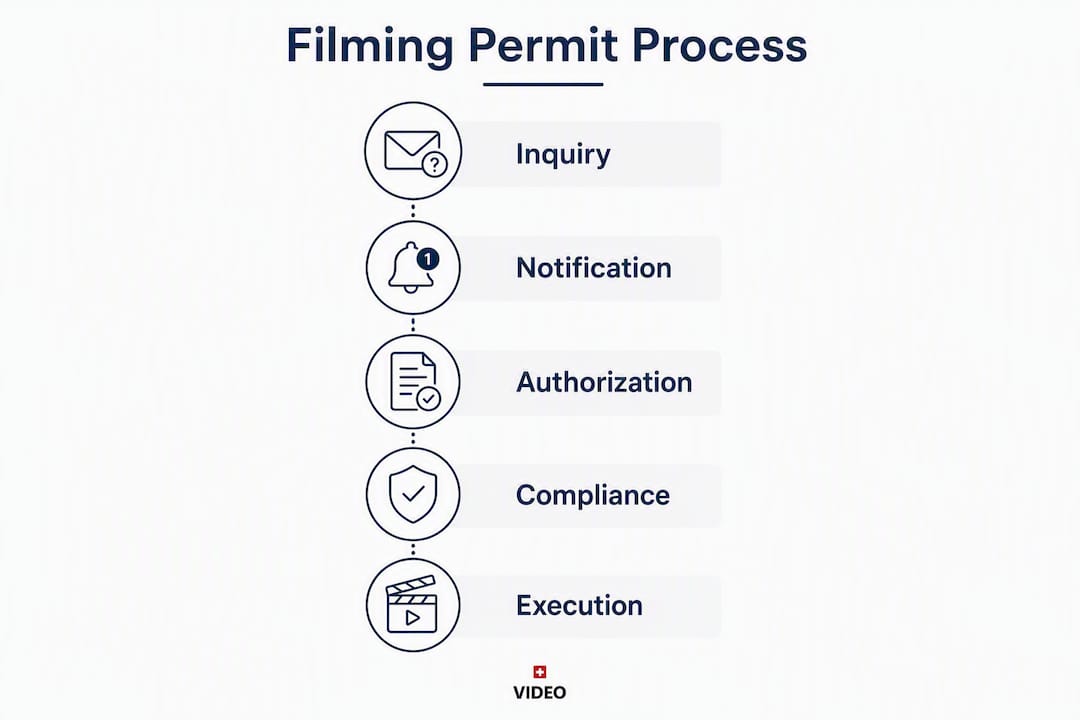
Basel-Stadt uses a tiered notification and authorization system. A shoot lasting up to half a day on a pavement or square without traffic restrictions requires a notification submitted at least 14 days before filming. Shoots lasting up to four continuous days, with or without road closures, require a simplified authorization submitted at least six weeks in advance. Anything longer than four days triggers a standard application with a three-month lead time.
Trigger | Zurich threshold | Basel-Stadt threshold | Typical lead time |
Duration | More than 1 hour | Up to 12 hours (notification) | 14 days (notification) |
Crew size | More than 5 people | Not specified separately | 6 weeks (simplified auth.) |
Infrastructure | Spotlights, camera rails | Road/pavement closures | 3 months (standard auth.) |
Drone use | FOCA permit required | FOCA permit required | Varies by FOCA |
Advertising shoots | Restricted on major holidays | Detailed schedule required | Per application type |
The application workflow follows a consistent pattern across cantons. Start with an early inquiry to the relevant film office or municipal public-works department, well before your shoot date. Film Zurich handles Zurich city and canton; Geneva has its own film office; Basel-Stadt’s Tiefbauamt manages the process there. Submit your application with a detailed shooting schedule, proof of third-party liability insurance, a site plan showing equipment placement, and FOCA documentation if drones are involved. For complex shoots involving road closures or night work, budget for a police coordination fee.
If you want to avoid the permit maze entirely, working with a local production support service that already has established relationships with these offices saves significant time. Videoproductionswitzerland handles permit applications and production logistics for international crews across Switzerland, taking the guesswork out of which office to contact and what documents to prepare.
Which locations and events require extra caution?
Semi-public and protected sites carry a higher privacy expectation than open streets. Treat them as effectively private for filming purposes, even when the public technically has access.
High-sensitivity locations where advance permission is always required:
Hospital grounds and medical facility entrances
School yards and university campuses during operating hours
Public swimming pools and sports facilities during opening hours
Private restaurant terraces and hotel courtyards
Places of worship (churches, mosques, synagogues, temples)
Diplomatic areas and embassy perimeters
Museum interiors and protected heritage gardens
Private residential building entrances and courtyards
When approaching a venue manager or event organizer, keep the outreach brief and specific. Something like: “We are a small production crew planning to film [brief description] at your venue on [date]. We would like to discuss access, any conditions you require, and whether a formal agreement is needed.” A direct, professional approach almost always gets a faster response than a vague inquiry.
Special events carry their own rules. Wedding photographers and videographers typically operate under a written agreement with the couple, but filming other guests without their knowledge is a separate issue. Concert and festival organizers in Switzerland routinely require press accreditation or a specific filming agreement, and some events prohibit commercial filming entirely. While political gatherings are public events, singling out individuals in footage for commercial use still triggers consent obligations. When in doubt, contact the event organizer in writing before the day and get any permission confirmed by email.
Indoor swimming pools and similar public facilities are best scheduled outside opening hours or off-season. If filming must happen during public hours, keep the crew small, limit the slot to before 11 AM, and cap the session at three hours to minimize approval friction and safety obligations.
How should you behave while filming in public in Switzerland?
Respect for personal space, quiet public behavior, punctuality, and language awareness will prevent most social problems on a Swiss shoot. These are not optional courtesies; they are the practical difference between a smooth day and a confrontation that shuts down your location.
Swiss public culture values quiet and order. Keep noise low, avoid blocking pedestrian flows, and pick up all equipment and waste before you leave. If you are shooting near residential buildings, avoid early-morning or late-evening work without explicit permission from the building management. Swiss neighbors do complain, and local authorities take those complaints seriously.
On language: A short greeting or a single-line permission request in the local language goes a long way. In Zurich and the German-speaking cantons, a simple “Darf ich Sie kurz filmen?” (May I film you briefly?) signals respect. In Geneva and Lausanne, “Puis-je vous filmer?” works the same way. In Ticino, “Posso filmarla?” In all three regions, attempting the local language, even imperfectly, is received far better than defaulting immediately to English.
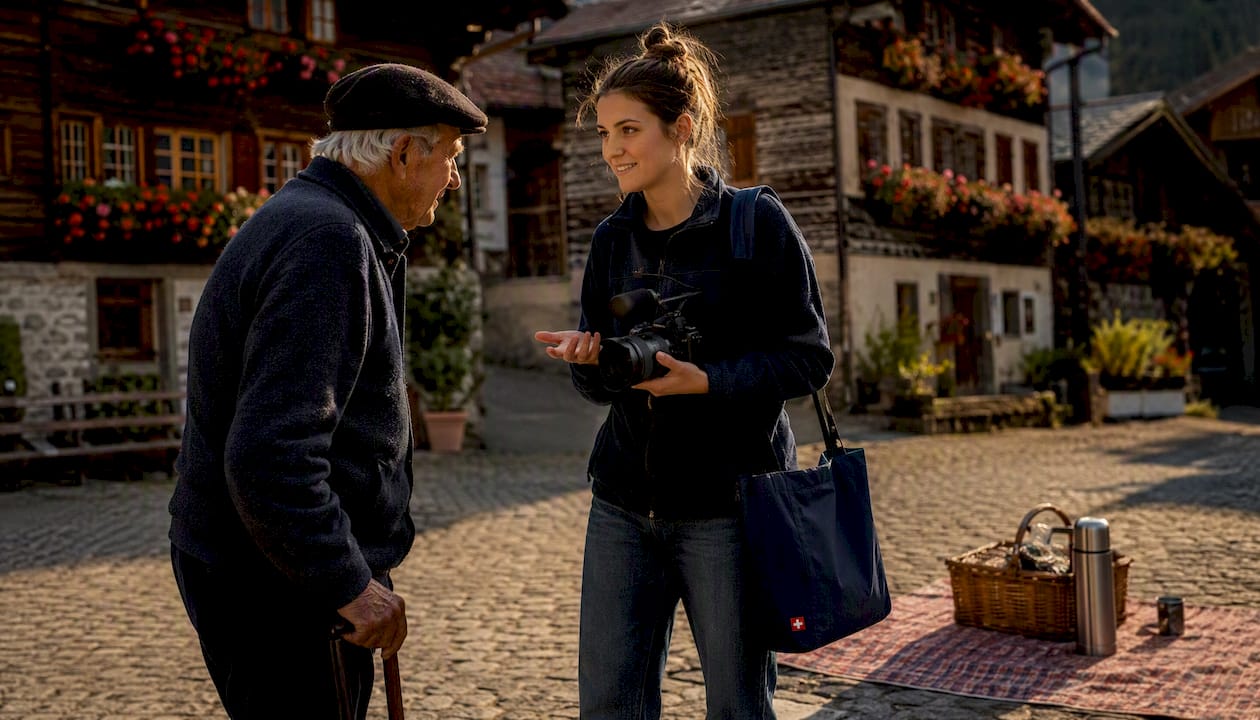
For casual creators and small crews, the practical rules are straightforward. Always ask before filming a portrait. Wear low-profile clothing that does not mark you as a large commercial operation if you are a solo shooter or a two-person team. Keep your tripod footprint tight on busy sidewalks. If someone asks you to stop filming, stop and explain your purpose calmly. Swiss law does not give bystanders an automatic right to demand you delete footage taken in public, but de-escalating politely is always the better choice.
For cultural context that goes deeper than the basics, the Swiss customs and traditions guide for filmmakers covers punctuality expectations, noise norms, and regional differences that affect how crews are perceived on location.
What labor, insurance, and safety rules apply to your crew?
Swiss working-time rules set a typical production week at 50 hours, and the daily working window must fit within 14 hours including breaks. Night work compresses that window to 9 hours within a 12-hour frame and requires special authorization, which can also trigger premium pay obligations. Factor these constraints into your schedule before you finalize shoot days.
Rule | Standard day | Night work |
Weekly hours | 50 hours | 50 hours (averaged) |
Daily working window | 14 hours (including breaks) | 12 hours |
Maximum daily work | 14 hours (including breaks) | 9 hours within 12-hour window |
Night/Sunday work | Standard authorization | Special authorization required |
Minimum rest between shifts | Extended rest required |
Productions often manage these rules by batching night shoots sparingly and negotiating average turnaround times across two-week schedules, which allows compliance with Swiss working-time law while maintaining shoot momentum.
For foreign crew, the rules on posting workers matter. EU citizens working in Switzerland for up to 90 working days do not need a formal work permit, but notification forms must be submitted in advance. Self-employed crew members are responsible for their own notifications. Failing to submit these forms is a compliance risk that Swiss labor authorities enforce.
Mandatory insurance and safety items to budget for:
Third-party liability insurance covering drone flights (required separately from general production liability)
SUVA accident insurance for all crew members working on Swiss soil
Rigging safety compliance: Swiss rigging guidance requires a designated head rigger or technical lead, a written hazard analysis, PPE for all rigging personnel, and a strict prohibition on personnel remaining under suspended loads
General production liability policy covering public-space shoots
For a detailed breakdown of what these items cost on a Swiss shoot, the video production costs page gives current estimates for labor premiums, insurance, and permit fees.
Pre-shoot checklist for visitors and small crews
Use this before you arrive on location. Store signed releases and permit PDFs both digitally and in a physical folder on set.
Confirm permits: Verify whether your shoot triggers a permit in the relevant canton (duration, crew size, infrastructure). Apply with the correct lead time.
Prepare release forms: Draft releases in the local language (German/French/Italian) plus English, with explicit scope-of-use language for commercial vs. editorial use.
Proof of insurance: Carry your third-party liability certificate and SUVA accident insurance documentation on set.
Film office contact: Save the direct contact for the local film office (Film Zurich, Geneva film office, Basel-Stadt Tiefbauamt, or the relevant cantonal authority).
FOCA drone compliance: If flying a drone, confirm FOCA authorization and any local no-fly zones before the shoot day.
Local-language permission text: Prepare a short, polite request in the dominant local language for approaching bystanders or venue staff.
Impact mitigation plan: Confirm your noise limits, equipment footprint, and crew behavior rules with the whole team before rolling.
Crew labor schedule: Map your shoot days against the 50-hour weekly limit and 14-hour daily window. Flag any night shoots for special authorization.
Medical and safety plan: Designate a first-aid contact, confirm the nearest hospital, and brief the crew on the site’s emergency procedures.
Equipment and tidy-up plan: Assign a crew member to track all gear and confirm the location is left in its original condition before departure.
For production queries beyond this checklist, the production FAQ covers common questions about permits, crew logistics, and Swiss shoot planning.
Key Takeaways
Filming in Switzerland is legally straightforward when you treat recognizability, commercial use, and public-space impact as the three triggers that create obligations.
Point | Details |
Recognizability triggers consent | Any identifiable person in commercial footage requires a signed release before publication. |
Permit thresholds vary by canton | Zurich triggers permits at one hour, five-plus crew, or technical infrastructure; Basel-Stadt uses a tiered notification system. |
Semi-private sites need advance permission | Hospital grounds, school yards, and private terraces carry higher privacy expectations than open streets. |
Labor rules affect scheduling | A standard Swiss production week runs 50 hours, with a daily working window of 14 hours for regular days and a 9-hour limit (within a 12-hour window) for night work; night work requires special authorization. |
Why the permit process is the last thing most crews think about
Most international crews arrive in Switzerland focused on the shot list and the gear. The permit process feels like paperwork until it is not — until a municipal officer stops a shoot on day one because the application was late or the wrong office was contacted.
The practical reality is that Switzerland’s cantonal system means there is no single national permit authority. A shoot in Zurich goes through Film Zurich. A shoot in Basel goes through the Tiefbauamt. Geneva has its own office with its own forms and timelines. Each has different lead-time requirements, different thresholds for what triggers a formal application, and different fees. Crews that treat this as a last-minute task routinely lose shoot days.
The fix is simple but requires discipline: contact the local film office at least six weeks before any shoot that involves more than a handful of people or any technical infrastructure. For complex shoots with road closures or night work, three months is the realistic minimum. Early contact also gives you the chance to ask about off-season windows for pools and high-traffic tourist sites, which can dramatically reduce both the permit complexity and the cost.
The cultural side is equally underestimated. Swiss public behavior norms are genuinely different from what most international crews expect. Noise, equipment sprawl, and blocking pedestrian paths are taken seriously by locals and by local authorities. A crew that operates with discipline, cleans up after itself, and communicates politely in the local language will almost never have a problem. A crew that treats a Swiss street like a film set in Los Angeles will.
Useful sources for permits, privacy, and safety
The sources below are the authoritative starting points for any Swiss shoot. Municipal rules change, so always confirm current forms and timelines directly with the relevant film office.
Film Commission Zurich — Permits: Permit triggers, application forms, and scheduling guidance for Zurich city and canton, including pool and public-facility rules.
Basel-Stadt filming and photography guidance: The clearest canton-level code of practice available in English, covering notification timelines, authorization tiers, and drone rules.
Basel-Stadt Code of Practice (PDF): Full text of the Basel-Stadt filming code, useful for understanding the legal basis and exact procedural requirements.
SECO — Working conditions and labor regulation: The federal authority for working-time rules, night-work authorization, and labor compliance for production crews.
FOCAL / Production Value — Working conditions in Switzerland: Practical guidance on posting foreign workers, notification obligations, and industry labor practices.
SSFV industry working and safety guidelines (PDF): The Swiss film and audiovisual production association’s document covering working-hour rules, minimum breaks, rest periods, and safety expectations.
Swiss rigging safety guideline (PDF): Mandatory reference for any shoot involving temporary structures, rigging, or suspended loads.
Global Law Experts — Filming in public in Switzerland: A clear legal overview of personality rights, recognizability standards, and consent requirements under Swiss law.
Videoproductionswitzerland — Full production support: Local production support covering permits, crew sourcing, location scouting, insurance coordination, and logistics for international crews shooting anywhere in Switzerland.
Always check the local film office for canton-specific forms and current timelines before submitting any application — procedures and fees are updated periodically and the office contact is your most reliable source.
Recommended
