
Film Crew B&Bs in Switzerland: Free Needs Assessment for Logistics & Permits

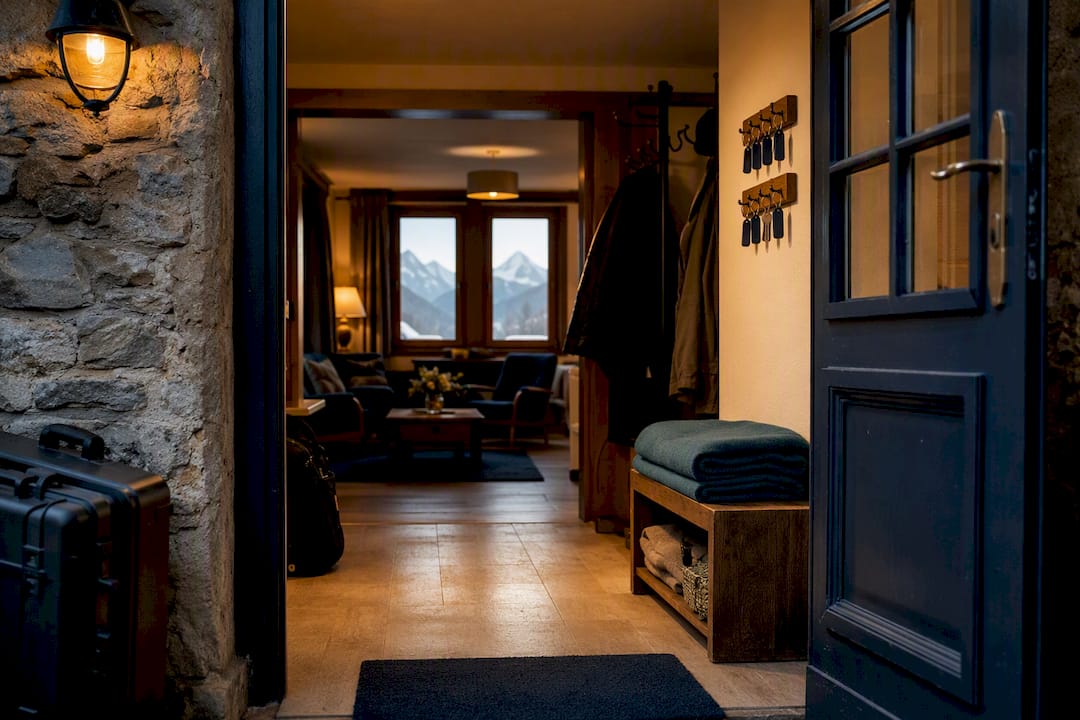
Crew-focused bed and breakfast accommodation means small-scale, privately run lodging booked specifically to house a film crew near a shoot location, usually for productions of 15 people or fewer working close call-times in one area. It works best for single-location shoots, mountain base camps, and tight-budget productions that need proximity over hotel amenities. If you’re weighing this option against a hotel block for an upcoming Swiss shoot, Videoproductionswitzerland can run a free needs assessment and tell you within a day whether it fits your crew size and location.
TL;DR:
Crew capacity is limited to around 10 to 20 beds, making crew management and gear storage challenging for larger groups.
Booking should be done 8 to 12 weeks in advance, especially in resort areas during peak season, to avoid high rates and limited options.
Permits, visas, and customs rules vary by canton and require early coordination with local authorities and proper documentation like ATA Carnets.
Flexible cancellation policies are rare, and contracts should specify access, parking, insurance, and noise restrictions in writing before booking.
Reliable Wi-Fi, secure gear storage, and separate quiet spaces significantly improve crew productivity and safety during a shoot.
Table of Contents
What Is Crews Inn Bed & Breakfast Accommodation, and When Should You Book It?
How Do You Book and Manage Crew B&B Logistics From Pre-Production to Wrap?
What Permits, Visas, and Customs Rules Affect Your Accommodation Plan?
What Drives Crew B&B Costs in Switzerland, and How Do You Budget for Them?
What Amenities Actually Matter for Crew Comfort and Productivity?
What Are the Standard Cancellation and Modification Policies?
What Do Past Film Crews Say About Staying at Small Swiss Properties?
What Health and Safety Protocols Should Your Crew Accommodation Support?
A Practitioner’s View on What Actually Goes Wrong With Crew Lodging
Let Videoproductionswitzerland Handle Your Crew Lodging and On-Ground Logistics
Where to Verify Permit, Visa, and Customs Details Before You Book
What Is Crews Inn Bed & Breakfast Accommodation, and When Should You Book It?
For production purposes, “crews inn bed & breakfast” style accommodation refers to independently owned guesthouses and small inns that a production books out, in whole or in part, to house crew during a shoot. It differs from a hotel block in three practical ways: fewer standardized services, more direct negotiation with an owner-operator, and typically closer proximity to remote or rural filming sites than a branded hotel chain can offer.
This model fits certain shoot profiles far better than others. A single-location documentary shoot in a valley town, a commercial with a five-person crew working 14-hour days, or an Alpine base camp two hours from the nearest city center are all strong candidates. You get short walks to set, direct relationships with owners who understand irregular hours, and often better rates than resort-area hotels during peak season.
It has real limits, though. Most B&B-style properties cap out around 10 to 20 beds, offer little dedicated storage for camera and grip equipment, and rarely have 24-hour reception for late wrap nights. Catering is usually breakfast-only, so you’re sourcing lunch and dinner separately.
Before booking, ask yourself:
Does your crew count fit comfortably under the property’s bed capacity, with a buffer for late additions?
Is there a secure, lockable space for gear, or will you need supplemental storage arranged as part of location management?
Are call times tight enough that proximity outweighs hotel-grade amenities?
How Do You Book and Manage Crew B&B Logistics From Pre-Production to Wrap?
Booking a B&B for a production crew is not the same transaction as booking one for a family vacation, and treating it that way is where most first-time producers in Switzerland get burned. Follow a sequence, not a checklist you fill in randomly.
Before you book:
Finalize your crew list and map who sleeps where, including any last-minute add crew members.
Confirm meal plans. Ask specifically whether breakfast service can accommodate a 5:00 AM call time.
Note storage and power needs. Camera batteries and monitors alone can overload an old property’s electrical circuits.
Confirm parking and loading dock access. Many Swiss village inns have narrow streets that can’t fit a grip truck.
Set arrival and departure windows in writing, especially if you’re staggering crew across two units.
On arrival and during the shoot, key handovers need a clear owner. Somebody on your production team, not a random PA, should manage keys, security codes, and any local emergency contacts. If your edit team needs a dailies workspace, confirm Wi-Fi bandwidth can handle uploads before you arrive, not after.
Your contract with the property should explicitly cover:
Access windows for early departures and late returns
Parking allocations, including how many vehicles and where
Insurance and liability coverage for equipment left on-site
Noise and common-area use restrictions, particularly in residential neighborhoods
Pro Tip: Stage your equipment cases in one dedicated room rather than spreading gear across multiple guest rooms. It cuts inventory-check time at wrap by half and makes it obvious immediately if something is missing.
Staggering call times by department (grip and electric out first, talent and hair/makeup later) also reduces bottlenecks at breakfast and in shared bathrooms, a detail that sounds minor until you’re the one waiting behind six people for a shower at 4:30 AM.
What Permits, Visas, and Customs Rules Affect Your Accommodation Plan?
Where your crew stays is directly shaped by where you’re legally allowed to film and how fast your gear clears customs. Switzerland sits in the Schengen area, so most crew members can enter for short stays without a visa, though longer working stays may require permits depending on nationality, and UK passport holders in particular should confirm current rules with local embassies before booking anything.
Equipment crossing the border typically travels under an ATA Carnet, the standard customs document for temporary import of professional gear, and getting it right avoids the kind of delay that leaves a crew checked into their B&B with no cameras to unload.
A few things that directly affect your lodging decisions:
Permits are handled at the cantonal or municipal level, and rules on loading zones, parking, and private-property staging vary from one canton to the next.
A private home or B&B used as a staging base may need its own agreement with the owner covering loading and unloading windows.
Drone approvals, if you’re using aerial units near your accommodation, are a separate process from general filming permits.
A dedicated permit guide for Swiss shoots is worth reviewing before you finalize any location-adjacent lodging.
Because permitting is decentralized, hiring a local fixer or immigration specialist early is often the difference between a two-day approval and a two-week one. Prepare your crew list, passport copies, equipment manifest, and carnet documentation well before you need to book rooms.
What Drives Crew B&B Costs in Switzerland, and How Do You Budget for Them?
Switzerland’s accommodation quality is consistently high, but so is the price tag, and resort and Alpine areas carry a real premium during peak season. Understanding what actually drives the number on your invoice lets you negotiate the parts that are actually negotiable.
Primary cost drivers include:
Seasonality: winter Alpine destinations and summer lakeside towns both see sharp rate increases during their respective high seasons.
VAT, Switzerland’s standard rate runs around 8.1%, which adds up fast across a multi-week block booking.
Transport and storage fees for gear that can’t fit in standard vehicles.
Mountain-access charges, including cable car or private transfer costs to reach remote base camps.
Overtime and staffing costs if a property needs extra help to service an entire crew.
Block-booking an entire property, rather than individual rooms, usually gets you a better nightly rate and simplifies your invoice down to one line item. A hybrid strategy, housing core crew in a B&B and visiting talent or creatives in a nearby hotel, often balances cost against comfort more effectively than putting everyone in the same tier of lodging. Negotiate meal service and any service charges upfront rather than accepting a default package; owners running smaller properties usually have more flexibility here than a hotel chain’s revenue management system allows. For a detailed breakdown of what a full production budget looks like in Switzerland, our video production cost guide walks through typical line items by shoot size.
What Amenities Actually Matter for Crew Comfort and Productivity?
Not every amenity a property advertises matters to a working crew, and a few that don’t get advertised at all can make or break a shoot week. Reliable Wi-Fi tops the list, not for streaming, but for uploading dailies, syncing footage to cloud storage, and keeping producers in different time zones in the loop overnight.
A quiet room or two, separate from where the rest of the crew sleeps, matters more than people expect. Directors and DPs reviewing footage or prepping the next day’s shot list need somewhere without foot traffic and clinking breakfast dishes at 6:00 AM. If the property has a common area that can double as an informal production meeting space, that’s worth more than an extra star rating on a booking site.
Laundry access ranks higher on a crew’s actual priority list than it does on most property listings, especially for shoots running two weeks or longer in the same wardrobe rotation. A drying room or mudroom for wet gear becomes essential on Alpine or lakeside shoots where equipment gets soaked daily.
Power capacity deserves a direct question to the owner before booking, not an assumption. Older Swiss properties, particularly in rural and mountain regions, weren’t wired with a dozen laptop chargers and camera battery stations in mind. Ask about outlet count per room and whether the property has experienced power issues with large groups before.
What Are the Standard Cancellation and Modification Policies?
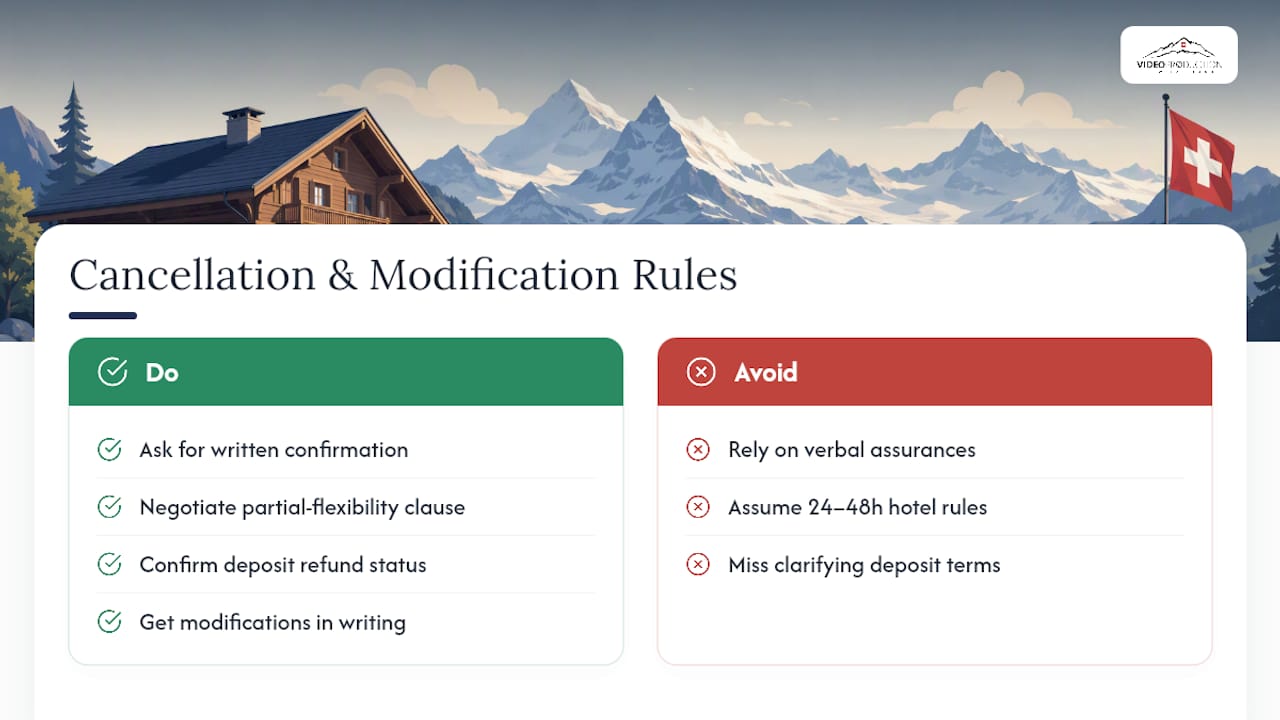
Cancellation terms for crew B&B bookings vary significantly by property, and they’re rarely as flexible as a major hotel chain’s standard 24 to 48 hour window. Many independent inns require 30 to 60 days’ notice for a full refund on a multi-room or full-property booking, since turning around that much lost revenue on short notice is harder for a small operator than for a 200-room hotel.
Modifications, adding or dropping a few crew members, shifting dates by a few days, tend to be handled more informally with independent owners than through a corporate booking system. That flexibility cuts both ways: it’s easier to negotiate a change, but there’s also less of a paper trail if something goes wrong. Get any agreed modification in writing, even if it’s just a confirming email.
Weather and permit delays are common enough in Swiss production that it’s worth negotiating a partial-flexibility clause into your original contract, rather than trying to renegotiate after a delay hits. A clause allowing a shift of a few days without full-cancellation penalties, in exchange for a modest holding fee, protects both sides better than an all-or-nothing cancellation policy.
Always confirm whether a deposit is refundable, partially refundable, or a straight holding fee, and get the property’s specific policy in writing before you sign anything, not a verbal assurance during a phone call.
What Do Past Film Crews Say About Staying at Small Swiss Properties?
Crews who’ve worked through smaller Swiss guesthouses consistently point to two things: the personal relationship with owners, and the flexibility around irregular hours that larger hotels struggle to match. A production that wraps at 2:00 AM and needs a quiet check-in, with breakfast pushed back three hours, gets accommodated far more easily by an owner-operator who’s invested in repeat business than by a hotel’s overnight front desk staff working from a rigid policy manual.
The trade-off crews report most often is around equipment security. Independent properties don’t always have the lockable storage or insurance infrastructure that a corporate hotel provides as standard, which is exactly why production-service providers who coordinate accommodation alongside permits and crew sourcing tend to flag this upfront rather than let a production discover it on day one.
Feedback also consistently favors properties within short walking or driving distance of the actual set. Producers who prioritized proximity over amenity count in their reviews reported fewer late arrivals and less crew fatigue over multi-week shoots, a pattern that holds regardless of whether the shoot was in a city, a lakeside town, or an Alpine village.
What Health and Safety Protocols Should Your Crew Accommodation Support?
Crew accommodation isn’t just a place to sleep. It’s part of your production’s overall duty-of-care plan, and it should be treated that way in your pre-production paperwork. Confirm the property has clear, posted emergency exit routes and that your production coordinator knows the nearest hospital or clinic before the first night, not after an incident.
Fire safety matters more in older Alpine properties, some of which have limited modern sprinkler systems or narrow stairwells. Ask directly about fire extinguisher placement and evacuation procedures rather than assuming compliance.
For shoots involving physically demanding work, stunts, water units, high-altitude scenes, make sure your accommodation is close enough to allow rest between demanding days, since fatigue is one of the most preventable causes of on-set incidents. If your crew includes anyone with dietary restrictions or medical needs, communicate those to the property in advance; a small owner-operated inn may need more lead time to accommodate them than a hotel with a full kitchen staff.
Finally, keep a simple emergency contact sheet at the property itself, not just on someone’s phone, listing local emergency numbers, the nearest hospital, and your production’s own safety coordinator.
A Practitioner’s View on What Actually Goes Wrong With Crew Lodging
The mistake I see most often isn’t a bad accommodation choice. It’s booking lodging in isolation from the rest of the logistics plan. A production locks in a beautiful B&B two hours from the shoot location because the rate looked good, then spends the entire week losing an hour a day to a commute nobody budgeted for.
The fix is boring but effective: treat accommodation as one line item in a single logistics plan that also covers permits, transport, and crew sourcing, worked out together rather than in sequence. That’s how Videoproductionswitzerland’s process runs, a needs assessment that maps lodging against call sheets and permit timelines before anything gets booked.
On timing, book Alpine and peak-season lodging 8 to 12 weeks ahead if you can. Properties in resort towns fill fast, and last-minute availability usually means paying resort rates for a compromise location.
— Pieter
Let Videoproductionswitzerland Handle Your Crew Lodging and On-Ground Logistics
Chasing down B&B availability, permit contacts, and equipment storage across three different cantons while also trying to lock your shooting schedule is exactly the kind of coordination overload that derails otherwise well-planned shoots. Videoproductionswitzerland is the alternative to piecing together accommodation, permits, and transport through separate local contacts: one point of coordination handles all of it before your crew ever lands.
[
A free consultation starts with a needs assessment covering your crew size, equipment list, and preferred base location, and typically produces a crew-rooming plan, a transport schedule, and a permit checklist before you commit to anything. To get started, reach out through Videoproductionswitzerland’s production support team with your crew list and target dates, and check current service pricing while you’re mapping your overall budget.
Where to Verify Permit, Visa, and Customs Details Before You Book
A few sources are worth bookmarking and sharing directly with your line producer or local fixer before finalizing any accommodation tied to a shoot location:
Film Commission Zurich’s production guide lists permit contacts and short-term rental platforms specific to Zurich-based shoots.
Pact’s Switzerland country intel hub covers Schengen rules, VAT rates, and nationality-specific visa notes.
Always confirm visa specifics with the relevant embassy or consulate for each crew member’s nationality rather than relying solely on general guidance, since rules shift and individual circumstances vary. For sourcing local venue or event-space contacts beyond standard accommodation, providers like Dulce Compania’s Zurich event services can also be a useful local reference point.
Sources
Recommended
