
Digital Product Management for Teams: Lifecycle, Strategy, Production


Digital product management is the discipline of owning strategy, roadmap, and lifecycle outcomes for software, apps, platforms, and online services. The Skills England apprenticeship standard defines the role as end-to-end ownership from inception through decommissioning, and the person who carries that ownership is the digital product manager. Videoproductionswitzerland applies the same lifecycle logic to production projects, where digital tools and physical logistics have to move in sync.
TL;DR:
A digital product manager must prioritize features based on clear, data-driven bets and test hypotheses through continuous cycles of learning and iteration.
Track core metrics like activation, retention, and revenue per user using behavioral analytics and experimentation tools to inform decision-making.
Develop a strategy with explicit bets that define how a product wins and evolve the roadmap based on real-time insights rather than static plans.
Stakeholder management relies on separate, regular communication tailored to each group’s needs, focusing on outcomes and decisions, not activity reports.
Common pitfalls include vague strategies, measuring the wrong signals, scope creep, and unmanaged technical debt, which hinder effective product delivery and growth.
Table of Contents
What Counts as a Digital Product?
A digital product is anything users experience primarily through a screen or an API: a mobile app, a SaaS platform, a streaming service, an internal tool, or a booking system. These products share sectors as different as banking, telecoms, gaming, and the public sector, but they all run on the same underlying logic: code ships fast, and feedback arrives faster.
That speed is what separates digital product management from managing a physical product line. A packaged good might get a redesign once a year. A digital product can ship a change weekly or even daily, because deployment cost is near zero and every interaction generates usable data.
Common digital product categories include:
Consumer apps (fitness trackers, food delivery, media streaming)
B2B platforms (CRM systems, analytics dashboards, workflow tools)
Embedded digital services (a bank’s mobile app, a retailer’s loyalty program)
Internal tools (scheduling systems, logistics platforms, content management systems)
Digital product management applies wherever a team can measure usage, test a change, and ship the next version without waiting for a factory line.
What Does a Digital Product Manager Actually Do?
A digital product manager owns the full lifecycle of a product, not just the launch. That means carrying a feature from a rough idea through prototyping, release, iteration, and eventually retirement when it no longer earns its place. The job title suggests a single function, but the daily reality splits into a handful of recurring activities.
Set and defend priorities. Every backlog has more requests than capacity, so the product manager decides what ships next and says no to what does not.
Run discovery. User interviews, usability tests, and quick prototypes surface what people actually need before engineering spends a sprint building it.
Manage delivery. Coordinating releases, feature rollouts, and rollback plans with engineering keeps shipping predictable.
Align stakeholders. Sales, support, leadership, and design all want different things; the product manager translates those wants into one coherent plan.
Watch the numbers. Usage data and experiment results decide whether a feature stays, gets refined, or gets cut.
Most digital product managers report to a head of product or a VP of product, and they work inside real constraints: limited engineering capacity, legacy systems, and competing executive priorities that never fully disappear.
What Skills Do Employers Actually Expect?
Job postings for digital product manager roles tend to blur two skill sets together: classic product management and digital-specific technical fluency. Employers expect candidates to combine tech, data, and user understanding into one coherent decision-making process, not to specialize in just one.
The core skill list looks like this:
Strategic thinking: the ability to turn a vague business goal into a specific, testable bet
Prioritization: frameworks like RICE or weighted scoring to decide what earns engineering time
Analytics literacy: reading funnels, cohort retention, and A/B test results without needing a data scientist to translate
UX fluency: enough design sense to critique a prototype and spot a confusing flow
Instrumentation awareness: knowing what to track before a feature ships, not after
Stakeholder communication: explaining a tradeoff to an executive in one sentence, not a ten-slide deck
Influence without authority: getting engineering and design to commit to a plan they did not write
Pro Tip: *When you evidence these skills in an interview or a portfolio, use a before-and-after metric, not a job description.
How Does the Digital Product Lifecycle Actually Work?
Most digital product teams organize work around a recognizable sequence, even when they use different names for each stage. The lifecycle typically runs through seven phases, and skipping one is usually where products fail.
Discover: talk to users, study competitors, and identify a real problem worth solving.
Define: turn the problem into a scoped opportunity with a rough success metric attached.
Develop: build the smallest version that can test the core assumption, often called an MVP.
Release: ship to a limited audience first, then expand once the signal looks healthy.
Learn: run experiments and read the data the release generates.
Grow: double down on what works with retention and expansion features.
Retire: sunset the product or feature once it no longer earns its maintenance cost.
A typical loop looks like this: a team notices drop-off at signup, runs a two-week usability study, builds a simplified onboarding flow as an experiment, and measures activation against a clear OKR before deciding whether to roll it out fully. That loop, repeated constantly, is what separates continuous digital product management from a one-time launch project.
How Do You Build a Digital Product Strategy That Actually Guides Work?
A digital product strategy has to answer four questions: who is this for, what is the differentiated bet, how does it win against alternatives, and how will we know it worked. Skip any one of those and the “strategy” becomes a wish list dressed up in a slide deck. According to Cabin’s product strategy framework, a real strategy is a small set of explicit bets, not a catalog of features.
Vision, strategy, and roadmap are three different documents, though teams often confuse them. Vision is the five-year destination. Strategy is the current set of bets on how to get there. The roadmap is the sequence of work that expresses those bets right now, which means it should change whenever the strategy learns something new.
Turning a strategic choice into a roadmap item means writing the tradeoff out loud: “We are betting on self-serve onboarding over sales-assisted signup because our data shows 70% of trial users never talk to sales anyway.” That sentence becomes an experiment, and the experiment becomes a roadmap entry with an outcome metric attached, such as:
Activation rate among new signups
Time-to-first-value
Weekly retention at 30 and 90 days
Revenue per active user
Digital strategy also has to account for continuous optimization and ecosystem thinking, things a physical product line rarely deals with: subscription pricing tiers, freemium conversion, and integrations that make the product more valuable the more it connects to. Readers building out their own strategy examples can see this applied in client-centric video production strategies, where the same logic of explicit bets and measurable outcomes shapes a production plan.
What Metrics and Tools Keep Digital Products on Track?
Digital product teams live and die by a handful of core metrics: activation, retention, engagement, and conversion. LogRocket’s product management research points to these funnel metrics, alongside revenue per user, as the standard measurement stack most product organizations rely on.
Tooling generally splits into four categories:
Product analytics (behavioral data, funnels, cohort analysis)
Experimentation platforms for A/B and multivariate testing
Roadmapping tools to track and communicate current bets
Issue tracking systems that connect engineering work back to product priorities
None of these tools matter without a habit of using the data to settle arguments instead of opinions. If two stakeholders disagree about which onboarding flow converts better, the product manager runs the test rather than picking a side. For teams building out their own measurement stack, this guide to web KPIs and measurement tools covers the same instrumentation logic applied to a website funnel.
Collaboration between product, design, and engineering works best with clear handoff points: design delivers validated prototypes, engineering estimates and builds against a defined scope, and marketing gets metrics and messaging inputs before launch, not after.
Where Does This Role Go? Career Paths and Contexts
Digital product management careers usually follow a recognizable ladder: associate product manager, product manager, senior product manager, director of product, and eventually chief product officer. Titles vary by company, but the scope of ownership grows at each step.
Company size and sector change what the job actually feels like:
Startups: wide scope, little budget authority, constant tradeoffs between speed and polish
Enterprise: narrower scope per person, more process, and formal budget and headcount authority
Public sector: slower release cycles, heavier compliance requirements, but real influence over services used at scale
Professionals moving in from design, analytics, or project management usually have a head start. Designers already understand user needs; analysts already read data for a living; project managers already know how to keep cross-functional work on schedule. The gap to close is usually strategic framing: learning to argue for a bet, not just execute a plan handed down from someone else.
Applying Product Thinking to Complex Production Projects
Digital product principles translate directly to production-heavy work, and some video production partners treat a Swiss shoot the same way a product team treats a release: as a system with owners, checkpoints, and measurable outcomes, not a checklist to survive. Coordinating a shoot means syncing a digital layer (scheduling software, permit applications, budget tracking) with a physical one (crew availability, gear delivery, location access), and a release gate for one side means nothing if the other side is not ready.
Production teams can borrow a short list directly from digital product practice:
Assign one clear owner for each milestone, not a group that assumes someone else has it
Treat permit approval and crew confirmation as release gates, tracked with the same rigor as a software deployment
Run small experiments on new tools or workflows before committing an entire shoot to them
Require stakeholder signoff at defined checkpoints instead of assuming alignment
Pro Tip: Instrument the physical milestones the same way you would a digital metric. “Permits received” and “crew confirmed” deserve a dashboard entry just like activation rate does. Anyone weighing whether to bring in outside coordination can review what full production support typically costs before scoping a shoot.
How Do You Manage Stakeholders and Communicate Across Teams?
Stakeholder management is often the difference between a digital product manager who ships and one who spends every quarter putting out fires. The job involves translating between groups that rarely speak the same language: engineering wants scope clarity, sales wants a delivery date, leadership wants a growth number, and support wants fewer tickets.
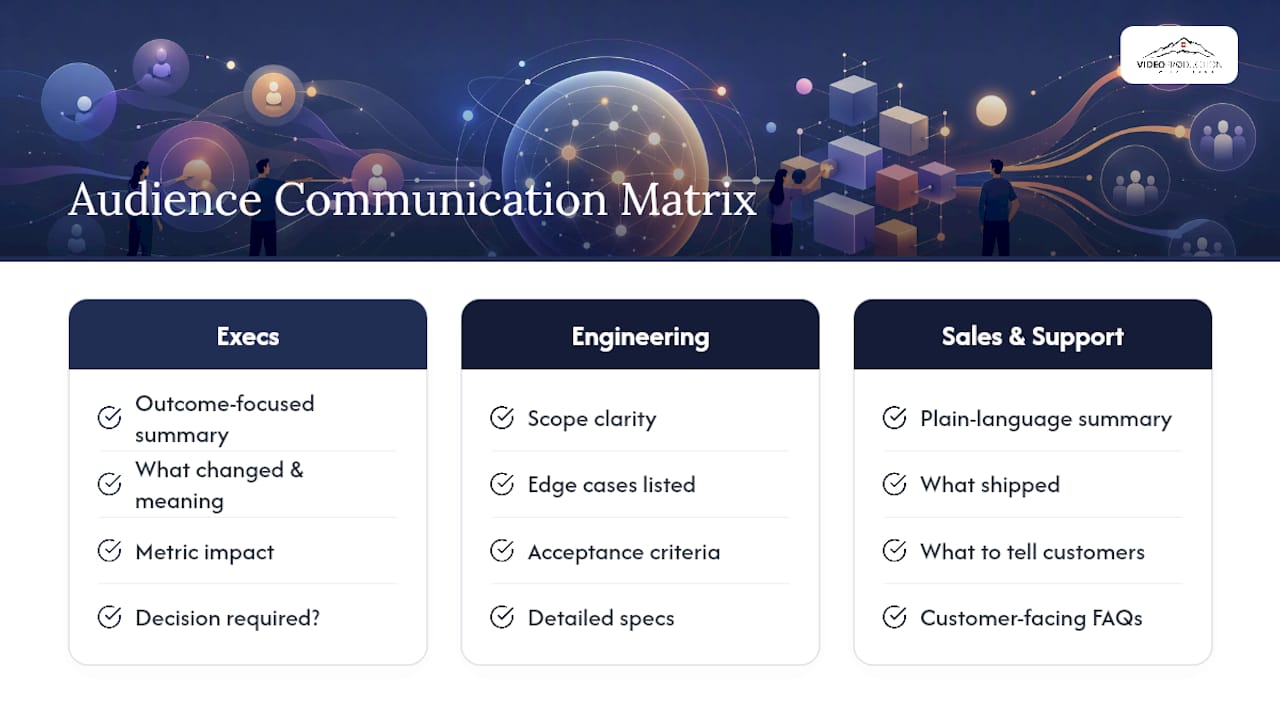
The most reliable pattern is to separate communication by audience and cadence rather than sending the same update to everyone. Executives generally want a short, outcome-focused summary: what changed, what it means for a metric they care about, and what decision, if any, is needed from them. Engineering needs detail: scope, edge cases, and acceptance criteria written clearly enough that nobody has to guess. Sales and support need plain language about what shipped and what to tell customers who ask.
Regular rituals help more than ad hoc updates. A weekly roadmap review keeps engineering and design aligned on priority changes before they become surprises. A monthly stakeholder briefing, focused on metrics rather than activity, keeps leadership informed without turning into a status theater exercise. Writing decisions down, including the reasoning behind a “no,” prevents the same debate from resurfacing every few weeks.
The skill that separates strong product managers from mediocre ones is not persuasion. It is knowing which stakeholders actually need to be consulted before a decision, and which only need to be informed after. Confusing those two categories either slows decisions down with unnecessary meetings or blind sides people who should have had a say.
What Actually Goes Wrong in Digital Product Management?
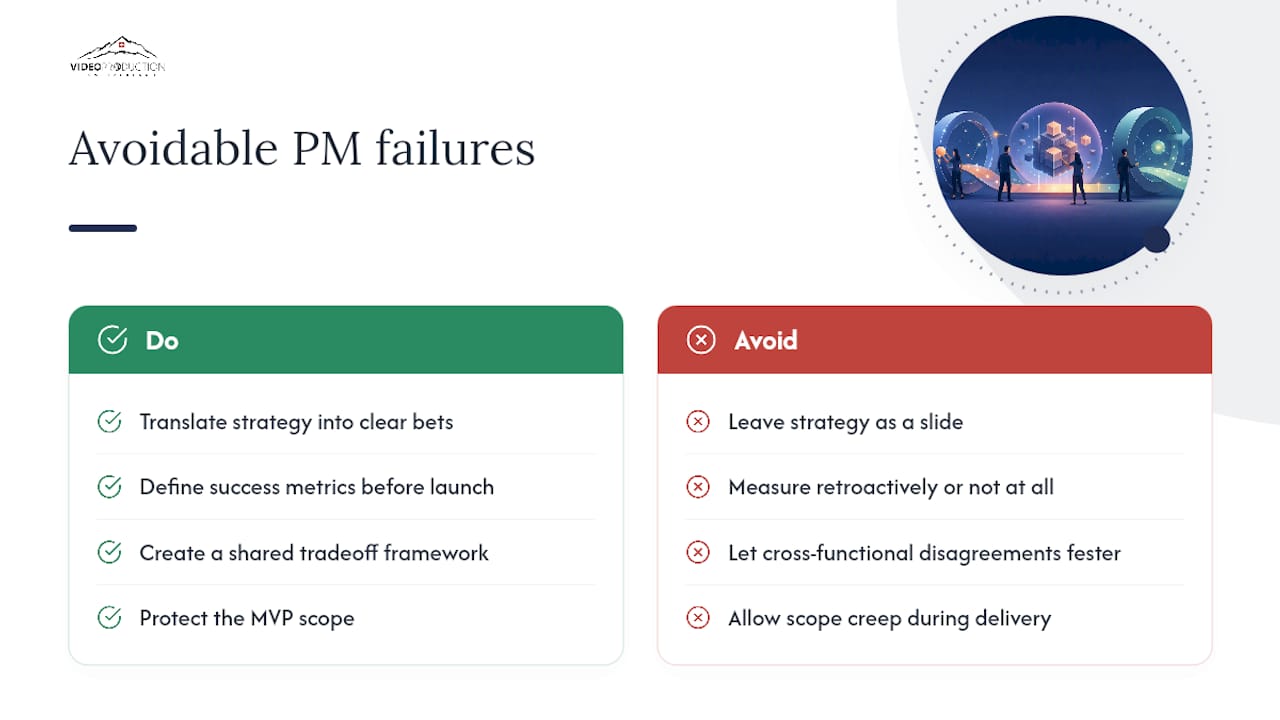
The most common failure in digital product management is not a bad idea. It is a strategy that never gets translated into anything a team can act on, leaving the roadmap as a running list of feature requests with no explicit bet behind any of them.
A second recurring risk is measuring the wrong thing, or measuring nothing at all. Teams often ship a feature, watch usage numbers move in some direction, and declare success without ever defining what success meant before the launch. Retroactive metrics invite retroactive justification.
Cross-functional friction is a third persistent risk. Product, design, and engineering optimize for different things by default: design for user delight, engineering for stability and clean architecture, product for business outcomes. Without a shared framework for tradeoffs, every disagreement turns into a negotiation instead of a decision grounded in data.
Scope creep during delivery causes its own damage. A well-defined MVP can quietly grow as stakeholders add “just one more thing,” and by the time it ships, the original hypothesis is buried under features nobody asked to test. Digital products also carry a specific risk that physical products do not: technical debt compounds quietly, and a product manager who only tracks feature velocity can miss that the team is slowing down for reasons that never show up on a roadmap.
The organizations that avoid most of this treat strategy as a living document that gets revisited, not a slide written once and filed away.
What the Research Actually Supports
The conventional wisdom on digital product management oversells the framework and undersells the discipline. Anyone can learn OKRs, RICE scoring, or the discover-define-develop lifecycle in an afternoon. What separates a strong product manager from a mediocre one is the willingness to say no to a stakeholder with more authority than they have, backed by data instead of opinion.
The most overrated skill in this field is roadmap software fluency. The most underrated one is writing a strategy specific enough that it rules things out, the kind Cabin’s framework describes as a real bet rather than a feature list. Most teams write strategy documents that could apply to any company in any industry, which is the clearest sign the document is decoration, not direction.
If there is one thing readers should prioritize first, it is this: define what “how we know” means before building anything. Every other skill on this list, from analytics literacy to stakeholder communication, exists to answer that one question honestly. Get that wrong and the rest of the toolkit just makes bad decisions look organized.
— Pieter
Sources
Recommended
