
How to Stay Within Your Budget for Film Shoots


Switzerland captivates many international film producers with its striking scenery, but managing costs can be challenging when everything from equipment rentals to location permits adds up fast. Even seasoned American and European teams report that careful planning makes or breaks their budgets. This guide reveals practical steps to help you gain financial clarity, prioritize essential expenses, and stay in control while bringing your creative vision to life in Switzerland’s unique production climate.
Table of Contents
Quick Summary
Key Insight | Explanation |
1. Establish a detailed budget | Create a comprehensive budget categorizing expenses to effectively map out financial resources for the production. |
2. Prioritize essential expenses | Distinguish between critical and non-critical expenses to ensure that spending aligns with fundamental project requirements. |
3. Research local cost factors | Investigate regional pricing for crew, equipment, and permits to accurately forecast expenses based on the filming location. |
4. Track expenses in real time | Implement a system for continuous monitoring of expenditures to avoid budget overruns and adjust spending as needed. |
5. Regularly review and adjust budget | Hold weekly budget review meetings to analyze spending patterns and optimize resource allocation accordingly. |
Step 1: Define your total production budget
Defining your total production budget is the foundation of financial success for any film shoot. This critical first step helps you map out your financial resources and understand exactly how much money you will need to bring your creative vision to life.
To create a comprehensive budget, start by breaking down your expenses into key categories such as documentary film budgeting categories. These typically include above the line costs like talent and creative team expenses, below the line costs covering technical production, equipment rentals, location fees, post production work, and essential contingency funds. Professional film producers recommend allocating approximately 10 to 15 percent of your total budget as a buffer for unexpected expenses.
Here’s how major budgeting categories impact your production:
Budget Category | Typical Expenses | Impact on Production |
Above the Line | Director, producers, main talent | Influences creative quality |
Below the Line | Crew wages, equipment rentals, locations | Affects technical execution |
Post Production | Editing, sound, visual effects | Shapes final project output |
Contingency Fund | Emergency cash reserve | Provides financial stability |
When drafting your budget, consider all potential expenses from pre production through final delivery. Research your specific project requirements thoroughly. Will you need specialized equipment? Are there unique location costs? What about permits, insurance, and potential overtime for your crew? Creating a detailed spreadsheet that tracks every potential expense will help you maintain financial control throughout your production.
Pro tip: Always track your budget in real time using cloud based spreadsheet tools that allow multiple team members to update and monitor expenses simultaneously.
Step 2: Identify essential expenses and prioritize
Identifying essential expenses and establishing clear financial priorities is crucial for maintaining budget control throughout your film production. Your goal in this step is to separate absolute necessities from potential extras and create a strategic spending roadmap.
Start by categorizing production expenses into critical and non critical line items. Essential expenses typically include crew salaries, critical equipment rentals, location permits, basic technical requirements, and core creative team compensation. These are the non negotiable costs that directly impact your ability to complete the project. Consider your project requirements carefully. A documentary about remote wildlife might prioritize specialized camera equipment and travel costs, while a studio based narrative might focus more on set design and actor compensation.
Prioritize your spending by mapping each expense against its direct contribution to your storytelling and production quality. This means being ruthlessly pragmatic about what truly matters. Can you rent equipment instead of purchasing? Are there creative alternatives to expensive locations? Can your crew multitask to reduce overall personnel costs? Remember that smart prioritization is not about cutting corners but about maximizing value and ensuring your most critical creative needs are met.

Pro tip: Create a color coded spreadsheet that visually ranks expenses from mission critical red to optional green to help your entire team understand financial priorities at a glance.
Step 3: Research local costs and plan allocations
Researching local costs and strategically planning your budget allocations is a critical step in ensuring your film production remains financially sustainable. Your mission is to understand the specific economic landscape of your filming location and create a precise financial roadmap that maximizes your resources.
Local economic factors play a significant role in determining production expenses. Begin by conducting comprehensive research into regional crew rates, equipment rental prices, location fees, and permit costs. Different regions have dramatically different pricing structures. A film shoot in a major metropolitan area will have substantially different expenses compared to a production in a rural setting. Reach out to local film commissions, production companies, and industry networks to gather accurate pricing information. Consider factors like seasonal variations, local union rates, transportation costs, and potential tax incentives that might impact your overall budget.
Here’s a summary of local cost factors film producers should review:
Factor | Urban Area Impact | Rural Area Impact | Strategic Benefit |
Crew Rates | Generally higher | Often lower | Influences personnel selection |
Equipment Rentals | Widely available | Limited availability | Affects access to technology |
Location Fees | Expensive and strict | More flexible | Determines shooting locations |
Permit Costs | Heavily regulated | Fewer requirements | Impacts legal compliance |
Tax Incentives | May be substantial | Often lower | Can attract external investment |
Develop a detailed spreadsheet that breaks down anticipated expenses by category and location. Be specific about each line item and include buffer funds for unexpected costs. Pay special attention to location specific expenses such as accommodation for crew, local transportation, and potential additional permits. Your goal is to create a flexible yet structured budget allocation that allows for creative problem solving while maintaining strict financial discipline.
Pro tip: Conduct preliminary location scouts and request multiple quotes from local vendors to create the most accurate cost projections possible.
Step 4: Track spending in real time
Tracking your film production spending in real time is a critical financial management strategy that can prevent budget overruns and provide immediate insights into your project’s financial health. Your goal is to create a transparent and dynamic financial monitoring system that allows for swift adjustments.
Implement budget monitoring best practices by establishing a comprehensive tracking system that compares budgeted amounts against actual expenditures continuously. Utilize cloud based spreadsheets or specialized production budgeting software that allows multiple team members to update expenses instantly. Create detailed categories for each spending area such as equipment rental, crew wages, location fees, and transportation. Update these records daily or after each significant transaction. Color code entries to highlight potential overspending areas quickly red and cost saving opportunities in green.
Consider designating a dedicated financial manager or production accountant responsible for daily budget reconciliation. This person should generate weekly financial reports that show precise spending against your original budget allocations. Include variance explanations for any line items that deviate significantly from the initial plan. This approach ensures transparency and enables your team to make informed financial decisions quickly. Remember that real time tracking is not about micromanaging but about maintaining financial control and preventing unexpected budget shortfalls.
Pro tip: Use cloud synchronized spreadsheet tools with automated calculation features to reduce manual data entry and minimize human error in financial tracking.
Step 5: Review and adjust as needed
Reviewing and adjusting your film production budget is a dynamic process that ensures financial flexibility and project success. Your goal is to transform your budget from a static document into a responsive financial strategy that can adapt to the realities of production.
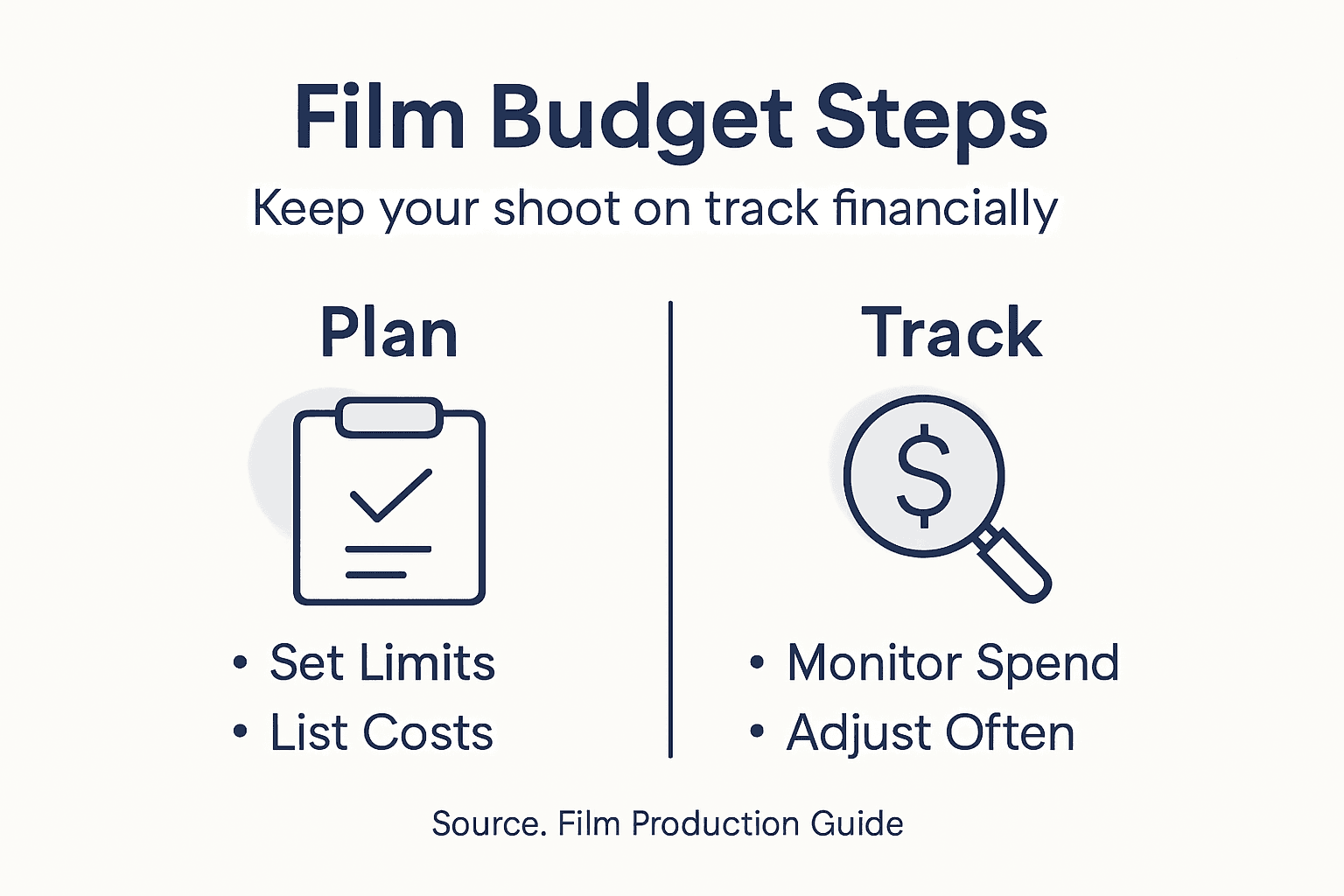
Treat your budget as a living production document that requires consistent monitoring and strategic adjustments. Schedule weekly budget review meetings with your key financial team members to analyze spending patterns, identify potential cost overruns, and reallocate resources strategically. Compare actual expenditures against your original budget allocations and look for opportunities to optimize spending. Some line items might require more funding while others can be trimmed. Be prepared to make tough decisions that balance financial constraints with creative requirements.
During these review sessions, evaluate both micro and macro financial perspectives. Examine individual transaction details as well as overall budget trends. Consider external factors that might impact your budget such as equipment availability, crew scheduling, or unexpected location challenges. Your contingency fund is a critical buffer that allows creative problem solving without derailing the entire production. Maintain clear documentation of every budget adjustment to ensure transparency and accountability throughout the project lifecycle.
Pro tip: Create a visual budget dashboard that provides instant insights into spending trends and allows for rapid decision making during your review sessions.
Stay On Budget with Expert Film Production Support in Switzerland
Staying within your film shoot budget takes careful planning, local cost research, and real-time expense tracking to avoid surprises. The article highlights the pain points of managing unpredictable local crew rates, equipment rentals, permit fees, and contingency funds that can quickly strain your finances. You want a reliable partner who understands these complexities and keeps your production on track without compromising quality.
At Video Production Switzerland, we bring over 20 years of experience helping international filmmakers tackle these exact challenges. From securing permits and trusted local crew to managing equipment and locations with unmatched logistical precision, we provide financial clarity and operational control throughout your shoot. Our client-centric approach assures you smooth coordination, timely updates, and budget transparency so you can focus on creative priorities.
Take control of your production budget today

Reach out for a free consultation at Video Production Switzerland and discover how our local expertise and full-service support can help you prioritize expenses, track spending, and avoid costly surprises. Deliver your vision on time and within budget by partnering with a team that knows the Swiss production landscape inside out.
Frequently Asked Questions
How can I effectively define my total production budget for a film shoot?
Defining your total production budget starts with breaking down your expenses into key categories. Create a detailed list of all potential costs like crew salaries, equipment rentals, and location permits to ensure you have a clear financial roadmap.
What are essential expenses I should prioritize in my film production budget?
Essential expenses typically include crew salaries, critical equipment rentals, and basic location fees. Prioritize these items based on their direct impact on your ability to complete the project successfully.
How do I research local costs when planning my film shoot?
Research local costs by investigating regional crew rates, equipment rental prices, and permit costs. Reach out to local film commissions or production companies to get accurate pricing information that reflects your specific filming location.
What best practices should I follow to track spending in real time during production?
To track spending effectively, establish a system where team members can update budget figures instantly. Implement a cloud-based spreadsheet that categorizes expenses and requires daily updates after significant transactions.
How often should I review and adjust my film production budget?
You should review and adjust your film production budget weekly to adapt your financial strategy to ongoing spending. Set aside time during these meetings to analyze expenditures and reallocate resources as needed to maintain budget control.
What should I do if I encounter unexpected expenses during my film shoot?
If unexpected expenses arise, consult your contingency fund to cover these costs without disrupting the production. Regularly evaluate your budget to determine if reallocating resources from less critical areas is necessary.
Recommended
